Case Reference: DHR Holding India Private Limited v. Union of India & Ors.
Court: Bombay High Court
Case No.: Writ Petition No. 1214 of 2025
Decision Date: 30 October 2026
Introduction
Payment of Goods and Services Tax (GST) under an incorrect tax head can create significant compliance difficulties for taxpayers, particularly where the nature of a transaction subsequently requires payment under a different tax category. However, an error in selecting the appropriate tax head does not automatically establish tax evasion or justify the initiation of stringent recovery proceedings.
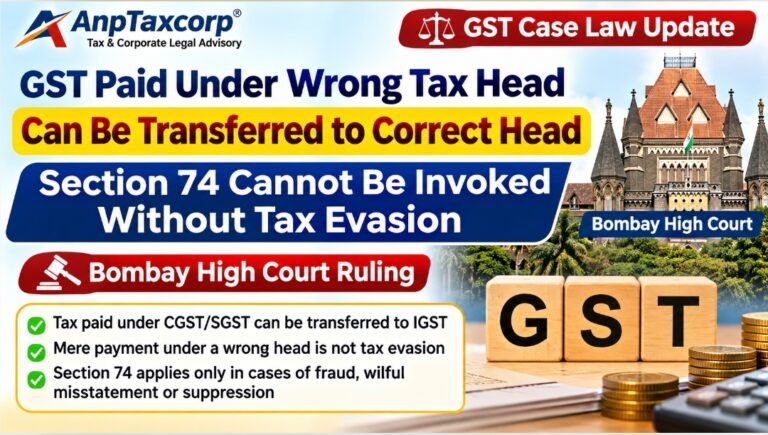
In an important ruling, the Bombay High Court has held that GST paid under the wrong tax head, without any fraudulent intention or deliberate attempt to evade tax, cannot be a ground for invoking Section 74 of the Central Goods and Services Tax (CGST) Act, 2017. The Court also recognised that tax already deposited under CGST and SGST could be transferred to the appropriate IGST account in accordance with the statutory provisions.
The judgment reinforces the principle that procedural or classification-related errors should not be treated as deliberate tax evasion in the absence of the necessary statutory ingredients.
Background of the Case
The petitioner, DHR Holding India Private Limited, was engaged in facilitating the sale of medical equipment and providing support services to its foreign group companies.
In connection with warranty support services provided to overseas group entities, the company received certain payments and discharged GST liability under the heads of Central GST (CGST) and State GST (SGST).
Subsequently, the GST authorities took the view that the relevant transactions attracted Integrated GST (IGST) instead of CGST and SGST. Consequently, the department issued a show cause notice under Section 74 of the CGST Act, demanding IGST on the same transactions for the relevant period.
The company challenged the demand, contending that it had already discharged the entire tax liability in monetary terms. According to the petitioner, the amount deposited under CGST and SGST should be transferred or adjusted against the IGST liability rather than requiring it to pay the tax again.
The GST department, however, argued that CGST, SGST and IGST were credited to separate government accounts and that there was no legal obligation on its part to transfer the amounts already deposited.
Legal Provisions Considered by the Court
The Bombay High Court examined the relevant statutory framework governing payment of GST under an incorrect tax head.
1. Section 77 of the CGST Act, 2017
Section 77 deals with situations where a registered person initially pays CGST and SGST on a transaction subsequently held to be an inter-State supply, or vice versa.
The provision recognises that a taxpayer may make an incorrect determination regarding the nature of a supply. It provides a mechanism to address such errors without treating the initial payment as deliberate tax default.
2. Section 19 of the IGST Act, 2017
Section 19 of the IGST Act contains corresponding provisions dealing with the payment of IGST where a transaction is subsequently determined to be an intra-State supply, and vice versa.
These provisions are intended to provide relief where tax has been discharged under an incorrect classification of the supply as inter-State or intra-State.
3. Section 74 of the CGST Act, 2017
Section 74 provides for determination of tax not paid, short paid, erroneously refunded, or input tax credit wrongly availed or utilised by reason of fraud, wilful misstatement or suppression of facts to evade tax.
Therefore, the existence of an incorrect tax payment, by itself, is insufficient to attract Section 74. The department must establish the essential statutory ingredients necessary for invoking this provision.
Findings and Observations of the Bombay High Court
A Division Bench comprising Justice M.S. Karnik and Justice Sandesh D. Patil rejected the department’s approach and held that the proceedings under Section 74 were not justified in the facts of the case.
The Court observed that the company had already deposited the GST amount under CGST and SGST. The dispute essentially concerned the appropriate tax head under which the liability was required to be discharged.
The Bench referred to Section 77 of the CGST Act and Section 19 of the IGST Act and concluded that the department could have transferred the amount deposited under CGST and SGST to the appropriate IGST account.
The Court also relied upon the Supreme Court’s decision in Tata Steel Limited v. Union of India, emphasising that proceedings under Section 74 require the establishment of fraud, wilful misrepresentation or suppression of facts.
In the absence of any deliberate attempt by the petitioner to evade tax, the mere payment of GST under an incorrect head could not justify invoking the stringent provisions of Section 74.
The Court accordingly observed that the department could not initiate Section 74 proceedings in the circumstances of the case merely because the tax had initially been paid under CGST and SGST instead of IGST.
However, the Court clarified that it had not adjudicated the actual quantum of IGST payable by the petitioner. The department remained entitled to recover any additional tax that might legally be payable after appropriate determination.
Final Decision
Allowing the writ petition, the Bombay High Court set aside the impugned GST demand order.
The Court directed that the amount already deposited under CGST and SGST be transferred to the IGST account upon an application being made by the petitioner.
The ruling provided relief to the taxpayer against a demand arising from the incorrect tax head while preserving the department’s right to recover any additional legitimate tax liability.
Implications for GST Taxpayers and Businesses
This judgment carries considerable significance for businesses facing GST disputes involving incorrect classification of supplies or payment under the wrong tax head.
Its key takeaways are:
-
Wrong tax head is not automatically tax evasion: An incorrect payment classification cannot, by itself, establish fraudulent intent.
-
Section 74 requires statutory justification: The department must establish the necessary ingredients of fraud, wilful misstatement or suppression to evade tax.
-
Adjustment of tax deserves consideration: Tax already deposited under an incorrect head cannot be disregarded without considering the statutory framework.
-
Protection against double payment: Taxpayers should not ordinarily be compelled to discharge the same tax amount again merely because it was initially credited under an incorrect head.
-
Additional tax remains recoverable: The judgment does not grant immunity from payment of any additional tax legally determined to be payable.
Conclusion
The Bombay High Court’s ruling is an important clarification on the distinction between a genuine tax payment error and deliberate tax evasion under GST law.
The decision reinforces that Section 74 should not be invoked mechanically in cases involving incorrect payment under CGST, SGST or IGST. GST authorities must examine the actual circumstances and establish the statutory conditions before initiating proceedings under this provision.
For taxpayers, the judgment provides an important legal basis to challenge demands raised under Section 74 where the underlying dispute concerns only payment under an incorrect tax head and there is no evidence of fraudulent intention.
The ruling also highlights the importance of applying the corrective mechanisms provided under the CGST and IGST Acts before resorting to coercive recovery proceedings.
Disclaimer: This summary is for educational and informational purposes only and does not constitute legal advice. Readers should refer to the original judgment before taking any legal action.