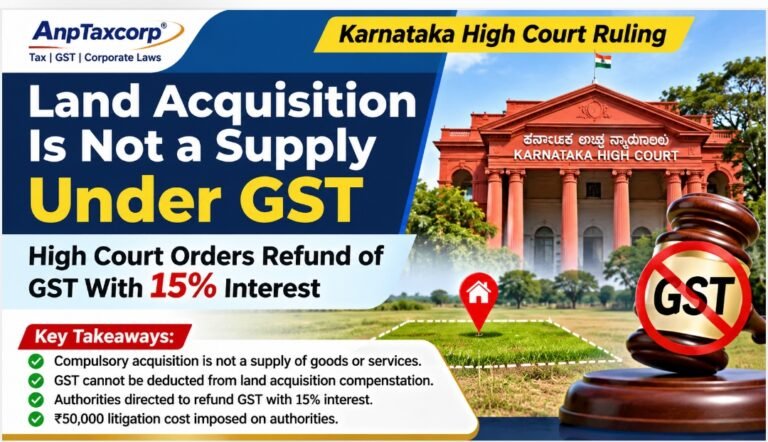
The Karnataka High Court has ruled that compulsory acquisition of land by the State does not constitute a supply of goods or services under the GST law. Consequently, GST cannot be deducted from compensation payable to landowners for property acquired under statutory powers.
In a significant ruling concerning GST on land acquisition compensation, the Court directed the authorities to refund the GST deducted from a landowner’s compensation, along with interest at 15% per annum. It also imposed costs and directed that the interest liability be recovered personally from the concerned acquisition officials.
Background of the Case
The petitioner, Prakash, approached the Karnataka High Court challenging the deduction of GST from compensation awarded for the compulsory acquisition of his land. The land measuring approximately 1,187 square metres was situated at Mellahalli Village, Periyapatna Taluk, Mysuru District, and was acquired for widening the Mysuru–Madikeri Highway.
The compensation determined for the acquired land and structure amounted to approximately ₹38.10 lakh. However, the acquisition authorities deducted ₹3,20,585.80 towards GST at the rate of 18% from the compensation payable to the landowner.
The petitioner argued that compulsory acquisition of land cannot be regarded as a sale of goods or provision of services. Since the acquisition was carried out by the State under statutory powers, the deduction of GST was without legal authority and was liable to be set aside.
The National Highways Authority of India (NHAI), on the other hand, defended the deduction by contending that GST was applicable to the works contract or structure-related valuation component and that similar deductions had been made in other cases.
Court’s Analysis: Compulsory Acquisition Does Not Constitute Supply
The Karnataka High Court rejected the authorities’ contention and examined the fundamental requirement for levy of GST—whether the transaction could be characterised as a supply of goods or services under GST law.
The Court observed that land is immovable property and cannot be treated as goods for the purpose of the disputed transaction. More importantly, compulsory acquisition takes place through the exercise of the State’s statutory power of eminent domain.
In such circumstances, the landowner does not voluntarily sell the property or provide a service to the acquiring authority. The transfer of ownership occurs because the State exercises its legal power to acquire the property, and the compensation is paid as a statutory consequence of such acquisition.
The Court therefore held that compulsory acquisition of land cannot be equated with a taxable supply of goods or services under the GST framework.
It also noted that the respondents had failed to identify any specific statutory provision under the GST law authorising the levy or deduction of GST from compensation payable for land or structures acquired compulsorily.
Reliance on Earlier Judicial Decisions
The High Court also referred to the decision of the Madras High Court in M. Poomani v. The District Collector/Sole Arbitrator, W.P. No. 3278 of 2024, which had considered the applicability of GST to compensation arising from land acquisition.
The Court further referred to its earlier ruling concerning tax deduction on interest awarded in land acquisition proceedings. It observed that interest forming part of compensation is intended to account for the loss arising from delay in payment and the impact of inflation between the determination of compensation and its actual payment.
The Court’s reasoning reinforced the principle that compensation arising from compulsory acquisition is fundamentally different from consideration received in an ordinary commercial transaction.
Final Decision of the Karnataka High Court
Allowing the writ petition, the Karnataka High Court quashed the award notice dated 29 October 2024 to the extent it provided for deduction of GST from the land acquisition compensation.
The Court directed the authorities to:
-
Refund the GST amount of ₹3,20,585.80 deducted from the compensation.
-
Pay interest at 15% per annum from the date of the award until the refund is actually made.
-
Recover the interest liability personally from the concerned Special Land Acquisition Officer and competent authority.
-
Pay ₹50,000 towards litigation costs to the petitioner within one month.
The Court found that the GST deduction was not supported by the GST legislation and that the authorities had exceeded their legal powers in making such deduction.
Legal Significance of the Judgment
This judgment is important for landowners whose properties are compulsorily acquired for highways, infrastructure projects, public utilities and other government purposes. It reiterates that compulsory acquisition is not a commercial supply and that GST cannot automatically be deducted from land acquisition compensation merely because compensation includes land, buildings or structures.
The ruling may provide a legal basis for affected landowners to challenge GST deductions made from acquisition compensation, subject to the facts of their individual cases and the applicable statutory provisions.
-
Case Title: Prakash v. The Deputy Commissioner, Mysore District, Mysore
-
Court: Karnataka High Court
-
Judge: Justice R. Nataraj
-
Case Number: Writ Petition No. 26903 of 2026 (LA-RES)
-
Subject: GST deduction from compensation for compulsory land acquisition
-
Decision: GST cannot be deducted from compensation awarded for compulsory acquisition of land.
-
Refund Ordered: ₹3,20,585.80
-
Interest: 15% per annum from the date of award until payment
-
Litigation Costs: ₹50,000
-
Date of Decision: The reported judgment was published on 24 November 2026; the precise judgment date should be verified from the full order.
Disclaimer
This article is published for informational and educational purposes only and is intended to provide a general overview of the judicial decision discussed. It does not constitute legal advice or create an advocate-client relationship.