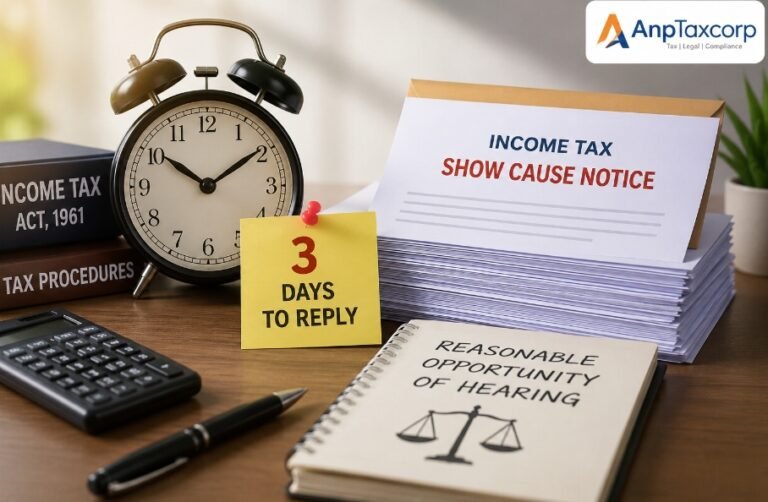
In a significant ruling reinforcing the principles of natural justice, the Gujarat High Court has held that providing a taxpayer with only three days to respond to an Income Tax Show Cause Notice (SCN) is not a reasonable opportunity of hearing. The Court observed that such a short time frame deprives the taxpayer of a fair chance to present its case and therefore cannot be sustained in law.
The judgment is an important reminder that while the Income Tax Department has the authority to conduct scrutiny assessments, taxpayers must be given an adequate and meaningful opportunity to defend themselves before any adverse assessment order is passed.
Background of the Case
The case arose from the scrutiny assessment of SN Advance Ventures Private Limited for Assessment Year (AY) 2024-25. The company had filed its income tax return declaring a total income of approximately ₹1.05 crore.
During the scrutiny proceedings, the Assessing Officer issued a Show Cause Notice dated 8 March 2026, directing the company to submit its response by 11 March 2026.
The taxpayer contended that the notice was issued on a Sunday, effectively leaving it with only three days to prepare and submit a comprehensive reply. Considering the complexity of scrutiny proceedings, the company argued that such limited time was unreasonable and contrary to the principles of fair hearing.
The company also submitted a grievance requesting a video conference hearing and emailed both its grievance and detailed reply on 16 March 2026. However, according to the taxpayer, neither the grievance nor the reply was considered before the assessment order was finalized.
Aggrieved by the assessment order, the company approached the Gujarat High Court.
Revenue’s Stand
The Income Tax Department argued that the taxpayer had filed its reply before the jurisdictional Assessing Officer instead of uploading it through the Faceless Assessment Portal, where the proceedings were pending.
According to the Revenue, the jurisdictional Assessing Officer had no authority to consider the reply or grievance submitted outside the designated faceless assessment mechanism.
Gujarat High Court’s Observations
A Division Bench comprising Justice A.S. Supehia and Justice Vaibhavi D. Nanavati examined the matter and found that there was no dispute regarding the fact that only three days’ time had been granted to respond to the Show Cause Notice.
The Court emphasized that granting such a short period cannot be regarded as a meaningful opportunity of hearing. It further observed that the taxpayer’s grievance requesting additional time and a virtual hearing was completely ignored while passing the assessment order.
The High Court also noted that the taxpayer had emailed both its grievance and reply on 16 March 2026, yet the Assessing Officer proceeded to pass the assessment order without considering these communications.
The Bench reiterated that compliance with the principles of natural justice is an essential requirement in tax proceedings. A fair opportunity to respond is not merely a procedural formality but a substantive right available to every taxpayer.
High Court’s Decision
After considering the facts, the Gujarat High Court quashed the assessment order and remanded the matter back to the Assessing Officer for fresh adjudication.
The Court directed the Assessing Officer to:
- Provide the taxpayer with an adequate opportunity of hearing.
- Grant a personal hearing wherever permissible under the Income-tax Act.
- Pass a fresh assessment order after considering the taxpayer’s submissions.
- Complete the exercise within twelve weeks.
Why This Judgment Matters
This ruling carries significant implications for taxpayers facing scrutiny assessments under the Income-tax Act. It reinforces that tax authorities cannot complete assessments by merely issuing notices; they must also ensure that taxpayers receive sufficient time to prepare an effective response.
The decision also highlights the importance of considering grievances relating to inadequate time, requests for personal or virtual hearings, and any replies submitted before finalizing an assessment.
For taxpayers, the judgment serves as a valuable precedent in situations where assessments are completed without granting a reasonable opportunity of hearing. If an assessment order is passed in violation of the principles of natural justice, courts may intervene and set aside such orders.
Key Takeaways
- Three days to respond to an Income Tax Show Cause Notice is generally not a reasonable opportunity of hearing.
- Tax authorities must provide adequate time for taxpayers to submit their replies during scrutiny assessments.
- Requests for additional time or personal/video conference hearings should be properly considered before passing an assessment order.
- Failure to follow the principles of natural justice can result in the assessment order being quashed by the High Court.
- The judgment strengthens taxpayer rights by emphasizing fairness and due process in income tax assessments.
Case Title: SN Advance Ventures Private Limited v. Assistant Commissioner of Income Tax Assessment Unit & Anr.
Case Number: R/Special Civil Application No. 6284 of 2026