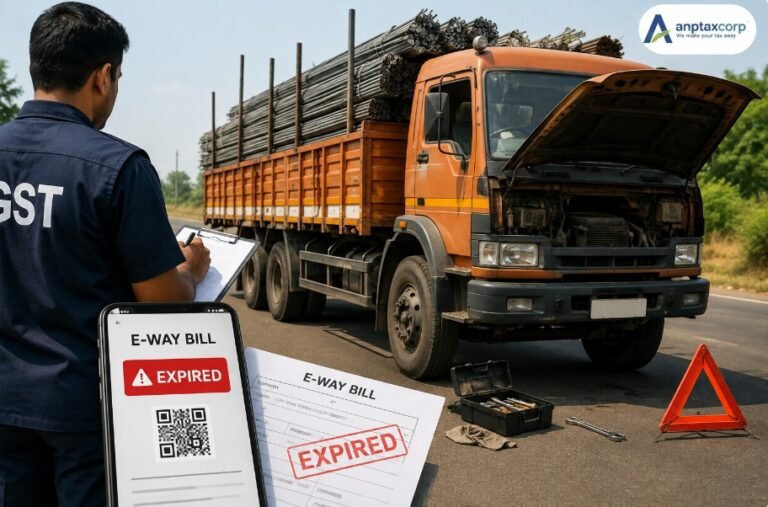
In a significant judgment reinforcing the principle that GST enforcement should target tax evasion rather than genuine procedural lapses, the Andhra Pradesh High Court has ruled that goods cannot be detained merely because an e-way bill expired due to an unavoidable vehicle breakdown, when there is no evidence of any intention to evade tax.
The decision, delivered on 16 July 2026, provides much-needed relief to businesses engaged in the transportation of goods and clarifies the scope of Section 129 of the Central Goods and Services Tax (CGST) Act, 2017, which deals with detention, seizure, and release of goods and conveyances during transit.
Background of the Case
The case arose from a writ petition filed by SLV Elite Spaces LLP, challenging a detention order issued by the GST authorities in Form GST MOV-06 dated 14 April 2026.
The company had transported a consignment of TMT boxes from Vizianagaram to Suryaraopet, Vijayawada, accompanied by all the prescribed tax documents, including a valid e-way bill. The consignment successfully reached Vijayawada within the validity period of the e-way bill.
However, before the goods could reach their final destination, the transport vehicle suffered an unexpected mechanical breakdown while undergoing a routine check at a weighbridge. As a result, the vehicle was parked at Bhavanipuram with the intention of obtaining a fresh e-way bill before completing the remaining journey.
During this period, GST officers inspected the vehicle and detained both the goods and the vehicle solely on the ground that the e-way bill had expired at 11:59 p.m. on 13 April 2026.
Petitioner’s Contentions
SLV Elite Spaces LLP argued that the delay in delivery was entirely beyond its control and was caused exclusively by the mechanical failure of the transport vehicle. The petitioner emphasized that:
- All statutory documents accompanied the consignment.
- The goods had already reached Vijayawada within the validity period of the e-way bill.
- There was no attempt to divert, conceal, or unlawfully transport the goods.
- The authorities had no evidence suggesting any intention to evade GST.
The petitioner therefore contended that invoking Section 129 of the GST Act was unjustified and contrary to the object of the legislation.
Stand of the State
The State filed its counter affidavit defending the detention proceedings. However, during the course of the hearing, the Government Pleader informed the High Court that the vehicle and the goods had already been released in compliance with an interim order previously passed by the Court.
The dispute consequently centered on whether the detention proceedings could continue despite the absence of any material indicating tax evasion.
High Court’s Observations
A Division Bench comprising Justices Ninala Jayasurya and T.C.D. Sekhar carefully examined the facts and found that the detention order relied exclusively on the expiry of the e-way bill. Importantly, the authorities had not alleged any other statutory violation or any attempt to evade payment of GST.
The Bench observed that the transport vehicle had reached Vijayawada within the validity period of the e-way bill. Its inability to complete the final stretch of the journey was solely attributable to the unexpected mechanical breakdown.
The Court also took note of the geographical facts. It observed that Bhavanipuram and Suryaraopet are both situated within Vijayawada, and the distance between them is less than eight kilometres. This factual circumstance strengthened the petitioner’s explanation that the transportation had substantially been completed before the breakdown occurred.
The Court categorically held that there was no material whatsoever indicating tax evasion on the part of the petitioner. It observed:
“On overall consideration of the case on hand, it is apparent that there is no evasion of tax on the part of the petitioner. In such circumstances, continuation of proceedings against the petitioner may not be proper, especially when this Court has already directed the 4th respondent to release the vehicle and the goods.”
The Bench further remarked that merely because the e-way bill expired due to circumstances beyond the taxpayer’s control, the authorities could not mechanically invoke Section 129 of the GST Act.
Final Decision
Allowing the writ petition, the Andhra Pradesh High Court directed the fourth respondent to drop all proceedings initiated under Section 129 of the GST Act against SLV Elite Spaces LLP.
The judgment effectively recognizes that GST detention provisions are intended to curb tax evasion and fraudulent transportation, not to penalize taxpayers who experience genuine logistical difficulties during transit.
Why This Judgment Is Important
This ruling is likely to have far-reaching implications for taxpayers and transporters across India. Mechanical failures, road accidents, traffic disruptions, natural calamities, and other unforeseen events may occasionally result in the expiry of an e-way bill despite the taxpayer acting in good faith.
The High Court has clarified that an expired e-way bill, by itself, is not sufficient to justify detention of goods under Section 129. GST authorities must establish circumstances indicating an intention to evade tax before initiating detention proceedings.
The judgment also reinforces the principle that tax laws should be administered in a fair and reasonable manner. Genuine procedural lapses caused by unavoidable circumstances cannot automatically attract harsh penal consequences where all relevant documents are available and there is no revenue loss to the Government.
For businesses involved in the transportation of goods, this decision serves as an important precedent emphasizing that substance should prevail over technical procedural defects, particularly where the facts clearly demonstrate bona fide conduct.
Case Details
- Case Title: SLV Elite Spaces LLP and Others v. The State of Andhra Pradesh and Others
- Case Number: Writ Petition No. 10030 of 2026
- Court: Andhra Pradesh High Court
- Decision Date: 16 July 2026
- Coram: Justice Ninala Jayasurya and Justice T.C.D. Sekhar
- Counsel for the Petitioner: B. Abhay Siddhanth Mootha, Advocate
-
Counsel for the Respondents: Government Pleader for Commercial Taxes