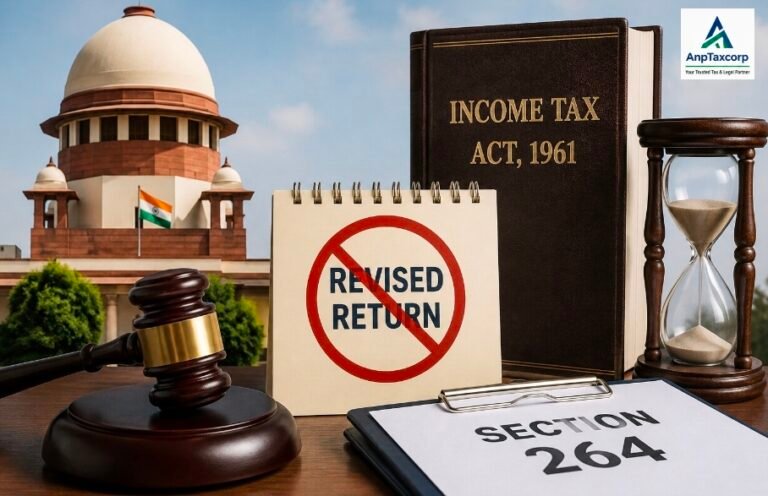
The Supreme Court has held that an assessee cannot use a revision petition under Section 264 of the Income Tax Act, 1961, as an alternative route to make changes to a self-assessment return after the statutory period for filing a revised return has expired.
A Bench comprising Justice J.B. Pardiwala and Justice K. Vinod Chandran recently set aside an order of the Bombay High Court that had remanded the matter for fresh consideration. The Supreme Court made it clear that the revisional jurisdiction under Section 264 cannot be invoked as a “backdoor” mechanism to introduce a claim that was neither made in the original return nor incorporated through a valid revised return within the prescribed time.
Background of the Case
The matter arose from an appeal filed by the Deputy Commissioner of Income Tax, CPC, Bengaluru and others concerning M/s Om Siddhakala Associates.
The assessee had filed its self-assessment income tax return, which was subsequently processed by the Centralised Processing Centre (CPC), Bengaluru. Following the processing of the return, an intimation under Section 143(1) and a consequential demand under Section 156 were issued to the assessee.
The tax demand was based on the figures and claims contained in the return originally filed by the assessee.
Instead of filing a revised return within the statutory period, the assessee subsequently sought relief by invoking Section 264 of the Income Tax Act. The revision petition was filed before the Principal Commissioner of Income Tax (PCIT).
The PCIT rejected the revision petition, among other reasons, on the ground that the assessee was effectively attempting to alter its tax position after the permissible period for revising the return had expired.
Section 264 Cannot Become A Substitute For Revised Return
The central issue before the Supreme Court was whether Section 264 could be invoked to introduce a claim that had not been made in the original return and which could have been incorporated through a revised return within the prescribed statutory period.
The Supreme Court answered the issue against the assessee.
The Bench observed that the assessee had not claimed the benefit relating to the tolerance limit under Section 43CA in its original return. The assessee also failed to make the claim through a revised return within the time permitted by the Income Tax Act.
According to the Court, once the statutory opportunity to revise the return had expired, the assessee could not seek substantially the same result through proceedings under Section 264.
The Court observed that permitting such a course would effectively amount to revising the return “under the garb of a revision.”
Supreme Court Sets Aside Bombay High Court Remand
The Bombay High Court had earlier remanded the matter for fresh consideration. However, the Supreme Court found that such a remand was not warranted in the circumstances.
The Supreme Court accordingly set aside the High Court’s order.
The Court further clarified that any reassessment order subsequently passed pursuant to the High Court’s remand order would also stand nullified.
Consequently, the assessee was required to discharge its tax liability in accordance with the original return on the basis of which the Section 143(1) intimation and consequential demand had been issued.
Court Leaves Section 43CA Retrospectivity Issue Open
An important aspect of the judgment is that the Supreme Court did not decide whether the tolerance limit under Section 43CA has retrospective or prospective application.
The Court considered that question unnecessary for deciding the appeal because the assessee had failed at the threshold to claim the benefit in the original return or through a timely revised return.
Therefore, the judgment primarily deals with the procedural limitation on using Section 264 to alter a return after the prescribed period for revision has expired, rather than conclusively determining the temporal operation of the Section 43CA tolerance limit.
Key Takeaway For Taxpayers
The judgment reinforces an important principle of income tax procedure: Section 264 is a revisional remedy and cannot ordinarily be converted into a substitute for filing a revised return.
Taxpayers who discover an omission, incorrect claim or additional deduction should therefore carefully examine the statutory time limit for filing a revised return. Waiting until that period expires and subsequently attempting to introduce the claim through Section 264 may not be permissible where the proposed revision effectively seeks to rewrite the original return.
The ruling also highlights the importance of making all relevant claims at the return-filing stage and taking timely corrective action whenever an error or omission is discovered.
Conclusion
The Supreme Court’s decision in the case of M/s Om Siddhakala Associates underscores the importance of complying with statutory timelines under the Income Tax Act. A revision petition under Section 264 cannot be used as a backdoor mechanism to revise a self-assessment return after the deadline for filing a revised return has expired.
For taxpayers and tax professionals, the decision serves as a reminder that procedural timelines are not merely technical requirements. Where the law provides a specific mechanism and time period for correcting a return, that mechanism must ordinarily be followed within the prescribed period.