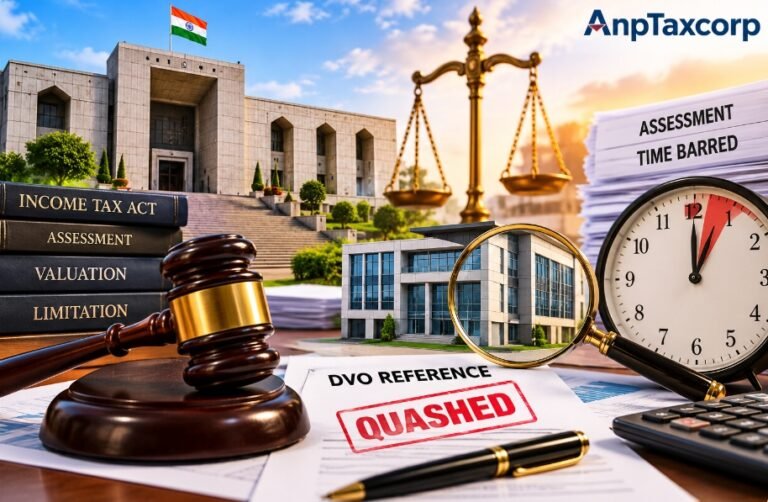
The Gujarat High Court has set an important limitation-related precedent in income-tax assessment proceedings by quashing a reference made by the Assessing Officer (AO) to the Departmental Valuation Officer (DVO) just one day before the statutory time limit for completing the assessment was due to expire.
In Slimtile Private Limited v. Assistant Commissioner of Income Tax & Anr., the Court found that the valuation reference under Section 142A of the Income Tax Act, 1961 was not genuinely required for determining the taxable income. Instead, the reference was found to have been made primarily to obtain additional time for completing the assessment.
A Division Bench comprising Justice A.S. Supehia and Justice Vaibhavi D. Nanavati held that the Assessing Officer had sufficient material already available on record to examine the issues raised against the taxpayer. The Court concluded that invoking the valuation mechanism at the eleventh hour amounted to a colourable exercise of power.
Background of the Case
The case concerned Slimtile Private Limited, which had declared total income of approximately ₹8.18 crore for Assessment Year 2021-22.
During the assessment proceedings, the Revenue raised questions concerning certain assets and payments made by the company. The Assessing Officer also questioned the depreciation claimed by the company on certain fixed assets.
The relevant search material had been made available to the Income Tax Department much earlier. According to the Court, the material had been handed over to the Deputy Commissioner of Income Tax, Surat, on 28 December 2022.
The company had also furnished details concerning its assets, payments and supporting documents during December 2022.
However, the Assessing Officer issued show-cause notices only in June 2023 and subsequently made a reference to the DVO on 24 June 2023.
Significantly, the Assessing Officer had himself recorded that the assessment proceedings would become time-barred on 25 June 2023.
DVO Reference Made Just One Day Before Limitation
The central controversy before the High Court was the timing and necessity of the DVO reference.
The reference was made under Section 142A of the Income Tax Act, which permits the Assessing Officer to require a valuation by a Valuation Officer in specified circumstances, including determining the value of an asset or investment where such valuation is relevant to the assessment.
The Revenue sought to rely upon Explanation 1(v) to Section 153. This provision provides for exclusion of the period between making a valuation reference and receiving the valuation report while calculating the limitation period for completing an assessment.
According to the Revenue, therefore, the reference to the DVO had the effect of extending the available period for completion of the assessment.
The taxpayer, however, challenged the reference on the ground that it was made solely to overcome the impending limitation period.
Two Grounds Cited for the Valuation Reference
The DVO reference was sought to be justified on two principal grounds.
First, the Revenue alleged that the company had made unaccounted cash payments connected with purchases of shares and had also shown an increase in its fixed assets.
Second, questions were raised regarding the company’s claim of depreciation on fixed assets purchased in the names of individuals.
The High Court examined both grounds in detail.
Depreciation Issue Did Not Require DVO Valuation
With regard to the depreciation claim, the Revenue itself conceded before the Court that there was no necessity for making a valuation reference.
The Revenue submitted that if the depreciation claim was found to be bogus or otherwise inadmissible, the Assessing Officer could directly disallow the claim while completing the assessment.
The High Court accepted this position.
It observed that the depreciation issue could have been examined and dealt with directly by the Assessing Officer. There was therefore no justification for using this issue as a basis for making a reference to the DVO.
The Court found that the depreciation issue had effectively been used to strengthen the basis for the valuation reference and thereby obtain additional time beyond the limitation period.
Relevant Asset Details Were Already Available
The Court also examined the Revenue’s contention concerning the company’s assets and alleged unaccounted payments.
Importantly, the Court noted that the company had already submitted details relating to its assets, payments and relevant supporting documents to the Assessing Officer in December 2022.
Despite this, the show-cause notices issued in June 2023 did not raise any specific issue requiring valuation of those assets.
The issue of valuation surfaced only when the DVO reference was made on 24 June 2023, immediately before the assessment was due to become time-barred.
The Court therefore found the timing of the reference significant.
Revenue Failed to Explain the Delay
The High Court also expressed concern over the considerable delay in taking action on the search-related material.
Although the relevant material had been handed over to the Deputy Commissioner of Income Tax on 28 December 2022, the Revenue did not issue the relevant show-cause notices until June 2023.
The Court found that no satisfactory explanation had been provided for this delay.
According to the Court, the Assessing Officer had sufficient time to examine the information already available, reconsider the taxpayer’s explanations regarding the payments and examine the depreciation claim.
Instead, the valuation reference was made at the last moment.
Court Finds Colourable Exercise of Power
The High Court ultimately concluded that the Assessing Officer had invoked Section 142A not because an independent valuation was genuinely necessary, but to overcome the impending limitation period.
The Court found that an artificial basis had been created for obtaining a valuation of the assets and for connecting the depreciation issue with that valuation exercise.
The Bench observed:
“Thus, the overall analysis and the appreciation of facts manifest that the Assessing Officer has very ingeniously raised two issues for making reference to the District Valuation Officer in order to cover-up his inaction in completing the assessment proceedings before 25.06.2023.”
The Court consequently held that the action of the Assessing Officer amounted to an illegal and colourable exercise of power.
Gujarat High Court Quashes DVO Reference
Considering the overall facts and circumstances, the Gujarat High Court quashed the DVO reference dated 24 June 2023.
The decision reinforces an important principle of tax administration: statutory powers cannot be exercised merely as a mechanism to extend the limitation period when the Assessing Officer has failed to complete the assessment within the prescribed time.
A valuation reference under Section 142A must have a genuine assessment-related purpose. The provision cannot be invoked artificially at the last moment simply to obtain the benefit of the exclusion contemplated under Section 153.
Key Takeaway for Taxpayers
The judgment is significant for taxpayers facing assessment proceedings involving valuation references.
Where the Assessing Officer already possesses the relevant documents and information, and the issue can be decided directly from the material available on record, a last-minute reference to the DVO may face judicial scrutiny.
The decision also highlights the importance of assessment limitation periods. Tax authorities must exercise their statutory powers bona fide and within the prescribed framework. A valuation reference cannot be used as a device to cure administrative inaction or to artificially extend the assessment period.
The Gujarat High Court’s ruling therefore provides useful guidance on the interplay between Section 142A and Section 153 of the Income Tax Act, particularly where a DVO reference is made immediately before the assessment limitation expires.
Case Details
Case Title: Slimtile Private Limited v. Assistant Commissioner of Income Tax & Anr.
Case Number: R/Special Civil Application No. 13575 of 2023
Court: Gujarat High Court
Bench: Justice A.S. Supehia and Justice Vaibhavi D. Nanavati
Provision Involved: Section 142A and Explanation 1(v) to Section 153 of the Income Tax Act, 1961
Date of DVO Reference: 24 June 2023
Assessment Limitation Date: 25 June 2023
For Petitioner: B.S. Soparkar
For Respondents: Karan G. Sanghani