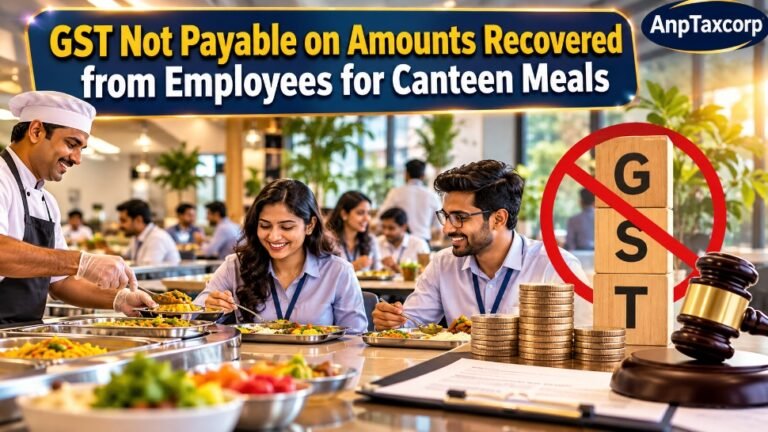
Gujarat AAR rules that GST is not payable on employee canteen meal recoveries by Torrent Pharmaceuticals. Learn about GST liability and ITC eligibility under the CGST Act.
The Gujarat Authority for Advance Ruling (AAR) has held that amounts recovered by an employer from employees towards subsidised canteen meals do not constitute a taxable supply under Section 7 of the CGST Act, 2017. The ruling also clarifies the extent to which an employer can claim Input Tax Credit (ITC) on GST paid to a third-party canteen service provider.
The decision in In re: M/s Torrent Pharmaceuticals Ltd., Advance Ruling No. GUJ/GAAR/R/2026/36, dated 25 September 2026, provides important guidance to businesses operating employee canteen facilities.
Background of the Case
Torrent Pharmaceuticals Ltd. approached the Gujarat AAR seeking clarification on the GST implications of amounts recovered from employees for canteen facilities provided at its Indrad manufacturing plant, research and development facility at Bhat, Ahmedabad, and corporate office at Torrent House, Ahmedabad.
The company stated that its Indrad plant and R&D facility employed more than 250 workers, while its corporate office had more than 100 employees. The canteen facilities were maintained in accordance with the applicable statutory requirements.
For the manufacturing plant and R&D facility, the company referred to Section 46 of the Factories Act, 1948, which provides for canteen facilities in factories employing more than 250 workers. For the corporate office, it relied on Section 23 of the Gujarat Shops and Establishments (Regulation of Employment and Conditions of Service) Act, 2019.
Under the company’s canteen policy, the cost of meals, breakfast and snacks was shared between the employer and employees. At the plant and R&D facility, the employer generally subsidised 50% of the cost, while the employees’ share was deducted from their salaries. At the corporate office, the subsidy varied according to employees’ grades.
The third-party canteen service provider raised invoices on Torrent Pharmaceuticals and charged GST at 5%. The company recovered the employees’ portion without retaining any profit margin.
Issues Before the Gujarat AAR
The principal questions before the Authority were:
- Whether amounts recovered from employees for canteen meals constituted a taxable supply under Section 7 of the CGST Act, 2017.
- Whether the company was eligible to claim ITC on GST charged by the canteen service provider.
- If ITC was admissible, whether the credit was available on the entire canteen expenditure or only on the portion borne by the employer.
AAR’s Findings on GST Liability
The Gujarat AAR examined the statutory provisions, the company’s canteen policy and the arrangements with the external service provider.
The Authority noted that the canteen facilities were provided to employees in the context of the employer’s statutory obligations and that the company did not earn any profit from recovering the employees’ share of the food expenses.
The Authority concluded that the deductions made by Torrent Pharmaceuticals from employees availing food at its factory and corporate office would not be treated as a supply under Section 7 of the CGST Act, 2017.
Consequently, the amounts recovered from employees towards their share of subsidised canteen meals were not liable to GST in the hands of the employer.
The ruling reinforces the distinction between an employer’s taxable business supplies and the recovery of employees’ share of expenses incurred in providing canteen facilities. However, the conclusion must be understood in the context of the facts and statutory obligations considered by the Authority.
Input Tax Credit on Canteen Services
The AAR separately examined the company’s eligibility to claim ITC on GST paid to the third-party canteen service provider.
Section 17(5)(b) of the CGST Act generally restricts ITC on food and beverages. However, the proviso to the relevant provision permits credit where the employer is legally obliged to provide such goods or services to its employees under applicable law.
Considering the statutory requirements applicable to the company’s establishments, the Authority held that Torrent Pharmaceuticals was eligible to claim ITC on GST charged by the canteen service provider to the extent of the expenditure borne by the company itself.
The credit was not available in respect of the portion of canteen expenses recovered from employees. Accordingly, the employer could not claim ITC on the entire canteen bill merely because the supplier had raised the invoice on the company.
Key Takeaways for Employers
The ruling has practical implications for companies, factories and other establishments providing subsidised canteen facilities to employees.
- No GST on employee recoveries: Amounts recovered towards employee canteen meals may not attract GST where the arrangement falls within the principles laid down by the AAR.
- Statutory obligation matters: Employers should establish whether providing canteen facilities is mandatory under the applicable law.
- ITC is subject to restrictions: Credit on canteen services must be evaluated under Section 17(5)(b), including its proviso.
- Credit limited to employer-funded expenditure: The ruling restricts ITC to the portion of canteen costs actually borne by the employer.
- Maintain supporting documents: Canteen agreements, supplier invoices, employee recovery statements, salary deductions and records of the employer’s contribution should be maintained to substantiate the GST treatment.
Conclusion
The Gujarat AAR’s ruling in Torrent Pharmaceuticals Ltd. provides useful clarification on the GST treatment of employee canteen recoveries and the related availability of Input Tax Credit. It distinguishes between amounts recovered from employees, which were held not to constitute a supply on the facts of the case, and the employer’s own expenditure, for which ITC was allowed subject to the applicable statutory conditions.
Businesses should review their canteen arrangements, employee recovery mechanisms and ITC practices in light of this ruling. Since an advance ruling is ordinarily binding only on the applicant and the concerned or jurisdictional tax authorities under Section 103 of the CGST Act, its applicability to other taxpayers must be assessed carefully, considering their specific facts and legal obligations.