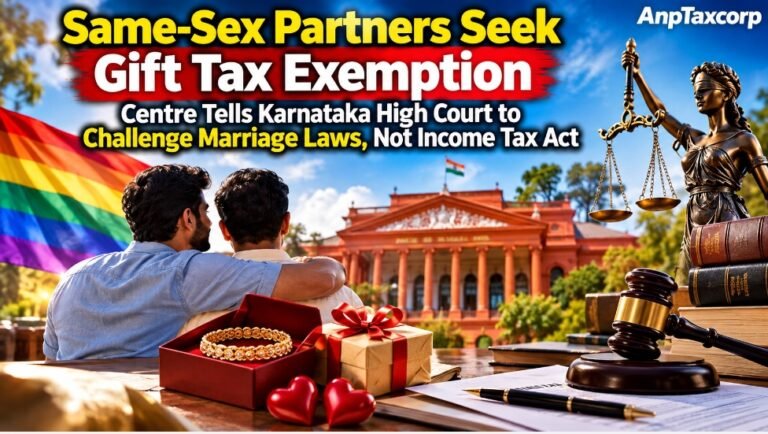
Karnataka High Court hears a plea seeking gift tax exemption for same-sex partners. Centre argues marriage laws, not the Income Tax Act, must be challenged.
The Centre has argued before the Karnataka High Court that same-sex partners seeking exemption from tax on gifts exchanged between spouses must challenge the laws governing marital status rather than the Income Tax Act, 1961. The dispute raises important questions concerning tax exemptions, equality, sexual orientation and the legal recognition of relationships in India.
1. Background of the Case
In Anurag Kalia v. Union of India, Writ Petition No. 28761 of 2025, the Karnataka High Court is examining a constitutional challenge to the exclusion of same-sex partners from the gift tax exemption available to spouses under the Income Tax Act, 1961.
The petition has been filed by Anurag Kalia and Akhilesh Godi, who have questioned the denial of the exemption to same-sex couples. The dispute arose after Godi gifted Kalia a 22-karat gold bracelet, which the petitioners described as a family heirloom.
According to the petitioners, gifts exchanged between legally recognised heterosexual spouses may qualify for exemption under the Income Tax Act, whereas comparable gifts received by same-sex partners may not enjoy the same treatment. They contend that this difference in tax treatment raises serious constitutional concerns.
The matter was heard by Justice B. M. Shyam Prasad of the Karnataka High Court.
2. Relevant Provisions of the Income Tax Act
Section 56(2)(x) of the Income Tax Act, 1961, provides for the taxation of specified sums of money and properties received without consideration or for inadequate consideration, subject to the conditions prescribed under the provision.
Broadly, where the aggregate value of specified receipts exceeds ₹50,000 during a financial year, the applicable amount may become taxable under the head “Income from Other Sources”, unless a statutory exception applies.
The provision contains exceptions for certain receipts, including gifts received from specified relatives. Section 2(41) of the Act defines the expression “relative” and includes an individual’s husband or wife within its scope.
The central legal question is whether the relevant statutory provisions can be interpreted to extend the benefit available to spouses to same-sex partners, even though Indian law does not currently recognise same-sex marriage as a legally recognised matrimonial relationship.
The petitioners have challenged the fifth proviso to Section 56(2)(x), read with the Explanation to Section 56(2)(vii), to the extent that it excludes same-sex couples from the relevant exemption.
They have requested the Court either to declare the exclusion unconstitutional or to interpret the term “spouse” in a manner that covers same-sex couples in comparable circumstances.
3. Centre’s Argument: Challenge the Marriage Laws
Opposing the petition, the Union Government submitted that the Income Tax Act merely relies on marital status recognised under other applicable laws. According to the Centre, the petitioners’ grievance arises from the absence of legal recognition of their relationship as a marriage, rather than from the tax legislation itself.
Additional Solicitor General K. Arvind Kamath, appearing for the Centre, argued before the Court that if the petitioners are aggrieved because their relationship does not qualify for the legal status of marriage, they should challenge the laws governing that status.
The Centre referred to legislation governing marriage and matrimonial relationships, including the Hindu Marriage Act, the Special Marriage Act, the Parsi Marriage and Divorce Act, the Indian Divorce Act and the Christian Marriage Act.
Its position is that these enactments determine who qualifies as a spouse, while the Income Tax Act uses that legally recognised status to determine eligibility for the exemption.
The Centre also argued that Indian legislative policy distinguishes between heterosexual and homosexual relationships and that the tax legislation follows the existing legal framework. It maintained that expanding the exemption to a new category of recipients would be a matter for Parliament or the competent legislative authority.
4. Petitioners’ Counterarguments: Equality and Non-Discrimination
Appearing for the petitioners, Advocate Dr. Dhruv Janssen Sanghvi argued that the existing tax framework creates unequal treatment between heterosexual and same-sex couples.
The petitioners submitted that heterosexual couples receiving gifts covered by the statutory exemption are not required to treat such receipts as taxable income. Denying comparable treatment to same-sex partners, they argued, results in discrimination based on sexual orientation.
Their challenge principally relies on Article 15 of the Constitution of India, which prohibits discrimination on specified grounds, including sex. They contend that the exclusion cannot be justified merely because their relationship does not receive the same legal recognition as a heterosexual marriage.
The petitioners also disputed the Centre’s apprehension that extending the exemption could facilitate tax evasion. They argued that an adverse decision would perpetuate unequal treatment and force same-sex couples to remain financially invisible within the legal system.
Their submissions therefore seek to distinguish between granting a tax benefit to a relationship and formally recognising that relationship as a marriage.
5. Connection with the Supreme Court’s Same-Sex Marriage Judgment
The proceedings also bring into focus the Supreme Court’s decision in Supriyo v. Union of India, concerning the recognition of same-sex marriage in India.
The Centre has relied on the Supreme Court’s judgment to contend that recognising same-sex marriages is a matter for the legislature. It argues that interpreting the word “spouse” in the Income Tax Act to include same-sex partners would indirectly confer recognition on a matrimonial relationship that the existing legal framework does not recognise.
The government has also expressed concerns that extending the exemption could create opportunities for tax avoidance and produce consequences across other areas of law.
The petitioners, on the other hand, seek relief specifically in the context of gift taxation. Their plea raises the question of whether a tax exemption can be extended through constitutional interpretation without requiring the Court to recognise same-sex marriage generally.
6. What Happens Next?
The Karnataka High Court has posted the matter for further hearing on 12 October 2026. As reported on 9 October 2026, the Court has not yet delivered a final judgment on the constitutional challenge.
The outcome may have implications for the interpretation of tax exemptions applicable to gifts between partners and the broader relationship between tax legislation and legally recognised marital status.
Conclusion
The dispute in Anurag Kalia v. Union of India highlights a significant legal question: whether the denial of a tax exemption to same-sex partners can withstand constitutional scrutiny when comparable gifts between recognised spouses qualify for favourable tax treatment.
The Centre maintains that the issue must be addressed through laws governing marriage, whereas the petitioners argue that unequal tax treatment violates constitutional protections against discrimination.
The Karnataka High Court’s eventual decision will clarify the scope of the challenge and the extent to which constitutional principles may influence the interpretation of gift tax exemptions under the Income Tax Act, 1961.