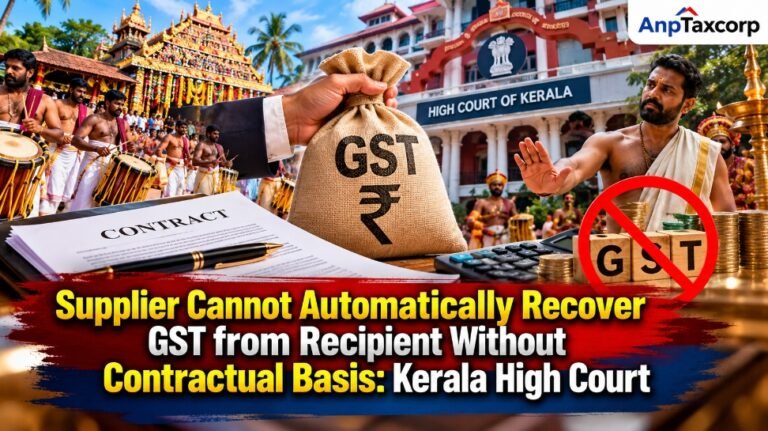
Kerala High Court rules that suppliers cannot automatically recover GST from recipients without contractual authority. Read the ruling in V.P. Sugathan v. Travancore Devaswom Board.
The Kerala High Court has reiterated an important principle concerning GST recovery under commercial contracts: a supplier’s statutory obligation to pay Goods and Services Tax does not automatically create a right to recover that tax separately from the recipient. The supplier’s entitlement to pass on the tax burden depends on the terms and conditions of the underlying contrat.
The ruling is significant for contractors, service providers, businesses participating in government tenders and taxpayers involved in disputes over whether GST is included in the agreed consideration or payable over and above the contract price.
In V.P. Sugathan v. Travancore Devaswom Board, the Court examined whether a successful tenderer could collect an additional amount from service recipients towards GST and claim reimbursement from the contracting authority when the tender conditions did not expressly permit such additional recovery.
1. Background of the Case
The dispute arose from a tender issued by the Travancore Devaswom Board for collecting fees from artists performing Chendamelam during the Pettathullal ceremony at Erumeli, conducted during the Mandalam-Makaravilakku season.
The petitioner, V.P. Sugathan, successfully secured the tender and obtained the right to collect ₹50 per performance from the participating artists.
Against the tender, Sugathan paid ₹46,98,117 as the tender amount and a further ₹8,40,261 towards GST at the rate of 18%.
He subsequently contended that he should be permitted to collect an additional ₹9 per performance towards GST, effectively increasing the fee payable by each artist from ₹50 to ₹59.
However, the Travancore Devaswom Board restricted the collection to the stipulated ₹50 per performance. Its position was that the approved fee was inclusive of all taxes and that the tenderer could not demand any additional amount from the artists.
Sugathan also sought reimbursement from the Board for the GST component that he claimed he had been prevented from recovering from the artists.
The dispute eventually reached the Kerala High Court, raising questions about the relationship between statutory tax liability and contractual rights to recover tax from another party.
2. Key Legal Issue: Can GST Be Recovered Without a Contractual Right?
The principal question before the Court was whether a supplier’s obligation to discharge GST under the applicable tax legislation independently entitles the supplier to recover the tax amount from the recipient over and above the agreed consideration.
The petitioner argued that the artists were the ultimate recipients of the service and that the GST burden could therefore be passed on to them.
The Court, however, distinguished between two separate legal concepts:
- Statutory liability: The obligation of the supplier to pay GST to the Government under the applicable law.
- Contractual entitlement: The right of the supplier to collect an additional amount from the recipient towards that tax.
These obligations do not automatically coincide. While GST legislation may require the supplier to discharge the tax, the right to recover that amount from another party depends on the contractual arrangement governing the transaction.
Consequently, the mere fact that a supplier has paid GST does not establish an enforceable right to demand additional consideration from the recipient.
3. Kerala High Court’s Observations
A Division Bench comprising Justice Raja Vijayaraghavan V. and Justice K. V. Jayakumar held that the supplier’s statutory obligation to pay tax and the contractual right to transfer its economic burden are distinct matters.
The Bench emphasised that parties are free to agree whether the consideration for taxable services will be inclusive or exclusive of GST. Their respective rights and obligations must be determined by examining the contract and its applicable conditions.
In the present case, the tender expressly fixed the fee at ₹50 per performance. The petitioner could not identify any provision authorising him to collect an additional ₹9 towards GST.
The Court rejected the argument that the artists’ status as recipients of the service independently entitled the petitioner to charge them an additional amount. Being the ultimate recipients of a service does not override the agreed contractual terms.
The Bench also found no statutory or contractual provision requiring the Travancore Devaswom Board to reimburse the petitioner for the tax that he claimed he could not recover from the artists.
Accordingly, the petitioner failed to establish an enforceable legal right to collect ₹50 plus 18% GST or to demand reimbursement from the Board.
4. Final Judgment of the Court
The Kerala High Court dismissed the writ petition without imposing any costs.
The decision confirmed that the petitioner could not unilaterally increase the prescribed fee or shift the tax burden to the contracting authority without establishing a supporting contractual or statutory right.
The judgment does not mean that GST can never be recovered separately from a customer. Rather, it establishes that such recovery must be supported by the applicable contract and law. Where the agreed terms prescribe a tax-inclusive amount or do not permit an additional charge, the supplier cannot assume an independent right to collect more merely because GST is payable on the transaction.
Case details:
- Case title: V.P. Sugathan v. Travancore Devaswom Board
- Case number: W.P.(C) No. 42585 of 2024
- Court: Kerala High Court
- Bench: Justice Raja Vijayaraghavan V. and Justice K. V. Jayakumar
- Citation: 2026 LLBiz HC (KER) 195.
5. Practical Implications for Businesses and GST Taxpayers
This ruling offers useful guidance for businesses, contractors and service providers entering into commercial agreements.
1. Clearly specify whether prices include GST
Every commercial contract, work order and tender should expressly state whether the quoted consideration is inclusive or exclusive of applicable GST.
2. Review government tender conditions carefully
Contractors should examine the tender documents before submitting bids. A supplier should not assume that GST can be recovered separately unless the tender terms or applicable legal provisions support that position.
3. Avoid unilateral price revisions
A supplier cannot ordinarily revise an agreed price merely because the transaction attracts GST. Any additional recovery must have a valid contractual or statutory basis.
4. Draft effective tax clauses
Businesses should include clear provisions addressing GST rates, changes in tax rates, invoicing, payment responsibilities and the treatment of additional tax liabilities.
5. Assess reimbursement claims on their merits
A claim against a customer or contracting authority for reimbursement of GST should be supported by the contract, applicable statutory provisions and relevant documentary evidence.
These precautions can reduce disputes over tax-inclusive pricing and help businesses manage GST exposure more effectively.
Conclusion
The Kerala High Court’s ruling in V.P. Sugathan v. Travancore Devaswom Board reinforces a fundamental principle of GST and commercial law: the statutory obligation to pay GST does not, by itself, establish a contractual right to recover that tax separately from the recipient.
For contractors and service providers, the judgment highlights the importance of carefully examining tender conditions and commercial agreements before seeking additional GST payments.
For businesses and legal professionals, the decision is a reminder that GST disputes frequently depend not only on tax legislation but also on the precise wording of the underlying contract.
A well-drafted agreement that clearly defines the treatment of GST can prevent avoidable litigation and provide greater certainty in commercial transactions.
Case details:
Case Title : V.P. Sugathan v. Travancore Devaswom Board
Case Number : WP(C) NO. 42585 OF 2024