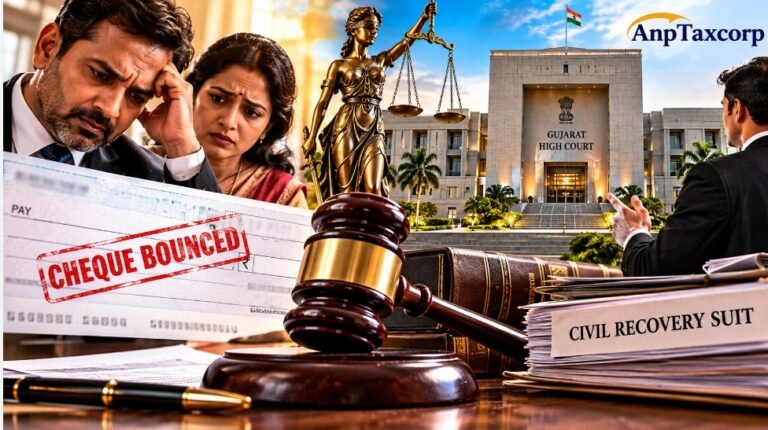
Gujarat High Court rules that cheque bounce compensation awarded in criminal proceedings cannot be added to a civil recovery suit. Read the case analysis.
Case Details:
Court: Gujarat High Court
Judge: Justice Maulik J. Shelat
Case Number: R/Special Civil Application No. 11470 of 2024
Citation: 2026 LLBiz HC (GUJ) 154
Decision: October 2026
Key Legal Provisions: Section 138 of the Negotiable Instruments Act, 1881; Sections 395, 461 and 471 of the Bharatiya Nagarik Suraksha Sanhita, 2023 (BNSS); corresponding provisions of the Code of Criminal Procedure, 1973 (CrPC).
1. Introduction
The recovery of money arising from dishonoured cheques can involve both civil litigation and criminal proceedings under Section 138 of the Negotiable Instruments Act, 1881. However, the existence of parallel remedies does not mean that every monetary claim arising during criminal proceedings can automatically be incorporated into a pending civil recovery suit.
In an important ruling, the Gujarat High Court clarified that compensation already awarded by a criminal court in cheque dishonour proceedings must be recovered through the procedure prescribed under criminal law. A claimant cannot seek to recover that compensation by amending an existing civil suit. The Court also held that legal expenses incurred in pursuing separate criminal proceedings cannot automatically be added to the original recovery claim when they arise from a distinct cause of action.
The decision highlights the importance of distinguishing between recovery of the underlying debt, enforcement of criminal court compensation and claims for litigation expenses.
2. Background and Facts of the Case
The plaintiffs, Kailashben Arunkumar Prajapati and another, had instituted Special Civil Suit No. 442 of 2014 to recover approximately ₹31.22 lakh from the defendant. The original civil claim included amounts relating to cheques that had been dishonoured.
Before filing the civil suit, the plaintiffs had also initiated criminal complaints in 2012 against the defendant under Section 138 of the Negotiable Instruments Act. The disputed cheque amounts involved in those proceedings were approximately ₹24.75 lakh.
Initially, the trial court acquitted the accused. The complainants challenged the acquittal before the Gujarat High Court, which allowed their criminal appeals through a common judgment dated June 14, 2018. The High Court set aside the acquittals and directed payment of compensation totalling ₹25 lakh across the two cases.
The accused challenged the High Court’s decision before the Supreme Court. However, following his death on May 14, 2021, the Supreme Court dismissed the appeals as having abated on August 23, 2021. Consequently, the compensation order remained undisturbed.
3. The Dispute Over Amendment of the Civil Suit
After the criminal proceedings reached this stage, the plaintiffs sought to amend their pending civil recovery suit. They proposed increasing the claim from approximately ₹31.22 lakh to ₹78.85 lakh.
The proposed amendment sought to include:
- Compensation awarded in the criminal proceedings.
- Interest on the compensation amount.
- Approximately ₹8.50 lakh towards legal expenses incurred in pursuing the criminal proceedings, including proceedings before the Supreme Court.
The plaintiffs contended that the compensation order remained effective and that subsequent developments justified incorporating the additional amounts into the pending suit. They argued that the amendment would assist in resolving the dispute comprehensively without changing the fundamental nature of the litigation.
The trial court rejected the amendment application on March 2, 2024. Aggrieved by this decision, the plaintiffs approached the Gujarat High Court under Article 227 of the Constitution of India.
4. Legal Issue Before the Gujarat High Court
The principal question was whether compensation awarded in criminal proceedings under Section 138 of the Negotiable Instruments Act could be recovered by amending an existing civil recovery suit.
A related question concerned whether legal expenses incurred during the criminal litigation could be added to the original civil claim.
The Court examined whether these proposed additions were legally maintainable and whether they arose from the same cause of action as the original recovery suit.
5. Court’s Analysis and Findings
A. Criminal Court Compensation Must Be Recovered Through the Prescribed Procedure
The Gujarat High Court observed that the compensation had already been determined by a competent court in the criminal proceedings.
The Court referred to Section 395 of the BNSS, corresponding to Section 357 of the CrPC, concerning compensation orders. It also considered the statutory recovery mechanism under Sections 471 and 461 of the BNSS, corresponding to Sections 431 and 421 of the CrPC.
The Court held that where compensation has already been awarded in criminal proceedings, the claimant must pursue the prescribed mechanism for its recovery rather than seek to recover the same amount through a civil suit.
The fact that the compensation order remained undisturbed after the Supreme Court proceedings abated did not create a right to incorporate that amount into the pending civil recovery suit.
B. The Proposed Amendment Introduced a Different Cause of Action
The Court further observed that the original civil suit concerned recovery of amounts arising from the underlying transactions and dishonoured cheques. The compensation claim, however, arose from the subsequent judgment in the criminal proceedings.
Accordingly, the proposed amendment sought to introduce an additional claim founded on a distinct cause of action rather than merely clarify or update the existing pleadings.
The Court emphasised that amendments to pleadings cannot be used indiscriminately to introduce claims that are legally distinct from the original dispute.
C. Criminal Litigation Expenses Could Not Automatically Be Added
The plaintiffs also sought reimbursement of approximately ₹8.50 lakh spent on legal proceedings connected with the cheque dishonour complaints.
The High Court held that these expenses arose from the prosecution of separate criminal proceedings and had no direct bearing on the original civil claim in the manner proposed.
The Court observed that such expenses would have to be pursued through an appropriate separate proceeding, subject to applicable law. They could not simply be added to the pending recovery suit through the proposed amendment.
6. Final Decision of the Court
The Gujarat High Court found no sufficient reason to interfere with the trial court’s order rejecting the amendment application. It dismissed the petition and upheld the refusal to incorporate the criminal compensation and associated legal expenses into the pending civil recovery suit.
Importantly, the ruling concerned the proposed amendment. It did not amount to dismissal of the original civil recovery suit.
7. Legal Significance and Practical Implications
This decision provides useful guidance for creditors, businesses, lenders and legal practitioners handling cheque dishonour disputes.
First, distinguish the remedies carefully. A civil recovery claim for the underlying debt and enforcement of compensation awarded in criminal proceedings are legally distinct matters.
Second, use the correct enforcement mechanism. Where compensation has already been ordered by a criminal court, practitioners should examine the statutory recovery procedure instead of attempting to recover the award through an unrelated civil claim.
Third, assess amendments before filing. An amendment application should be examined to determine whether the proposed claim arises from the original cause of action or introduces a fundamentally different dispute.
Fourth, maintain proper records of legal expenses. Costs incurred in separate proceedings should be documented and their recoverability assessed independently under the applicable law.
For businesses dealing with unpaid invoices, dishonoured cheques and commercial defaults, the judgment underscores the importance of selecting the correct legal remedy at each stage of a dispute.
8. Conclusion
The Gujarat High Court’s ruling in Kailashben Arunkumar Prajapati v. Legal Heirs of Deceased Sandipkumar Fatehsingh Vasava reinforces the distinction between civil debt recovery and enforcement of compensation awarded in criminal proceedings.
The central takeaway is that a pending civil recovery suit cannot automatically be expanded to include compensation already determined by a criminal court or legal expenses arising from separate criminal litigation. Creditors and their legal advisers must identify the appropriate statutory enforcement mechanism and ensure that any proposed amendment remains within the permissible scope of the original cause of action.
Disclaimer: This article is intended for general legal information and educational purposes only. It is not a substitute for examining the full judgment, applicable statutory provisions or the facts of an individual case.