Introduction
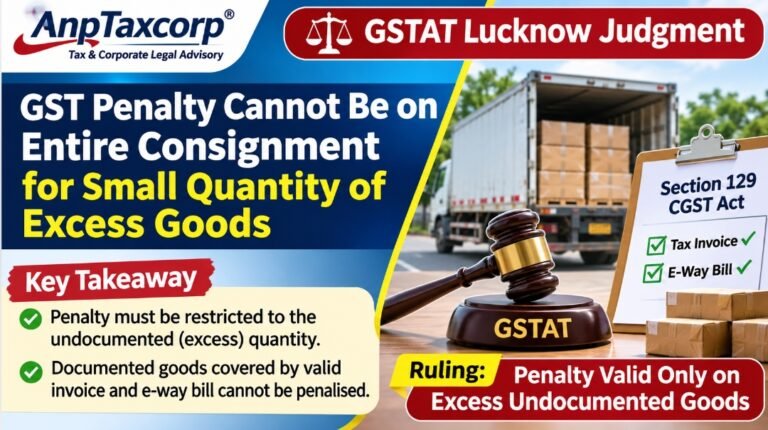
In an important ruling concerning the detention of goods during transportation under the Goods and Services Tax (GST) law, the State Bench of the Goods and Services Tax Appellate Tribunal (GSTAT), Lucknow, has clarified that a penalty cannot automatically be imposed on the entire consignment merely because a small quantity of excess goods is found during physical verification.
The Tribunal held that where the majority of the goods are supported by valid tax invoices and e-way bills, the alleged contravention must be examined with reference to the actual quantity of undocumented goods. A discrepancy involving a limited quantity cannot, by itself, establish that the entire consignment was being transported in violation of GST provisions.
The decision is significant for businesses, traders, manufacturers and transporters who frequently face detention proceedings under Section 129 of the CGST Act, 2017, due to discrepancies between the physical stock and the quantities declared in accompanying documents.
Case Details
-
Case Name: Ravish Kumar Singh v. M/s Mani Ply
-
Case Number: APL/239/LCK/2026
-
Tribunal: GST Appellate Tribunal, Lucknow
-
Date of Decision: 27 October 2026
-
Relevant Provision: Section 129(3) of the CGST/UPGST Act, 2017
The Bench comprised Judicial Member Santosh Kumar Srivastava and Technical Member Arvind Kumar.
Background and Facts of the Case
The dispute originated on 18 July 2023, when a Mobile Squad intercepted a vehicle transporting shuttering plywood from M/s Mani Ply, Raebareli, to Purvanchal Ply, Lucknow.
At the time of interception, the transporter produced a tax invoice and an e-way bill dated 17 July 2023. These documents covered the transportation of 418 pieces of plywood, measuring approximately 1,244.3024 square metres.
However, during physical verification, the authorities found 450 pieces measuring approximately 1,339.56 square metres. Consequently, 32 additional pieces were detected beyond the quantity mentioned in the accompanying documents.
Considering this discrepancy, the Proper Officer initiated proceedings under Section 129 of the CGST/UPGST Act, 2017, and imposed a penalty of ₹57,870 on the value of the entire consignment.
Decision of the First Appellate Authority
Aggrieved by the penalty, M/s Mani Ply challenged the departmental action before the First Appellate Authority.
The appellate authority examined the documentary evidence and observed that the tax invoice and e-way bill adequately covered 418 pieces of plywood. The discrepancy was confined to the additional 32 pieces found during physical verification.
Accordingly, it concluded that the alleged contravention could not automatically be extended to the entire consignment when the remaining goods were supported by valid transportation documents.
On this basis, the First Appellate Authority restricted the penalty to the excess quantity of 32 pieces and reduced the amount from ₹57,870 to ₹5,375.40.
Department’s Appeal Before GSTAT
The Department was dissatisfied with the reduction and filed a second appeal before the GST Appellate Tribunal under Section 112(3) of the CGST/UPGST Act, 2017.
The Department argued that transporting goods in excess of the quantity declared in the tax invoice and e-way bill constituted a statutory violation. According to the Department, the discovery of excess goods justified imposing a penalty on the entire consignment rather than restricting it to the additional quantity.
On the other hand, M/s Mani Ply maintained that 418 pieces were duly supported by valid documents and that the transaction was properly recorded in its regular books of accounts. It also submitted that the consideration, including applicable GST, had been received through banking channels.
Therefore, the discrepancy was limited to only 32 additional pieces and there was no justification for treating the entire consignment as undocumented.
GSTAT’s Observations and Findings
After examining the facts and documentary evidence, the GSTAT Lucknow rejected the Department’s arguments and upheld the decision of the First Appellate Authority.
The Tribunal observed that the availability of valid documentary evidence established that 418 pieces were covered by the requisite tax documents. The Department had not produced sufficient evidence to establish that these documented goods were being transported in violation of the GST provisions.
The Tribunal emphasised that merely detecting excess goods does not establish that the entire consignment is liable for penalty. Any allegation of non-compliance must be supported by evidence relating to the actual extent of the violation.
It further observed that deliberate tax evasion cannot be presumed in respect of the entire consignment without adequate factual justification.
The Tribunal accordingly held that the discovery of 32 excess pieces, without supporting evidence against the remaining 418 documented pieces, did not justify restoring the original penalty imposed on the entire consignment.
Final Verdict
The GSTAT Lucknow dismissed the Department’s appeal and affirmed the order of the First Appellate Authority.
Consequently, the penalty of ₹5,375.40, restricted to the additional 32 undocumented pieces, was sustained instead of the original penalty of ₹57,870 imposed on the entire consignment.
Legal Significance and Practical Implications
This ruling reinforces an important principle in GST detention proceedings: the extent of penalty must be supported by the extent of the established contravention.
For businesses and transporters, the decision carries several practical lessons:
1. Proper documentation is essential: Tax invoices and valid e-way bills should accurately reflect the quantity and description of goods being transported.
2. Discrepancies must be examined objectively: A mismatch in a limited quantity should not automatically render the entire consignment liable for penalty.
3. Evidence matters: GST authorities must establish the factual basis for extending penal consequences to goods that are otherwise supported by valid documents.
4. Proportionality in penalty proceedings: The nature and extent of the established violation should be considered while determining the penalty under Section 129 of the CGST Act.
5. Effective appellate remedy: Taxpayers facing disproportionate detention and penalty proceedings may rely on documentary evidence to challenge the excessive application of Section 129.
Conclusion
The decision in Ravish Kumar Singh v. M/s Mani Ply is a significant ruling for businesses dealing with transportation of goods under GST.
It clarifies that a limited discrepancy in the quantity of goods cannot, without further supporting evidence, justify penalising the entire consignment when the remaining goods are properly documented.
The ruling highlights the importance of evidence-based assessment, fairness and proportionality in GST enforcement proceedings. It also provides useful guidance for taxpayers challenging excessive penalties arising from discrepancies detected during the movement of goods.
Disclaimer: This article is intended solely for general legal information and educational purposes. The applicability of the ruling will depend on the facts and circumstances of each case.