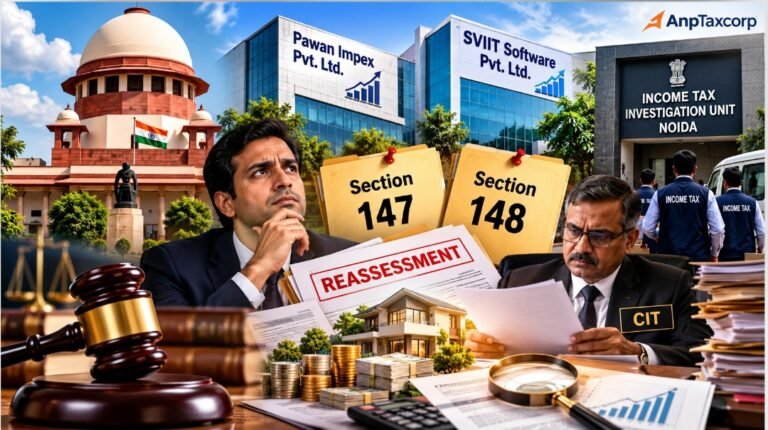
The Supreme Court of India has reiterated that an Assessing Officer cannot reopen a completed income tax assessment merely because the officer subsequently wishes to take a different view. However, reassessment may be initiated when tangible material provides a rational basis for believing that income has escaped assessment.
In Chetan Sabharwal v. Assistant Commissioner of Income Tax, Circle 28(1), New Delhi, the Supreme Court examined the scope of reassessment proceedings and clarified the legal distinction between a permissible reassessment and an impermissible review of an earlier decision.
Case Details
- Case Name: Chetan Sabharwal v. Assistant Commissioner of Income Tax, Circle 28(1), New Delhi
- Case Number: Civil Appeal No. 13953 of 2026 and connected appeals.
- Court: Supreme Court of India
- Relevant Provisions: Sections 147 and 148 of the Income-tax Act, 1961
- Decision Date: October 28, 2026
Background of the Case
The dispute arose from the sale of shares in Pawan Impex Pvt. Ltd. and SVIIT Software Pvt. Ltd. Chetan Sabharwal and his brother, Nitin Sabharwal, along with other shareholders, entered into agreements for the sale of shares involving substantial consideration.
The brothers subsequently invested the sale proceeds in residential property in Delhi and claimed tax benefits under Section 54F of the Income-tax Act, 1961.
After the original assessment proceedings, the Income Tax Department’s Investigation Unit, Noida, reported that the shares appeared to have been valued disproportionately compared with the cost of the underlying land and buildings owned by the companies.
Based on this information, the Assessing Officer issued notices under Section 148 to reopen the assessments for Assessment Years 2008-09 and 2009-10.
The assessees challenged the reassessment notices, contending, among other grounds, that the Department was attempting to reopen completed assessments on a mere change of opinion.
Supreme Court’s Analysis of Reassessment Proceedings
The Supreme Court, comprising Justice J.B. Pardiwala and Justice K. Vinod Chandran, examined whether the reassessment notices were legally sustainable.
The Court reiterated that the Assessing Officer possesses the power to reassess income but does not have an unrestricted power to review an earlier assessment merely because a different conclusion appears preferable.
For reopening an assessment, the officer must possess tangible material that has a rational connection or a live link with the belief that income has escaped assessment. At the notice stage, the Department is not required to conclusively establish the ultimate tax liability, but the statutory conditions for initiating reassessment must be satisfied.
The Court also explained that the defence of change of opinion presupposes that an opinion was actually formed during the original assessment proceedings. Whether such an opinion existed must be determined by examining the original assessment order and the surrounding assessment record.
When Does a Change of Opinion Arise?
The judgment provides important guidance for distinguishing between a genuine change of opinion and a legally permissible reopening of assessment.
1. Reassessment is not a power of review
An Assessing Officer cannot reopen an assessment simply to reconsider the same facts and substitute a different interpretation for the view already adopted.
2. An earlier opinion must actually exist
The taxpayer must establish that the relevant issue was consciously considered during the original assessment. A change of opinion cannot be presumed merely because an assessment order was passed.
3. The original assessment record is crucial
Courts must examine whether the original assessment order expressly or implicitly demonstrates that the officer formed an opinion on the issue now being reopened.
4. A cryptic assessment order may not establish consideration
Where an assessment order is silent or contains no meaningful indication that a particular issue was examined, it may be difficult to conclude that the Assessing Officer had previously formed an opinion on that issue.
5. Fresh tangible material may justify reopening
If new information emerges indicating possible escapement of income, reassessment may be permissible, subject to compliance with the applicable statutory requirements. Conversely, a different view on the same facts already considered cannot, by itself, justify reopening.
Why Did the Supreme Court Uphold the Reassessment Notices?
Although the Supreme Court reaffirmed the restriction against reassessment based on a mere change of opinion, it rejected the assessees’ challenge on the facts of this case.
In Nitin Sabharwal’s case, the returns had been processed under Section 143(1), without scrutiny assessment. Therefore, no assessment opinion had been formed on the disputed issues.
In Chetan Sabharwal’s case, although scrutiny assessments had been completed under Section 143(3), the Court found no indication in the original assessment orders that the specific issues underlying the reopening had been consciously examined.
The Investigation Unit’s report also supplied tangible material concerning the apparent share valuation discrepancies. The Court considered this material sufficiently connected with the belief that income might have escaped assessment.
Consequently, the Supreme Court dismissed the appeals and upheld the reassessment notices.
Implications for Taxpayers and Tax Professionals
This judgment is significant for taxpayers facing reassessment notices and for professionals handling income tax litigation.
Before challenging a notice on the ground of change of opinion, taxpayers should carefully examine the original assessment order, notices issued during scrutiny, replies submitted, supporting documents and the recorded reasons for reopening.
Where the disputed issue was previously examined and consciously decided, the taxpayer may have grounds to challenge a subsequent reopening based merely on a different interpretation of the same material.
However, the absence of a discussion in the assessment order does not automatically invalidate every reassessment notice. Fresh information, a lack of prior examination and other statutory conditions must be assessed on the facts of each case.
Conclusion
The Supreme Court has reaffirmed an important safeguard against arbitrary income tax reassessment: a completed assessment cannot be reopened merely to review an earlier opinion. Nevertheless, where tangible material indicates possible escapement of income and no opinion was previously formed on the relevant issue, reassessment may be legally justified.
The decision highlights the importance of maintaining complete assessment records and carefully evaluating the legal grounds for reopening before initiating litigation.
Case Details: Supreme Court decision in Chetan Sabharwal v. Assistant Commissioner of Income Tax, Circle 28(1), New Delhi, Civil Appeal No. 13953 of 2026 and connected appeals.
Disclaimer: This article is intended for general legal information and should not be treated as case-specific legal advice.