Introduction
The Madras High Court has reiterated the importance of following statutory procedures while collecting tax under the Goods and Services Tax (GST) law. In an important ruling concerning the non-issuance of Form GST DRC-04, the Court held that failure to issue the prescribed acknowledgement for payments made through Form GST DRC-03, coupled with the failure to consider the taxpayer’s objections, can render the subsequent GST proceedings unsustainable.
The judgment is particularly significant for businesses facing tax recovery during departmental inspections, where payments are allegedly obtained under pressure or without proper consent.
The Court not only set aside the impugned assessment orders but also directed the GST authorities to refund the amounts collected under IGST, CGST and SGST.
Case Details
-
Case Name: M/s Aruna Mills v. The State Tax Officer
-
Court: Madras High Court
-
Judge: Justice N. Senthilkumar
-
Case Number: W.P. Nos. 30908 of 2024
-
Date of Judgment: 28 October 2026
-
Relevant Provision: Rule 142(2) of the CGST Rules, 2017.
Facts of the Case
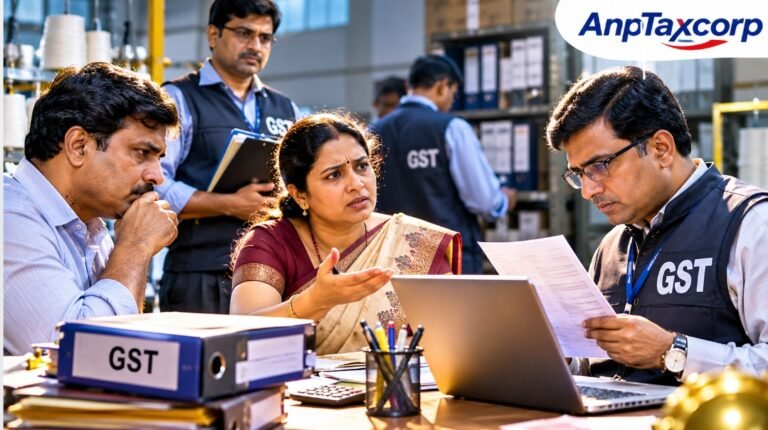
M/s Aruna Mills, engaged in the manufacture and supply of cotton yarn, poly-cotton yarn and synthetic fibres, was subjected to surprise inspections by the GST authorities on 19 and 20 October 2023.
During the inspection, the department allegedly compelled the company’s accounting staff to make payments through Form GST DRC-03 towards tax liabilities. The company contended that these payments were obtained without the consent of its partners and under coercive circumstances.
An additional circumstance highlighted before the Court was that the inspection coincided with a wedding in the family of the company’s partners. Consequently, the partners were not available at the business premises during the inspection.
Subsequently, on 6 November 2023, the company submitted a representation to the department objecting to the manner in which the payments had been collected.
The company also argued that the department had failed to issue Form GST DRC-04, which is the prescribed acknowledgement under Rule 142(2) of the CGST Rules for payments made through Form GST DRC-03.
Despite these objections, the State Tax Officer passed four orders dated 27 March 2024 concerning the assessment years 2020-21 to 2023-24. Aggrieved by the action, Aruna Mills approached the Madras High Court by filing writ petitions.
Arguments Presented by Both Parties
Contentions of the Petitioner
Aruna Mills challenged the legality of the proceedings on the following grounds:
-
The payments through Form GST DRC-03 were allegedly obtained under coercion during departmental inspections.
-
The partners had not voluntarily consented to the discharge of the alleged tax liabilities.
-
The department failed to issue Form GST DRC-04 as required under Rule 142(2) of the CGST Rules.
-
The representation dated 6 November 2023, disputing the payments, was not properly considered before passing the subsequent orders.
The petitioner maintained that the failure to follow the prescribed statutory procedure affected the validity of the entire proceedings.
Contentions of the GST Department
The department denied the allegation of coercion. It argued that payments through the GST portal could only be authenticated through an OTP sent to the registered mobile number and email address of the company’s partners.
According to the department, the payments were voluntarily made by the taxpayer and the proceedings had been concluded through issuance of Form GST DRC-05.
The department also questioned the delay of 17 days in submitting the taxpayer’s representation.
Findings and Observations of the Madras High Court
After examining the submissions and circumstances, the Madras High Court found deficiencies in the department’s approach.
1. Non-issuance of Form GST DRC-04
The Court took note of the department’s admission in its counter-affidavit that Form GST DRC-04 had not been issued.
Rule 142(2) of the CGST Rules prescribes the issuance of an acknowledgement in Form GST DRC-04 when payment is made through Form GST DRC-03.
The Court considered the failure to issue this statutory acknowledgement a significant procedural lapse.
2. Failure to Consider the Taxpayer’s Representation
The Court also observed that the representation submitted by Aruna Mills on 6 November 2023 had not been properly considered by the department.
The taxpayer had specifically disputed the circumstances under which the payments were obtained. However, the authorities proceeded without adequately addressing these objections.
The Court observed that the non-issuance of Form GST DRC-04, together with the failure to consider the taxpayer’s representation, was fatal to the department’s case.
3. Circumstances Surrounding the Departmental Inspection
The Court also examined the circumstances surrounding the inspection conducted on 19 and 20 October 2023.
It noted that the inspection coincided with a wedding in the petitioner’s family, making the presence of the partners at the business premises difficult.
The Court did not accept the department’s objection regarding the 17-day delay in submitting the representation as a sufficient reason to disregard the taxpayer’s grievance.
4. Reliance on Earlier Judicial Precedent
The Madras High Court relied upon the decision of the Calcutta High Court in ATR Malleable Casting (P.) Ltd. v. Inspector of Central Taxes.
Following the principles laid down in that decision, the Court concluded that the failure to issue the prescribed acknowledgement and consider the taxpayer’s objections rendered the impugned orders liable to be set aside.
Final Decision of the High Court
Allowing the writ petitions filed by Aruna Mills, the Madras High Court:
-
Set aside the four orders dated 27 March 2024 passed by the State Tax Officer.
-
Directed the GST authorities to refund the amounts collected under IGST, CGST and SGST.
-
Ordered that the refund be completed within eight weeks from receipt of a copy of the judgment.
-
Granted liberty to the petitioner to file an appeal manually within 12 weeks, if it so desired.
Legal Significance and Practical Implications
This judgment highlights an important aspect of GST administration: statutory procedures governing tax payments and recovery cannot be treated as mere formalities.
Form GST DRC-03 is used for making voluntary payments towards tax, interest, penalty or other amounts. Rule 142(2) provides for acknowledgement of such payments through Form GST DRC-04.
The ruling provides useful guidance for taxpayers who dispute payments allegedly obtained during inspections or departmental proceedings.
Businesses should particularly ensure that:
-
Payments through DRC-03 are made voluntarily and with proper authorisation.
-
Copies of DRC-03 challans and payment records are preserved.
-
The prescribed DRC-04 acknowledgement is obtained and verified.
-
Any objection regarding coercive recovery is immediately submitted in writing to the jurisdictional GST authority.
-
All inspection records, correspondence and supporting evidence are properly maintained.
An important qualification: The judgment should not be understood to mean that every non-issuance of Form GST DRC-04 automatically invalidates every GST demand or assessment. The decision must be appreciated in the context of its particular facts, including the disputed circumstances of payment and the department’s failure to consider the taxpayer’s representation.
Conclusion
The Madras High Court’s decision in M/s Aruna Mills v. The State Tax Officer reinforces the principle that GST authorities must strictly adhere to prescribed statutory procedures while collecting tax from taxpayers.
The ruling serves as an important reference for businesses challenging disputed payments made during departmental inspections, particularly where the prescribed acknowledgement under Rule 142(2) has not been issued and objections remain unaddressed.
It also reinforces the importance of procedural fairness, transparency and accountability in GST enforcement.
Disclaimer: This article is intended for general legal awareness and educational purposes. The applicability of the judgment depends upon the facts and circumstances of each case.