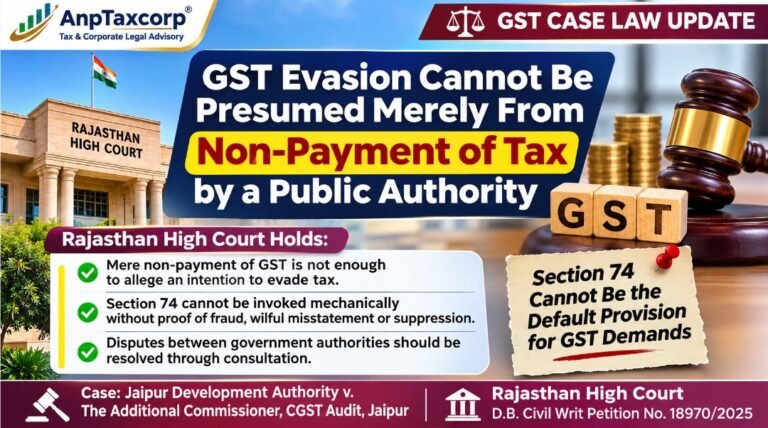
The Rajasthan High Court has held that mere non-payment of GST by a government authority does not automatically establish an intention to evade tax under Section 74 of the CGST Act, 2017. The Revenue must establish the essential ingredients of fraud, wilful misstatement or suppression of facts with an intent to evade tax before invoking the penal provisions of Section 74.
Introduction
The Rajasthan High Court has delivered an important ruling concerning the applicability of Section 74 of the Central Goods and Services Tax (CGST) Act, 2017. The Court emphasised that a mere failure to discharge an alleged GST liability cannot, by itself, be treated as evidence of an intention to evade tax.
The judgment is particularly significant for government departments, statutory authorities, public sector undertakings and other entities dealing with GST disputes involving substantial amounts.
The Court also cautioned tax authorities against routinely invoking Section 74, which carries serious penal consequences, without establishing the statutory conditions necessary for its application.
The decision arose from a GST demand of approximately ₹73.43 crore raised against the Jaipur Development Authority (JDA).
Background of the Case
The dispute arose when the GST authorities issued a show cause notice dated 30 September 2025 to the Jaipur Development Authority, proposing a tax demand of approximately ₹73.43 crore.
The proposed demand related to receipts from different activities undertaken by the Authority, including:
-
Road-cutting charges amounting to approximately ₹47.41 crore.
-
Additional Floor Area Ratio (FAR) charges and betterment levy amounting to approximately ₹25.86 crore.
-
Sale of Master Plan booklets and application forms amounting to approximately ₹15.94 lakh.
The JDA contended that these amounts were received in the course of performing its statutory functions and were duly reflected in its books of accounts.
The GST department, however, alleged that the Authority had failed to disclose and discharge its GST liability despite opportunities provided during the audit proceedings.
Consequently, the department initiated proceedings under Section 74 of the CGST Act, alleging circumstances warranting the invocation of the extended limitation period and penal provisions.
The Authority challenged the show cause notice before the Rajasthan High Court.
Key Issue Before the Rajasthan High Court
The principal issue before the Court was whether the mere non-payment of GST by a statutory public authority could justify the allegation of an intention to evade tax and consequently warrant proceedings under Section 74 of the CGST Act.
Another important consideration was whether the tax department could invoke Section 74 without demonstrating the necessary jurisdictional facts relating to fraud, wilful misstatement or suppression of facts with an intention to evade tax.
Court’s Observations and Legal Reasoning
A Division Bench comprising Justice Arun Monga and Justice Ashutosh Kumar examined the circumstances surrounding the issuance of the show cause notice.
The Court observed that the receipts in question were available in the books and records of the Jaipur Development Authority and were identified during the audit process. Therefore, the mere fact that the Authority had not paid the tax demanded by the department could not automatically establish an intention to evade GST.
The Bench also considered the nature of the JDA as a statutory public authority. It observed that the officers of the Authority had no apparent personal benefit to derive from non-payment of GST.
The Court reasoned that any tax payable by the JDA would effectively move from one public fund to another, as the amount would be paid from the Authority’s public funds and ultimately credited to the public exchequer.
In this context, the Court questioned the justification for attributing an intention to evade tax to government officers where no personal gain, directly or indirectly, was alleged or established.
However, the ruling does not create a blanket exemption for government authorities from GST liability. Its significance lies in the requirement that the statutory conditions for invoking the penal provisions must be independently satisfied.
Section 74 Cannot Be the Default Provision for GST Demands
One of the most important aspects of this judgment concerns the distinction between Sections 73 and 74 of the CGST Act.
Section 73 provides for determination of tax not paid, short-paid, erroneously refunded or input tax credit wrongly availed or utilised for reasons other than fraud, wilful misstatement or suppression of facts to evade tax, subject to the applicable statutory framework.
On the other hand, Section 74 deals with cases involving fraud, wilful misstatement or suppression of facts with an intention to evade tax. It carries more stringent consequences, including a higher penalty, an extended limitation period and the possibility of prosecution under the applicable provisions.
The High Court emphasised that the Revenue cannot reverse the statutory approach by treating Section 74 as the normal provision and Section 73 as an exception.
In other words, the department must first establish the circumstances justifying the invocation of Section 74. Non-payment of tax, standing alone, is insufficient to satisfy this requirement.
This observation reinforces the importance of distinguishing between a genuine tax dispute and conduct involving deliberate tax evasion.
Disputes Between Government Authorities Should Be Resolved Through Consultation
The High Court also made significant observations regarding disputes between different government authorities.
The Bench referred to the Office Memorandum dated 22 May 2018 issued by the Department of Public Enterprises, Ministry of Heavy Industries and Public Enterprises, which provides a mechanism for resolving commercial disputes involving Central Public Sector Enterprises and government departments.
Although the Court acknowledged that the memorandum did not strictly govern the particular dispute between the State authority and the Central GST department, it appreciated the underlying principle of resolving disputes through consultation rather than prolonged litigation.
The Court observed that disputes between different arms of the government should preferably be settled through discussions, as litigation involving public authorities ultimately consumes public money on both sides.
It suggested that the parties approach the Secretary of the relevant Ministry of the Government of India to explore an amicable resolution. The Court clarified that this was an observation and not a binding direction.
Final Decision of the Court
After examining the facts and circumstances, the Rajasthan High Court concluded that the show cause notice failed to disclose the essential jurisdictional fact of an intention to evade tax.
The Court rejected the department’s contention that non-payment of GST was sufficient to establish such intention.
Accordingly, the High Court:
-
Quashed the GST show cause notice dated 30 September 2025.
-
Quashed all proceedings initiated pursuant to the impugned notice.
-
Clarified that it was not deciding whether the disputed receipts were actually taxable under GST.
Therefore, the judgment should not be interpreted as a finding that road-cutting charges, FAR charges or betterment levies are necessarily outside the scope of GST.
Implications for GST Taxpayers and Professionals
This judgment carries considerable significance for GST litigation and departmental adjudication.
First, it reiterates that invoking Section 74 requires satisfaction of the statutory ingredients and cannot be justified merely by establishing non-payment of tax.
Second, the availability of transactions in the taxpayer’s books and records may be relevant while examining allegations of suppression, although disclosure in books does not automatically rule out suppression in every case.
Third, taxpayers facing proceedings under Section 74 should carefully examine whether the show cause notice identifies specific instances of fraud, wilful misstatement or suppression with the requisite intention to evade tax.
Finally, the judgment provides useful guidance in disputes involving statutory authorities and government organisations, particularly where tax liabilities arise from the performance of public functions.
Conclusion
The Rajasthan High Court’s decision reinforces an important principle of GST law: a tax dispute cannot automatically be converted into a tax evasion proceeding merely because the alleged tax liability remains unpaid.
The department must establish the statutory grounds for invoking Section 74, and the consequences of fraud-related proceedings cannot be imposed without satisfying those requirements.
For GST practitioners, this ruling provides a useful reference while challenging mechanically issued show cause notices and proceedings under Section 74 of the CGST Act.
Case Reference
-
Case Name: Jaipur Development Authority v. The Additional Commissioner, CGST Audit, Jaipur, Rajasthan
-
Court: Rajasthan High Court
-
Case Number: D.B. Civil Writ Petition No. 18970/2026
-
Bench: Justice Arun Monga and Justice Ashutosh Kumar
-
Relevant Legislation: Sections 73 and 74 of the CGST Act, 2017
-
Decision: Show cause notice and consequential proceedings quashed.
Disclaimer: This article is intended for general legal information and educational purposes. Readers should refer to the original court judgment and applicable statutory provisions before relying on the decision in any particular matter.