Introduction
The statutory time limit for completing an income tax assessment is not merely a procedural formality. It is a mandatory legal requirement, and the Income Tax Department cannot keep a tax demand alive indefinitely by delaying consequential assessment proceedings.
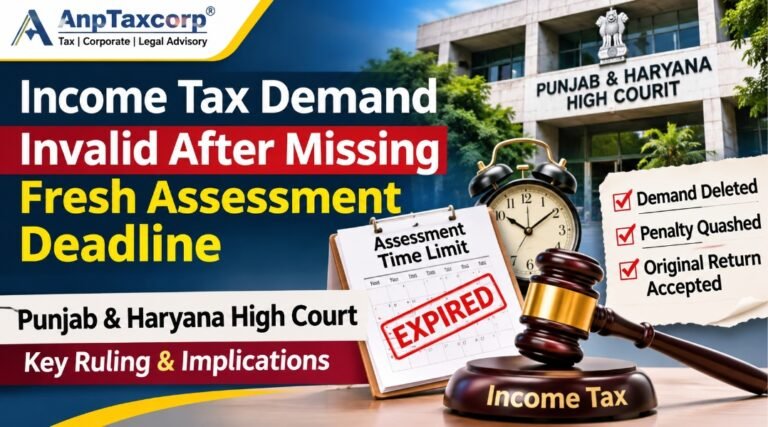
In an important judgment, the Punjab and Haryana High Court has held that the Income Tax Department cannot sustain an outstanding tax demand or continue consequential penalty proceedings when it fails to pass a fresh assessment order within the prescribed limitation period after the Income Tax Appellate Tribunal (ITAT) remits the matter for reconsideration.
The Court emphasised that departmental administrative delays cannot prejudice an assessee’s legal rights. The ruling reinforces the importance of statutory limitation under Section 153(3) of the Income Tax Act, 1961.
Background of the Case
The judgment was delivered in the matter of Orange Business Services India Solutions Pvt. Ltd. v. Assistant Commissioner of Income Tax & Ors., CWP No. 23027 of 2026 (O&M).
The dispute concerned transfer pricing adjustments made in respect of the company’s international transactions for Assessment Year 2018-19.
The ITAT, by its order dated 30 May 2023, deleted a transfer pricing adjustment of approximately ₹24.57 crore relating to interest on receivables. However, the Tribunal remitted the determination of the arm’s length price (ALP) of certain other international transactions to the Transfer Pricing Officer (TPO) for fresh consideration.
Following the Tribunal’s directions, the TPO was required to reconsider the relevant transactions and pass a fresh order within the statutory period.
However, no fresh order was passed by the TPO within the prescribed time.
Despite the absence of a fresh assessment order, the Income Tax Department continued to reflect an outstanding demand of approximately ₹31.97 crore on the income tax e-filing portal. The Department also initiated consequential penalty proceedings against the assessee.
Aggrieved by the continued demand and penalty notices, the company approached the Punjab and Haryana High Court.
Assessee’s Arguments
The assessee challenged the Department’s action primarily on the ground that the statutory limitation period under Section 153(3) had already expired.
It was submitted that the ITAT’s order dated 30 May 2023 had been duly brought to the notice of the TPO through a representation dated 9 August 2023.
Accordingly, the Department had sufficient knowledge of the Tribunal’s directions and was required to complete the fresh determination within the prescribed statutory period.
The assessee contended that once the limitation period expired without a fresh assessment order, the Department lost its authority to proceed with the reassessment. Consequently, the outstanding tax demand and related penalty proceedings could not legally survive.
Revenue’s Stand Before the High Court
The Income Tax Department argued that the limitation period should be calculated from the date on which the ITAT’s order was received by the specified senior departmental authorities, including the jurisdictional Commissioner of Income Tax.
According to the Revenue, the relevant date of communication to the competent departmental authorities was material for determining the limitation period.
The Department therefore sought to justify its position by relying on the internal communication and administrative process relating to receipt of the Tribunal’s order.
High Court’s Observations and Legal Findings
The Division Bench comprising Justice Deepak Sibal and Justice Sunish Bindlish rejected the Revenue’s contention.
The Court noted that the Commissioner of Income Tax was present when the ITAT pronounced its order. Further, a copy of the order had also been handed over to the office of the Senior Departmental Representative.
Therefore, the Department could not claim that the limitation period would commence only after completion of its internal administrative communication process.
The High Court relied upon the Delhi High Court’s decision in CIT v. Odeon Builders (P) Ltd., reiterating that internal administrative delays in communicating judicial orders cannot be used to the disadvantage of taxpayers.
The Court also considered the fact that the TPO had been informed about the ITAT’s directions but failed to complete the fresh determination within the prescribed statutory period.
Since the TPO did not pass the necessary order within the limitation period, the Assessing Officer could not proceed to pass a fresh assessment order on the basis of the remanded issues.
The Court consequently held that the Revenue was barred from passing such an assessment order after expiry of the statutory deadline.
It further observed that the assessee’s original income tax return filed on 30 November 2018 was required to be accepted.
Consequential Penalty Proceedings Also Quashed
Another significant aspect of the judgment concerns the validity of penalty proceedings.
The Department had issued a notice under Section 221(1) and two notices under Section 274 read with Section 270A of the Income Tax Act.
The High Court held that the original assessment order, which contained the satisfaction forming the basis for initiating penalty proceedings, had already been set aside by the ITAT.
Consequently, the foundation for the penalty proceedings no longer survived.
In reaching this conclusion, the Court relied upon the Supreme Court’s decision in CIT v. Jai Laxmi Rice Mills, supporting the principle that consequential penalty proceedings cannot survive when their underlying assessment foundation has been invalidated.
Final Decision of the High Court
Allowing the assessee’s writ petition, the Punjab and Haryana High Court granted substantial relief by directing the Income Tax Department to:
- Delete the outstanding tax demand of approximately ₹31.97 crore reflected on the income tax portal.
- Quash the notice issued under Section 221(1) of the Income Tax Act.
- Quash the two notices issued under Section 274 read with Section 270A.
- Accept the assessee’s original income tax return filed on 30 November 2018.
The judgment makes it clear that the Revenue cannot continue assessment-related proceedings after the expiry of the applicable statutory limitation period.
Legal Significance of the Judgment
This decision is important for taxpayers facing fresh assessment proceedings following an order of the ITAT or another appellate authority remitting matters for reconsideration.
It highlights three important legal principles:
- Limitation is mandatory: The Income Tax Department must complete fresh assessment proceedings within the time prescribed under the Act.
- Administrative delay is not an excuse: Internal departmental communication cannot extend the statutory limitation period to the detriment of an assessee.
- Consequential penalties must have a valid foundation: Where the underlying assessment order is set aside and the necessary statutory basis disappears, consequential penalty proceedings may also become unsustainable.
Taxpayers facing old demands, delayed fresh assessments or penalty notices should carefully examine the relevant appellate orders, dates of communication and statutory limitation provisions before accepting the Department’s claims.
Conclusion
The Punjab and Haryana High Court’s ruling in Orange Business Services India Solutions Pvt. Ltd. reinforces an essential principle of income tax law: the Department must exercise its assessment powers within the period prescribed by legislation.
A tax demand cannot be kept alive merely because the Department has failed to complete the necessary proceedings within time. Nor can internal administrative delays be used to extend statutory deadlines.
The judgment provides significant protection to taxpayers against time-barred assessment proceedings and consequential penalty actions. It also serves as a reminder that statutory limitation is equally binding on the tax authorities and must be strictly observed.
Case Reference: Orange Business Services India Solutions Pvt. Ltd. v. Assistant Commissioner of Income Tax & Ors.
Court: Punjab and Haryana High Court
Case Number: CWP No. 23027 of 2026 (O&M)
Relevant Provision: Section 153(3), Section 221(1), Section 270A and Section 274 of the Income Tax Act, 1961.
Disclaimer: This article is intended for general legal and informational purposes only. The legal position in any particular case depends on its facts, applicable statutory provisions and the complete judgment. Readers are advised to obtain appropriate professional advice before taking legal action.