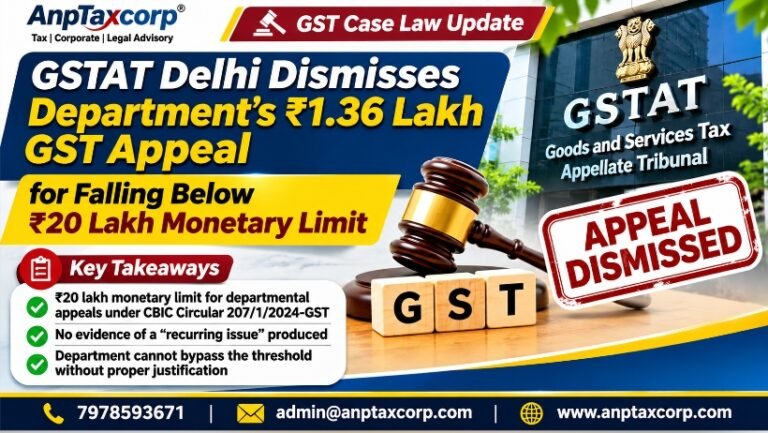
The Goods and Services Tax Appellate Tribunal (GSTAT), Principal Bench, New Delhi, has dismissed a GST appeal filed by the Department against Bangla Foods Private Limited on the ground that the disputed tax amount of ₹1,36,634 was below the prescribed monetary limit of ₹20 lakh for filing departmental appeals before the Tribunal.
In its decision, the Tribunal reiterated that the monetary limits prescribed under CBIC Circular No. 207/1/2024-GST must be followed by the tax authorities. It further observed that the Department cannot invoke exceptions to the monetary threshold without producing appropriate supporting evidence.
The ruling highlights the importance of adhering to the Government’s litigation policy and avoiding unnecessary litigation involving small tax demands.
Background of the Case
The dispute in Vishal Chaudhary v. Bangla Foods Private Limited, Appeal No. APL/54/PB/2026, arose from an allegation that Bangla Foods Private Limited had failed to discharge IGST liability under the Reverse Charge Mechanism (RCM) on online advertising services allegedly received from Facebook Ireland Limited during the financial year 2017-18.
The Directorate General of GST Intelligence (DGGI) issued an alert alleging non-payment of IGST amounting to ₹1,36,634 on services categorised as Online Information and Database Access or Retrieval (OIDAR) services.
Acting upon the information, the Department issued a Show Cause Notice dated 1 August 2024, proposing recovery of the alleged tax liability along with applicable interest and an equivalent penalty.
The adjudicating authority subsequently confirmed the demand through an order dated 22 January 2025.
Taxpayer’s Arguments Before the First Appellate Authority
Aggrieved by the adjudication order, Bangla Foods Private Limited challenged the demand before the First Appellate Authority.
The taxpayer specifically disputed having received any advertising services from Facebook Ireland Limited during the relevant financial year.
To substantiate its position, the company submitted its audited financial statements, Profit and Loss Account and advertising expenditure ledger.
The financial records reflected total advertising expenditure of only ₹42,738. However, there was no corresponding entry indicating any payment or transaction with Facebook Ireland Limited.
After examining the available financial records, the First Appellate Authority concluded that the adjudicating authority had relied primarily upon the DGGI alert without independently verifying whether the company had actually received the alleged services.
Accordingly, by an order dated 3 October 2025, the First Appellate Authority allowed the taxpayer’s appeal and set aside the entire GST demand.
Department’s Appeal Before GSTAT
The Department challenged the appellate order before the Principal Bench of GSTAT, New Delhi.
The Department contended that the taxpayer had received taxable OIDAR services from Facebook Ireland Limited and that the First Appellate Authority had failed to properly examine the relevant financial records.
It also argued that the dispute involved recurring issues concerning the interpretation of statutory provisions relating to reverse charge liability and place of supply.
According to the Department, the matter therefore fell within the exceptions provided under CBIC Circular No. 207/1/2024-GST, allowing departmental appeals even where the disputed tax amount was below the prescribed monetary threshold.
Taxpayer’s Objection Regarding the Monetary Limit
Before examining the Department’s grounds on merits, Bangla Foods raised a preliminary objection regarding the maintainability of the appeal.
The taxpayer submitted that CBIC Circular No. 207/1/2024-GST prescribes a minimum monetary threshold of ₹20 lakh for filing departmental appeals before GSTAT.
Since the disputed tax amount was only ₹1,36,634, the appeal was clearly below the prescribed limit.
It was further argued that while calculating the monetary threshold in cases involving a tax demand, the Department should consider the disputed tax amount and not add the consequential interest and penalty.
The taxpayer maintained that the Department could not bypass the prescribed monetary limit unless the case was specifically covered by one of the exceptions mentioned in the circular.
GSTAT’s Observations and Findings
The Tribunal, comprising Judicial Member Justice Mayank Kumar Jain and Technical Member A. Venu Prasad, examined the monetary threshold prescribed under CBIC Circular No. 207/1/2024-GST.
It noted that the disputed tax amount of ₹1,36,634 was substantially below the prescribed threshold of ₹20 lakh.
The Tribunal also examined the Department’s contention that the dispute involved a recurring legal issue and therefore qualified for an exception under the circular.
However, the Department failed to produce copies of show-cause notices allegedly issued for other financial years or any supporting adjudication orders to establish that similar disputes had arisen repeatedly.
The Tribunal observed that merely issuing a few show-cause notices would not establish that an issue was recurring in nature. The Department was required to substantiate its claim with credible documentary evidence.
The Bench also rejected the argument that the dispute involved a substantial question concerning the interpretation of statutory provisions relating to reverse charge liability or determination of the place of supply.
According to the Tribunal, the principal issue was essentially whether Bangla Foods had actually received OIDAR services from Facebook Ireland Limited during the relevant period.
The Department had failed to demonstrate that the matter fell within any of the recognised exceptions to the monetary limit.
Tribunal’s Remarks on Unnecessary Departmental Litigation
The Tribunal expressed serious concern over the Department’s decision to pursue an appeal despite the disputed tax amount being substantially below the prescribed monetary threshold.
It observed that such an approach frustrated the objectives of the National Litigation Policy and the spirit of the CBIC circular, besides unnecessarily consuming the judicial resources of the Tribunal.
Accordingly, the Bench held that the Department’s appeal was not maintainable.
Final Decision of GSTAT
The GSTAT dismissed the Department’s appeal on the ground that the disputed tax amount was below the prescribed monetary limit of ₹20 lakh and that no applicable exception had been established.
Importantly, the Tribunal did not examine the substantive question of whether Bangla Foods was actually liable to pay IGST under the Reverse Charge Mechanism on the alleged online advertising services.
Thus, the dismissal was based on the maintainability of the departmental appeal and not on an independent adjudication of the underlying RCM liability.
Legal Significance of the Ruling
This decision reinforces the importance of CBIC’s monetary limits for departmental appeals under GST.
It conveys three important messages:
1. Compliance with monetary limits: GST authorities must adhere to the prescribed monetary thresholds while filing appeals before GSTAT.
2. Evidence required for exceptions: The Department cannot claim that a dispute involves a recurring issue merely by referring to other notices. Documentary evidence must support such a contention.
3. Avoidance of unnecessary litigation: Departmental authorities should respect the National Litigation Policy and avoid pursuing appeals that do not satisfy the prescribed conditions.
The ruling is particularly relevant for taxpayers facing departmental litigation involving relatively small tax demands. It provides an important reference for raising preliminary objections regarding the maintainability of departmental appeals where the prescribed monetary threshold is not satisfied.
Case Reference:
-
Case Title: Vishal Chaudhary v. Bangla Foods Private Limited
-
Appeal No.: APL/54/PB/2026
-
Forum: GST Appellate Tribunal, Principal Bench, New Delhi
-
Relevant Circular: CBIC Circular No. 207/1/2024-GST
Disclaimer: This article is intended for general legal and informational purposes only. Readers should refer to the original Tribunal order and applicable statutory provisions and CBIC circulars before taking any legal or tax-related decisions.