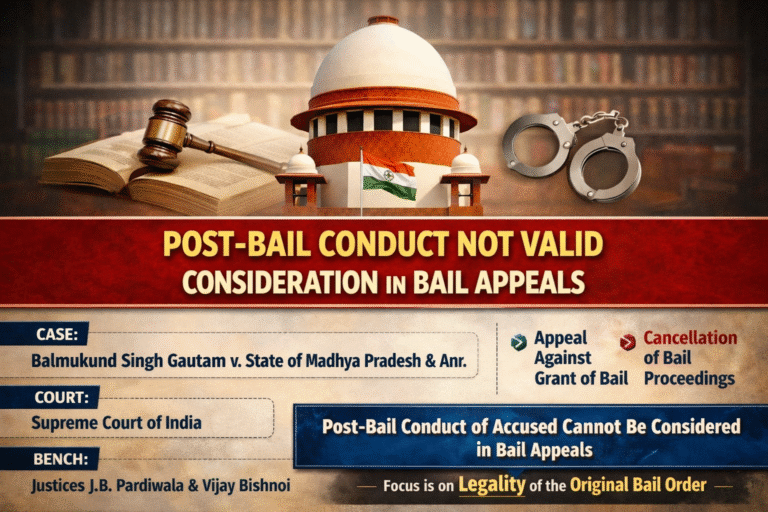
The Supreme Court has delivered an important clarification on the scope of judicial review in appeals challenging the grant of bail. In its recent ruling, the Court held that post-bail conduct of an accused cannot be treated as a valid factor while deciding an appeal against the order granting bail. The Court emphasised that such appeals must be confined strictly to examining whether the original bail order was legally justified at the time it was passed.
The judgment draws a clear distinction between an appeal against grant of bail and a cancellation of bail proceeding, observing that subsequent conduct may only be relevant in cancellation applications, not in appeals questioning the legality of the initial bail order. This ruling reinforces settled principles governing bail jurisprudence and ensures consistency in appellate scrutiny.
Case Title
Balmukund Singh Gautam v. State of Madhya Pradesh & Anr.
(Supreme Court judgment reported in LiveLaw, 17 Feb 2026)
Bench
- Justices J.B. Pardiwala and Vijay Bishnoi
Facts
- The Madhya Pradesh High Court granted anticipatory bail to an accused who was absconding.
- The complainant challenged that order in the Supreme Court.
- The accused argued that his conduct after being granted bail (post-bail behaviour) should be considered by the Supreme Court in deciding the appeal.
Supreme Court’s Holding
The Supreme Court set aside the High Court’s grant of anticipatory bail and clarified a key legal principle:
➡️ Post-bail conduct of an accused is not a valid consideration when deciding an appeal against the grant of bail by a lower court.
Core Legal Principle
- An appeal against the grant of bail is concerned with whether the original bail order was legally justified — i.e., whether it was perverse, illegal, inconsistent with settled law, or whether relevant factors were improperly ignored.
- Conduct that occurs after bail is granted does not go to the legality of the bail order itself and therefore cannot be considered in such an appeal.
When Can Post-Bail Conduct Be Relevant?
- The Court emphasised that post-bail conduct may be relevant in a separate application for cancellation of bail — not in an appeal against its grant.
Reference to Precedent
The Supreme Court’s reasoning draws from principles outlined in Ashok Dhankad v. State of NCT of Delhi — where the Court also held that post-bail conduct is relevant to cancellation of bail but not to the validity of the grant itself.