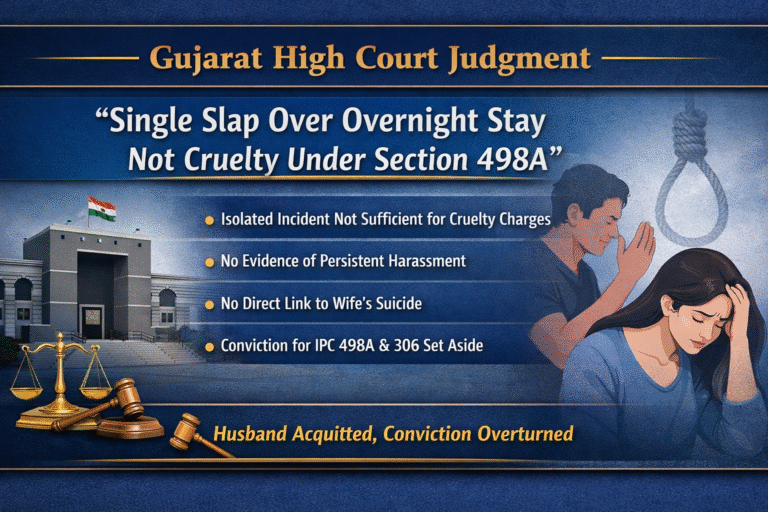
In a significant ruling, the Gujarat High Court has held that a single instance of a husband slapping his wife, without proof of sustained harassment, does not amount to “cruelty” under Section 498A of the Indian Penal Code (IPC). The Court set aside the conviction of a man who had been sentenced nearly two decades ago in connection with his wife’s suicide.
Background of the Case
The case dates back to 1996, when a married woman died by suicide in Gujarat’s Valsad district. Following her death, her father filed a complaint alleging that she had been subjected to cruelty by her husband. The prosecution claimed that:
- There were frequent quarrels between the couple.
- The husband worked late at night as a musician.
- On one occasion, he allegedly slapped his wife after she stayed overnight at her parents’ home without informing him.
Based on these allegations, the trial court in 2003 convicted the husband under:
- Section 498A IPC (cruelty by husband or relatives), and
- Section 306 IPC (abetment of suicide).
He was sentenced to imprisonment for both offences.
High Court’s Observations
While hearing the appeal, the High Court carefully examined whether the prosecution had established the ingredients required to prove cruelty and abetment of suicide.
a. Single Incident Not Enough for Cruelty
The Court emphasized that Section 498A IPC requires proof of conduct that is:
- Wilful,
- Of such a nature as is likely to drive a woman to commit suicide, or
- Likely to cause grave injury or danger to life, limb, or mental health.
The Court held that a solitary act of slapping, in the absence of evidence showing continuous harassment or grave mental cruelty, does not meet this legal threshold.
b. No Evidence of Persistent Harassment
The Court noted:
- No prior complaints were made by the deceased during her lifetime.
- There was no medical or documentary evidence showing repeated physical or mental cruelty.
- Witness testimonies lacked consistency and did not establish sustained abuse.
In criminal law, conviction must be based on proof beyond reasonable doubt, which the Court found lacking in this case.
c. No Direct Link to Suicide
For an offence under Section 306 IPC, there must be a clear and proximate link between the accused’s conduct and the suicide.
The High Court observed that:
- There was no material to show that the husband had instigated, aided, or intentionally provoked the suicide.
- The alleged single incident could not be considered a direct cause leading to the extreme step.
Verdict
After evaluating the evidence, the High Court:
- Set aside the 2003 conviction, and
- Acquitted the husband of charges under Sections 498A and 306 IPC.
Legal Significance of the Judgment
This ruling reiterates an important principle in matrimonial criminal cases:
Not every marital discord or isolated act of anger constitutes “cruelty” under Section 498A IPC.
The judgment underscores the need for:
- Clear evidence of sustained harassment,
- A demonstrable link between alleged cruelty and suicide (in abetment cases),
- Strict adherence to the standard of proof required in criminal trials.
While the law aims to protect women from genuine domestic violence and harassment, courts continue to stress that criminal liability cannot be imposed without legally sufficient evidence.