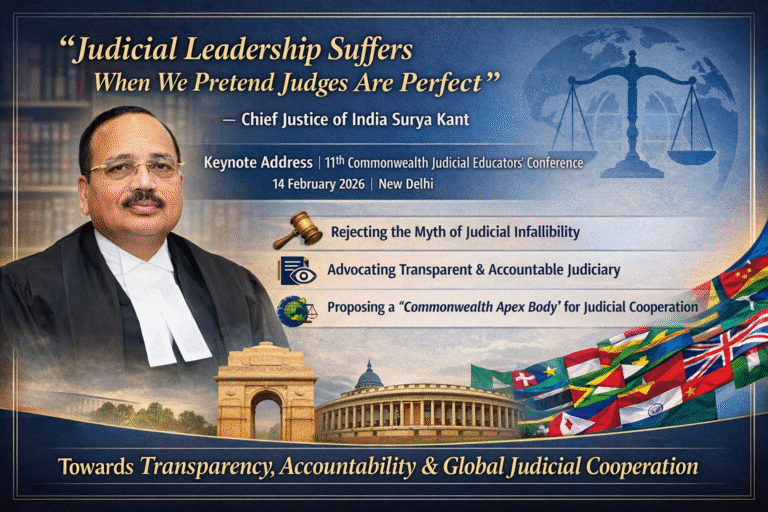
In a thought-provoking keynote address on 14 February 2026, CJI Surya Kant called for a fundamental rethinking of how judicial leadership is perceived and practiced. Speaking at the 11th Commonwealth Judicial Educators’ Conference in New Delhi, the Chief Justice emphasized that the strength of the judiciary lies not in claims of perfection, but in transparency, humility, and institutional accountability.
Challenging the Myth of Judicial Infallibility
In his address, the CJI observed that judicial leadership suffers when judges are portrayed as flawless or beyond criticism. He stressed that judges, like all public servants, are human and capable of error. Pretending otherwise, he noted, creates unrealistic expectations and weakens public trust.
According to him, acknowledging fallibility does not undermine judicial authority. Instead, it enhances credibility by demonstrating a commitment to self-correction and continuous improvement.
Transparency as the Foundation of Trust
Chief Justice Surya Kant underlined that public confidence in the judiciary grows when institutions operate with openness and integrity. Transparent processes, reasoned judgments, and ethical conduct are essential pillars of a strong judicial system.
He advocated for:
- Greater institutional introspection
- Constructive criticism within the legal ecosystem
- A culture that values accountability alongside independence
The CJI made it clear that independence of the judiciary does not mean insulation from scrutiny.
Proposal for a ‘Commonwealth Apex Body’
One of the most significant highlights of the address was the proposal to establish a “Commonwealth Apex Body.” The envisioned body would serve as a collaborative platform for apex courts across Commonwealth nations.
Its objectives would include:
- Sharing best practices in judicial education
- Promoting comparative constitutional dialogue
- Strengthening rule of law values across jurisdictions
- Enhancing cooperation among judiciaries facing common challenges
This proposal reflects India’s growing leadership role in global judicial discourse and constitutional development.
A Progressive Vision for Judicial Reform
The speech comes at a time when discussions around judicial accountability, transparency in appointments, and systemic reforms are gaining momentum. By openly acknowledging the need for institutional humility, the Chief Justice has signaled a progressive approach to judicial governance.
His remarks reinforce a powerful message: The legitimacy of courts does not rest on the perception of perfection, but on the willingness to uphold fairness, transparency, and accountability.
Conclusion
Chief Justice Surya Kant’s address marks an important moment in contemporary judicial thought. By rejecting the myth of infallibility and advocating for global judicial cooperation, he has articulated a modern vision of judicial leadership—one grounded in trust, responsibility, and reform.