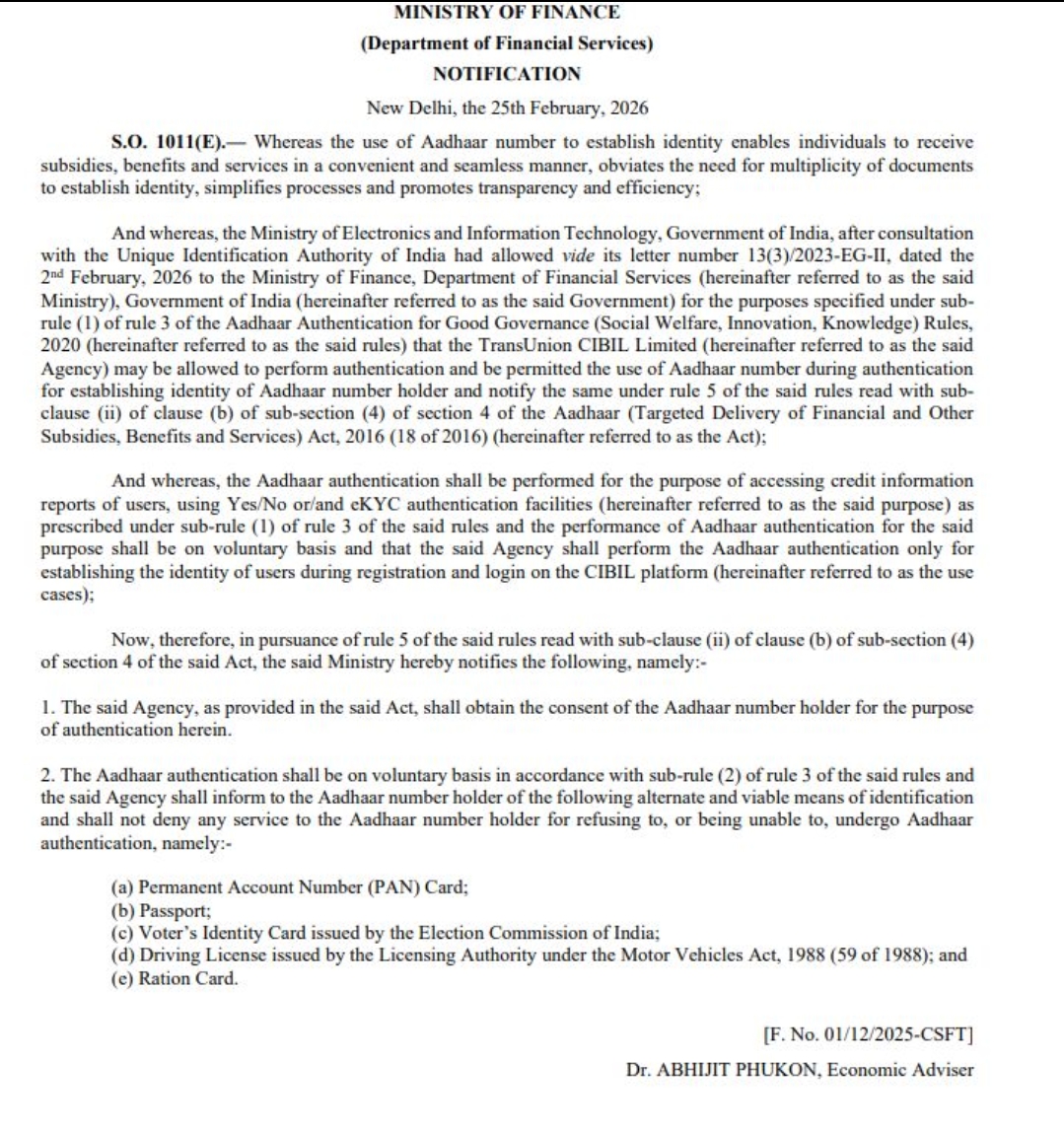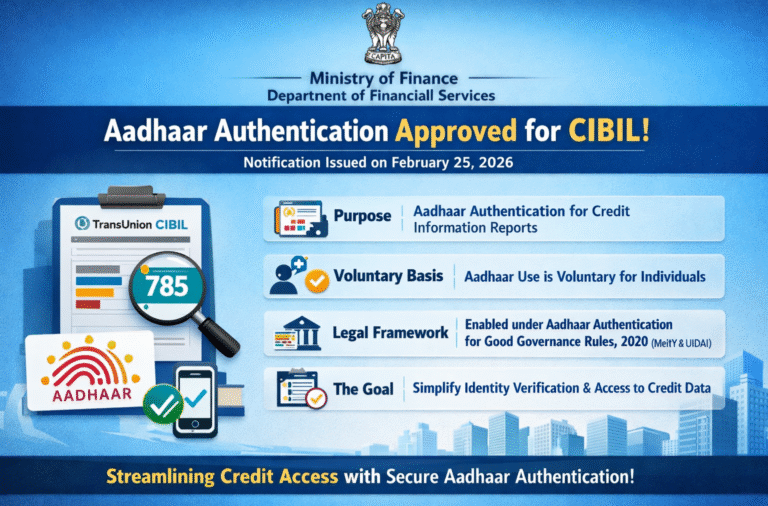
In a significant move to streamline credit-related services, the Ministry of Finance (Department of Financial Services) has issued a notification dated February 25, 2026, authorising TransUnion CIBIL Limited to use Aadhaar authentication for identity verification.
This development is expected to make the process of accessing credit information faster, simpler, and more efficient for individuals across India.
What Does the Notification Allow?
Under the notification, TransUnion CIBIL Limited is now permitted to use Aadhaar authentication (Yes/No and eKYC facilities) for the purpose of providing credit information reports.
This means individuals can verify their identity using Aadhaar when accessing their credit report, reducing the need for multiple physical documents.
Voluntary in Nature
Importantly, Aadhaar authentication for this purpose remains completely voluntary.
Individuals are not mandated to use Aadhaar. Alternative identity verification methods will continue to be available, ensuring compliance with privacy and consent requirements.
Legal Backing
The authorisation has been granted under the Aadhaar Authentication for Good Governance (Social Welfare, Innovation, Knowledge) Rules, 2020.
The approval followed due consultation with the:
-
Ministry of Electronics and Information Technology (MeitY)
-
Unique Identification Authority of India (UIDAI)
This ensures that the move aligns with existing legal and regulatory safeguards governing Aadhaar usage.
Why This Move Matters
The decision aims to:
-
Simplify identity verification procedures
-
Reduce paperwork and duplication of documents
-
Enhance efficiency in accessing credit information
-
Improve turnaround time for credit-related services
For borrowers and financial institutions alike, this could mean smoother onboarding processes and quicker access to credit data.
Impact on Consumers
With Aadhaar-based authentication, individuals may experience:
-
Faster access to their credit reports
-
Reduced documentation burden
-
More seamless digital verification
At the same time, the voluntary framework ensures that privacy and consent remain central to the process.
Conclusion
The latest notification from the Ministry of Finance marks another step toward digital governance and ease of access in the financial ecosystem. By enabling Aadhaar authentication for credit information reports, the government seeks to balance convenience, efficiency, and regulatory compliance.
As India continues its push toward digital financial infrastructure, such measures are likely to play a crucial role in strengthening credit access and transparency.