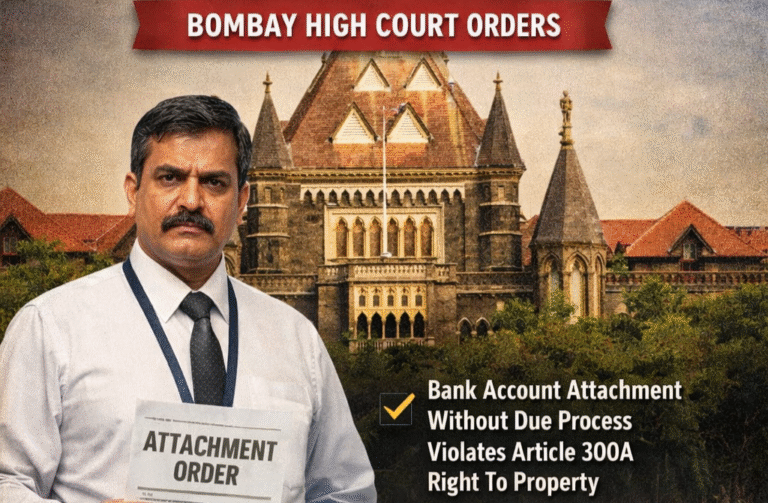
In a significant ruling reinforcing taxpayer rights and procedural safeguards, the Bombay High Court has held that unlawful attachment of a bank account without adherence to statutory requirements amounts to a violation of the constitutional right to property under Article 300A of the Constitution of India. The Court not only quashed the impugned attachment orders but also imposed costs of ₹25,000 on the concerned officer, underscoring the seriousness of arbitrary administrative action.
Background of the Case
The case, titled Nivara Infradevelopers LLP vs. Union of India & Ors., arose from a writ petition filed by the assessee challenging provisional attachment orders dated 23 January 2026. These orders were issued by State Tax authorities attaching the petitioner’s bank accounts, allegedly without following due process of law.
The petitioner contended that the attachment was executed arbitrarily—without forming any valid opinion based on tangible material, without issuing a proper show cause notice, and without considering the objections filed. The petitioner had also offered alternate security, which was disregarded by the authorities.
Court’s Observations on Provisional Attachment
A division bench comprising Justice G. S. Kulkarni and Justice Aarti Sathe examined the statutory provisions governing provisional attachment. The Court emphasized that such powers are drastic in nature and must be exercised with utmost caution and strict compliance with legal requirements.
The Bench observed that the “formation of opinion” by the competent authority is not a mere formality but a mandatory precondition. This opinion must be based on credible and tangible material indicating that such attachment is necessary to protect the interest of revenue.
However, in the present case, the Court noted a glaring absence of any such material. Even the pre-intimation issued on the same day as the attachment order failed to disclose any reasoning or justification. This, according to the Court, clearly demonstrated non-application of mind and violation of statutory safeguards.
Violation of Principles of Natural Justice
The High Court further held that the authorities failed to adhere to settled legal principles, including those laid down by the Supreme Court regarding provisional attachment. The action was termed arbitrary and in complete disregard of due process.
Importantly, the Court noted that despite the petitioner filing objections and highlighting legal infirmities, the authorities continued the attachment for months. This continuation, without addressing the representations, further aggravated the illegality.
The judgment underscores that procedural safeguards are not empty formalities—they are essential checks against abuse of power. Any deviation from these safeguards renders the action legally unsustainable.
Impact on Business and Right to Property
One of the most critical aspects of the ruling is the Court’s recognition of the severe consequences of bank account attachment. The Bench observed that freezing a bank account effectively paralyses business operations, leading to what it described as a “live death” of the enterprise.
Such coercive action directly impacts the fundamental right to carry on business and the constitutional protection of property under Article 300A. The Court categorically held that depriving a person of property without authority of law is unconstitutional.
The continued attachment of the petitioner’s bank accounts for over three months, without following due process, was held to be a clear violation of constitutional rights and resulted in serious civil consequences.
Court’s Decision and Imposition of Costs
Taking a stern view of the matter, the Bombay High Court quashed the provisional attachment orders. However, the Court went a step further by imposing costs of ₹25,000 on the concerned Joint Commissioner, directing the amount to be deposited with the Maharashtra State Legal Services Authority.
The imposition of costs signals judicial intolerance towards arbitrary exercise of power and serves as a deterrent against similar actions by tax अधिकारियों in the future.
Key Takeaways for Taxpayers and Authorities
This landmark ruling provides several important takeaways:
- Strict Compliance Required: Authorities must strictly adhere to statutory provisions before invoking provisional attachment.
- Formation of Opinion is Mandatory: Attachment cannot be made without a reasoned opinion based on tangible material.
- Natural Justice Must Be Followed: Taxpayers must be given a fair opportunity to respond, and their objections must be duly considered.
- Constitutional Safeguards Prevail: Any action violating Article 300A will not withstand judicial scrutiny.
- Accountability of Officers: Courts may impose personal costs on अधिकारियों for arbitrary actions.
Conclusion
The decision in Nivara Infradevelopers LLP vs. Union of India & Ors. marks a crucial reaffirmation of taxpayer rights and constitutional protections. It sends a strong message that while revenue authorities possess significant powers, such powers are not unfettered and must be exercised within the framework of law.
For businesses and professionals, this ruling serves as a valuable precedent to challenge unlawful attachments and protect their financial and operational stability. At the same time, it reminds tax authorities to act responsibly, transparently, and in strict compliance with legal mandates.