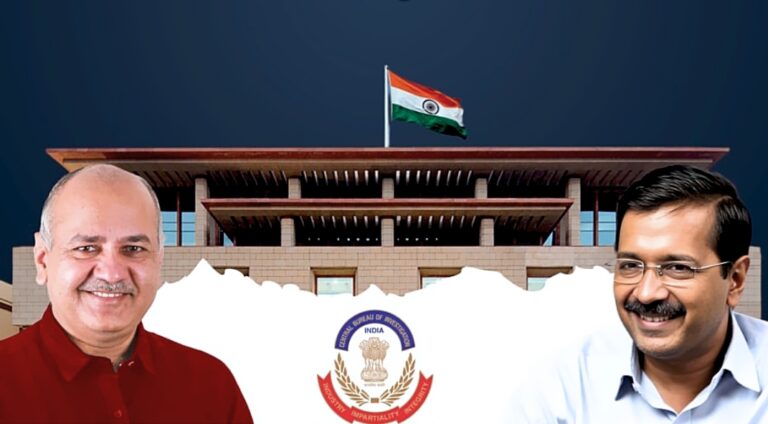
The Delhi High Court has scheduled March 9, 2026, to hear a revision petition filed by the Central Bureau of Investigation (CBI) challenging the discharge of former Delhi Chief Minister Arvind Kejriwal, former Deputy CM Manish Sisodia, and 21 others in the alleged irregularities relating to Delhi’s 2021–22 excise policy.
The matter is listed before Justice Swarana Kanta Sharma and is expected to address significant legal questions concerning the scope of judicial scrutiny at the stage of framing charges.
Background: Trial Court Discharge
On February 27, 2026, Special Judge Jitendra Singh of the Rouse Avenue Court discharged all 23 accused persons. The trial court held that:
- There was “no material at all” to establish criminal conspiracy or criminal intent.
- The CBI’s case was described as a “choreographed exercise” built on conjecture.
- The evidence placed on record failed to meet even the threshold required for framing charges.
The court further ordered an inquiry into the investigating officer, observing that the accused were allegedly framed without adequate evidentiary support.
CBI’s 974-Page Revision Petition: Key Legal Arguments
In response, the CBI has filed a detailed 974-page revision petition before the Delhi High Court, terming the discharge order as “patently illegal” and based on a “selective reading” of evidence.
1. The “Mini-Trial” Argument
A central plank of the CBI’s challenge is that the Special Judge conducted what effectively amounted to a “mini-trial” at the discharge stage.
According to the agency:
- The judge undertook an in-depth appreciation of evidence, which is typically reserved for a full-fledged trial.
- At the stage of charge, the court is only required to determine whether a prima facie case exists.
- The trial court allegedly examined each limb of the alleged conspiracy in isolation rather than viewing the material cumulatively.
The CBI argues that when the evidence is read holistically, it reveals a single, continuing criminal conspiracy aimed at monetizing the excise policy.
2. Alleged “Tailor-Made” Policy Framework
The CBI maintains that there is “unimpeachable evidence” demonstrating a pre-arranged quid pro quo.
Key allegations include:
- The excise policy framework was deliberately altered to introduce a private wholesale regime.
- Profit margins were allegedly increased from 5% to 12% despite contrary expert recommendations.
- Statements of senior bureaucrats and digital communications allegedly establish a preconceived intent to design the policy for financial gain.
The agency contends that these policy changes were not routine administrative decisions but part of a larger conspiracy.
3. Alleged Link to Goa Election Funding
Another significant component of the CBI’s case is the alleged diversion of funds for political purposes.
- The agency claims that the policy was structured to generate approximately ₹100 crore in kickbacks.
- These funds were allegedly routed for the AAP’s 2022 Goa Assembly election campaign.
- The CBI refers to a so-called “South Group” — described as certain liquor cartels — that allegedly provided upfront bribes.
The prosecution argues that this establishes motive and financial flow, strengthening the conspiracy narrative.
4. Objection to Departmental Inquiry Direction
The CBI has also sought a stay on the trial court’s direction ordering a departmental inquiry into its investigating officer.
The agency has described the observations as:
- “Unduly harsh”
- Based on an incorrect appreciation of law and facts
Additionally, the CBI has defended its reliance on approvers (accused-turned-witnesses), asserting that such practice is legally recognized and not merely a tool to “fill gaps” in a weak prosecution case.
ED Proceedings Continue Independently
Notably, a parallel money laundering case initiated by the Enforcement Directorate (ED) remains pending.
Although money laundering cases generally rely on a “predicate offence” (such as the CBI’s corruption case), the ED has maintained that its investigation can stand independently based on material gathered under the Prevention of Money Laundering Act (PMLA).
Legal experts note that the outcome of the High Court proceedings may have significant implications for the trajectory of the ED case.
What Lies Ahead?
The March 9 hearing before the Delhi High Court is expected to focus primarily on:
- The permissible scope of judicial scrutiny at the stage of discharge.
- Whether the trial court exceeded its jurisdiction by engaging in detailed evidence analysis.
- Whether sufficient prima facie material existed to frame charges.
The High Court’s ruling could set an important precedent on the threshold for discharge in complex corruption and conspiracy cases.
As the matter unfolds, it will remain a closely watched legal and political development with potential ramifications for both criminal procedure jurisprudence and ongoing enforcement actions.