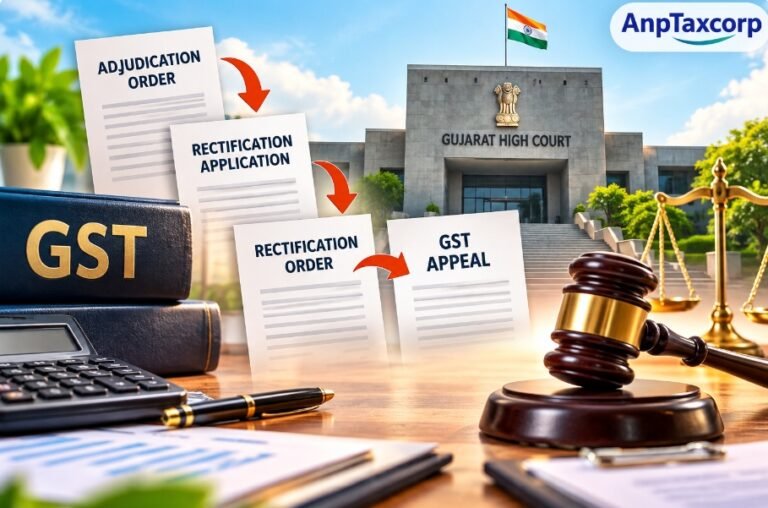
The Gujarat High Court has delivered an important ruling on GST appeal limitation and rectification proceedings, holding that a taxpayer’s appeal cannot be treated as time-barred merely by calculating the limitation period from the original adjudication order when a valid rectification application was filed within the prescribed time and was subsequently decided by the adjudicating authority.
The decision provides significant relief to taxpayers facing disputes concerning Section 161 and Section 107 of the CGST Act, particularly where an adjudication order is followed by a timely rectification application.
Gujarat High Court’s Ruling on GST Appeal Limitation
A Division Bench comprising Justice A.S. Supehia and Justice Vaibhavi D. Nanavati considered whether the Appellate Authority could disregard a rectification proceeding while determining the limitation period for filing a GST appeal.
The Court held that where a taxpayer has filed an application for rectification under Section 161 of the GST Act within the prescribed period, and the adjudicating authority has subsequently considered and decided that application by passing a reasoned order, the rectification proceeding must be taken into account for determining the limitation applicable to the subsequent appeal.
The Court observed that an appeal should not be rejected as time-barred by mechanically computing the limitation period from the original adjudication order in such circumstances.
In other words, where the rectification order gives rise to the subsequent appellate challenge, the Appellate Authority must consider the date of the rectification order while examining limitation.
Background of the Case
The ruling arose from a batch of petitions led by Kanan International Pvt. Ltd. & Anr.
In the lead matter, the petitioners had initially submitted a refund claim which was rejected by the authorities on 16 December 2019. The petitioners challenged the rejection before the Appellate Authority.
On 8 October 2020, the Appellate Authority allowed the appeal after finding that the refund claim had been rejected without providing the petitioners an adequate opportunity of hearing. The matter was consequently remanded for fresh consideration.
Following the remand, the adjudicating authority again rejected the petitioners’ refund claim on 3 October 2022.
The petitioners thereafter exercised their statutory right to seek rectification. They filed an application under Section 161 of the CGST Act on 2 January 2023, which was within the prescribed 90-day period.
The rectification application was ultimately rejected by the adjudicating authority on 14 September 2023.
The petitioners then filed an appeal on 11 January 2024, challenging the orders concerning the refund claim and rectification.
Why the Appeal Was Initially Rejected
The Appellate Authority rejected the appeal on the ground that it was filed beyond the prescribed limitation period.
While calculating limitation, the authority considered 3 October 2022, the date of the original adjudication order, as the relevant starting point. The subsequent rectification proceedings were not given the effect claimed by the petitioners.
The petitioners argued before the High Court that this approach was legally incorrect.
According to them, their rectification application had been filed within the statutory period and had been duly considered and decided by the adjudicating authority. Therefore, the limitation for challenging the rectification order should be considered with reference to 14 September 2023, the date on which the rectification application was rejected.
High Court’s Interpretation of Section 161 and Section 107
The Gujarat High Court accepted the substance of the petitioners’ contention.
The Court emphasized that the rectification proceeding could not simply be ignored when determining whether the subsequent GST appeal was filed within time.
Where a rectification application is:
- filed within the prescribed statutory period;
- entertained and considered by the adjudicating authority; and
- decided through a reasoned order,
the Appellate Authority must take that proceeding into consideration while determining limitation under Section 107 of the GST Act.
The Court therefore held that the appeal could not be rejected solely by computing limitation from the original adjudication order in such circumstances.
Important Clarification by the Court
The judgment does not establish that filing a rectification application automatically gives a taxpayer an unlimited or fresh period for filing an appeal.
The High Court specifically clarified that an appeal can still be rejected as time-barred if it remains beyond the permissible period even when limitation is calculated from the relevant rectification order.
Therefore, taxpayers cannot treat Section 161 proceedings as a mechanism for indefinitely extending the statutory limitation period.
The key principle is that a valid and timely rectification proceeding, once duly considered and decided by the adjudicating authority, must be factored into the limitation analysis.
High Court Sets Aside Rejection and Orders Fresh Consideration
Applying this principle, the Gujarat High Court quashed and set aside the orders of the Appellate Authority which had rejected the appeals as time-barred.
The matters were remanded to the Appellate Authority for fresh consideration on merits. The Court also directed the authority to provide the petitioners an opportunity of hearing and complete the proceedings within 12 weeks from receipt of the judgment.
Key Takeaway for GST Taxpayers
The judgment is significant for taxpayers dealing with GST refund disputes, adjudication orders, rectification applications and appellate proceedings.
A taxpayer who has filed a rectification application within the prescribed period should carefully examine the impact of the subsequent rectification order on the limitation period for an appeal.
The decision also highlights the importance of maintaining proper records of the original order, rectification application, date of filing, rectification order and subsequent appeal.
The ruling reinforces the principle that GST limitation provisions must be applied by considering the actual statutory proceedings undertaken by the taxpayer and the adjudicating authority, rather than by mechanically relying upon the date of the original order.
Case Details
Case Title: Kanan International Pvt. Ltd. & Anr. v. Union of India & Ors.
Case Number: R/Special Civil Application Nos. 1116, 1117, 1119, 1128, 1129, 1147, 1148 and 1169 of 2025
Court: Gujarat High Court
Key Provisions: Section 107 and Section 161 of the CGST Act
For Petitioners: Uchit N. Sheth
For Respondents: Deepak N. Khanchandani; Parth Patel, AGP; Utkarsh R. Sharma