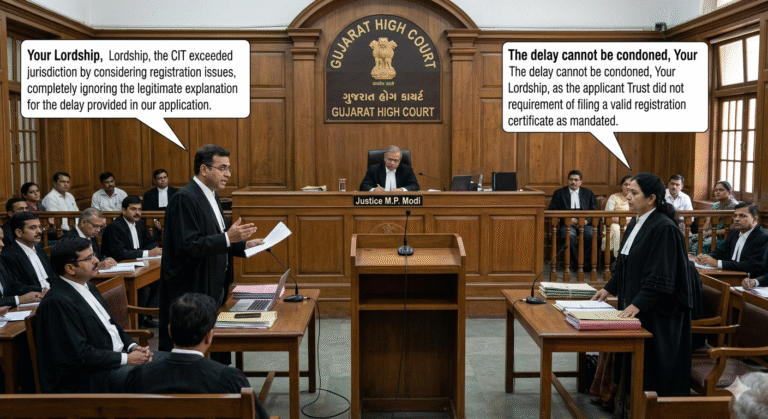
In a major relief for taxpayers, the Gujarat High Court has ruled that the Commissioner of Income Tax (CIT) cannot reject an application for condonation of delay by citing reasons that are completely outside the scope of that specific application.
The Core Issue
The Brahmchari Wadi Trust filed a plea to condone a delay in their filings. However, the CIT (Exemption) rejected the request. Instead of focusing on whether the Trust had a “sufficient cause” for being late, the CIT rejected the plea because the Trust allegedly failed to produce a valid registration certificate.
The Court’s Ruling
The High Court, led by the bench of Justice Mauna Bhatt, found this approach legally flawed. The court emphasized several key points:
- Limited Scope of Inquiry: When an authority is asked to condone a delay, their only job is to examine the reasons for the delay. They cannot use that moment to judge the merits of the entire case.
- Procedural Fairness: Issues regarding registration certificates are part of the assessment process. These should be addressed during the actual hearing of the case, not used as a gatekeeping tactic to prevent the case from being heard at all.
- Legal Unsustainability: The Court declared the CIT’s order “legally unsustainable” because it ignored the actual explanation provided by the Trust for its lateness.
What Happens Next?
The High Court has quashed the CIT’s original rejection. The matter has been sent back to the authority with a directive to:
- Re-examine only the specific reasons for the delay.
- Pass a fresh, reasoned order within six weeks.
The Takeaway
This judgment reinforces that administrative bodies must stick to the matter at hand. For taxpayers and trusts, it’s a reminder that procedural delays should be judged on their own merit, ensuring that “technicalities” don’t unfairly block the path to justice.