In a significant ruling dated March 28, 2026, the Gujarat High Court reinforced a crucial principle of quasi-judicial functioning under GST law: an appeal cannot be dismissed solely due to the absence of the appellant during personal hearing. The judgment serves as an important reminder that procedural lapses cannot override the statutory obligation to adjudicate disputes on merits.
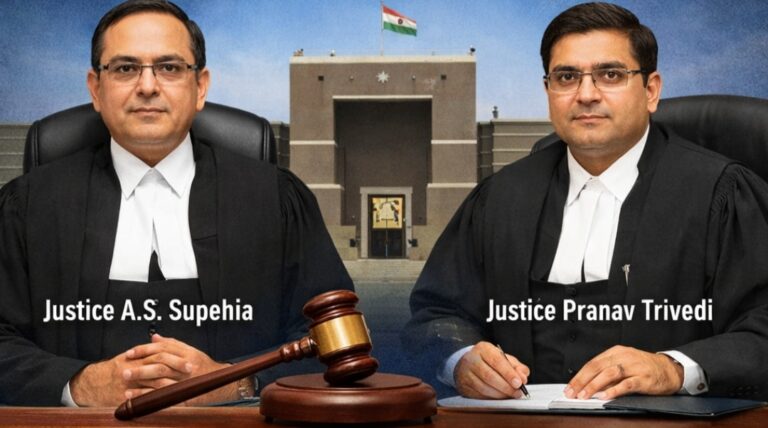
The Division Bench comprising Justice A.S. Supehia and Justice Pranav Trivedi delivered this ruling in the case involving SFC Global Commodity Private Limited. The Court categorically held that appellate authorities must independently evaluate the merits of the case, even if the appellant fails to appear during the course of proceedings.
Background of the Case
The petitioner, SFC Global Commodity Private Limited, had challenged an appellate order dated September 24, 2025. The said order dismissed the appeal purely on the ground of non-appearance during the scheduled personal hearing. Importantly, the appellate authority did not examine the grounds raised in the appeal memo or the supporting submissions placed on record.
Aggrieved by this summary dismissal, the petitioner approached the High Court, contending that such an order was legally unsustainable and contrary to the provisions of the GST law.
Key Legal Findings
1. Duty to Consider Merits
The High Court emphasized that appellate authorities perform quasi-judicial functions and are therefore bound to apply their mind to the material available on record. The mere absence of the appellant does not absolve the authority from its statutory duty.
The Court observed that even in cases of non-appearance, the authority must:
- Examine the appeal memo,
- Consider the grounds of challenge, and
- Pass a reasoned and speaking order.
Failure to do so renders the order legally defective.
2. Illegality of Procedural Dismissal
The Bench held that dismissing an appeal solely for default—without examining its merits—constitutes a “clear illegality.” Such action violates the foundational principles of natural justice, particularly the doctrine that justice must not only be done but must also appear to have been done.
The Court clarified that procedural compliance, such as attending hearings, cannot be elevated above substantive justice. A mechanical dismissal undermines the fairness embedded in the adjudicatory process.
3. Mandate under Section 107 of the CGST Act
Interpreting Section 107 of the CGST Act, the Court reiterated that the appellate authority is statutorily required to adjudicate the appeal on merits. The provision does not contemplate dismissal for non-prosecution in a manner akin to civil procedure.
Thus, the authority cannot bypass its obligation by merely citing the absence of the appellant during the hearing.
Court’s Decision and Directions
In light of the above findings, the High Court quashed the impugned appellate order. The matter was remanded back to the Appellate Authority with specific directions:
- To provide the petitioner with a proper opportunity of hearing,
- To examine the case on merits, and
- To pass a reasoned order in accordance with law.
The Court further directed that the entire exercise be completed within a period of 12 weeks from the date of receipt of the order.
Practical Implications
This ruling has far-reaching implications for GST litigation and appellate practice:
- Protection against arbitrary dismissals: Taxpayers cannot be deprived of their right to appeal merely due to absence at a hearing.
- Increased accountability: Appellate authorities must ensure that orders are reasoned and merit-based.
- Reinforcement of natural justice: The judgment strengthens procedural fairness within GST adjudication.
Conclusion
The decision of the Gujarat High Court underscores a vital legal principle: justice cannot be sacrificed at the altar of procedural technicalities. By mandating that appeals must be decided on merits, even in the absence of the appellant, the Court has ensured that the integrity of the appellate mechanism under GST remains intact.
For taxpayers and professionals alike, this ruling serves as a strong precedent to challenge summary dismissals and uphold the right to fair adjudication.