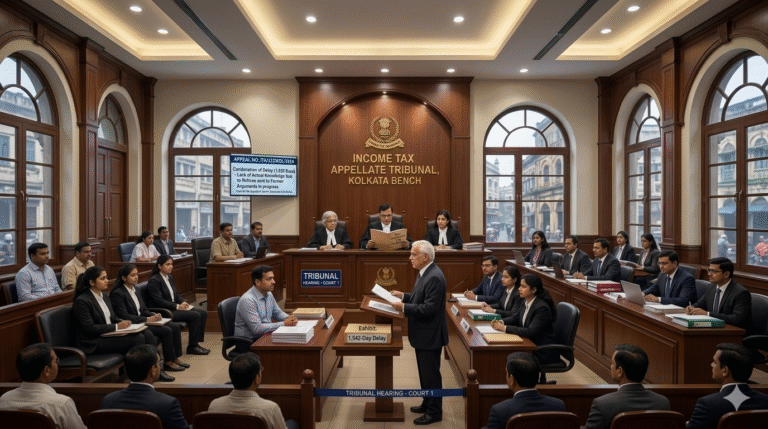
In a significant ruling reinforcing the principles of natural justice and fair hearing, the Kolkata Bench of the Income Tax Appellate Tribunal (ITAT) has condoned an extraordinary delay of 1,542 days in filing an appeal after finding that the taxpayer had not received the income tax communications because they were sent to a former authorised representative.
The Tribunal observed that procedural delays should not defeat substantive justice where the assessee establishes a genuine and sufficient cause for not acting within the prescribed limitation period.
Background of the Case
The case involved Angkur Moulik v. ITO, Ward-1(1), Siliguri (ITA No. 3124/KOL/2025).
The taxpayer, Angkur Moulik, had filed his Income Tax Return for Assessment Year (AY) 2019–20, declaring total income of Rs. 17.67 lakh.
However, during processing under Section 143(1)(a) of the Income Tax Act, the Centralized Processing Centre (CPC) made an adjustment amounting to Rs. 63.22 lakh, substantially increasing the assessed income to Rs. 82.10 lakh.
Subsequently, an appeal was filed before the Commissioner of Income Tax (Appeals) [CIT(A)]. However, the appeal suffered from a delay of 1,542 days, leading the appellate authority to reject the condonation request.
Taxpayer’s Explanation for the Delay
The assessee argued that he became aware of the tax demand only in April 2025.
According to his submissions, all communications from the CPC, including the intimation under Section 143(1)(a), had been sent to the email address and mobile number of his former tax consultant, who allegedly failed to forward those communications to him.
To support this contention, the taxpayer submitted an affidavit before the Tribunal stating that the registered contact details in the income tax records were not under his active control and that he had no actual knowledge of the proceedings.
CIT(A) Rejected Delay Condonation
The Commissioner (Appeals) refused to condone the delay.
The appellate authority relied on departmental records indicating that the communications had been properly dispatched through email, SMS, and postal channels, and therefore concluded that adequate service had been effected.
As a result, the appeal was dismissed without examining the merits of the case.
ITAT Kolkata’s Observations
The matter eventually reached the ITAT Kolkata Bench comprising Judicial Member George Mathan and Accountant Member Rakesh Mishra.
After examining the affidavit and the surrounding circumstances, the Tribunal took a more liberal and justice-oriented approach.
The Bench recognised that where a taxpayer demonstrates that notices were effectively inaccessible due to communication being routed through a former authorised representative, strict application of limitation rules may result in denial of a fair opportunity.
The Tribunal observed:
“After considering the details as mentioned in the affidavit and in the peculiar circumstances of the case, we deem it appropriate in the interest of justice and fair play to set aside the order of the Ld. CIT(A) and restore the appeal…”
Accordingly, the ITAT set aside the order of the CIT(A), condoned the delay, and restored the matter for fresh adjudication on merits.
The Tribunal further directed the appellate authority to provide a reasonable opportunity of hearing and consider Rule 46A wherever applicable.
Key Takeaway
This ruling highlights an important principle in tax litigation: procedural lapses should not override the right to substantive justice where genuine reasons are established.
Taxpayers should nevertheless ensure that their email IDs, mobile numbers, and authorised representative details are regularly updated on the Income Tax portal to avoid missing statutory communications.
The appeal was partly allowed for statistical purposes.
Counsel for Appellant: Siddarth Agarwal, Advocate
Counsel for Revenue: Santanu Ghosh, Senior Departmental Representative
Follow the Link below to watch the video: