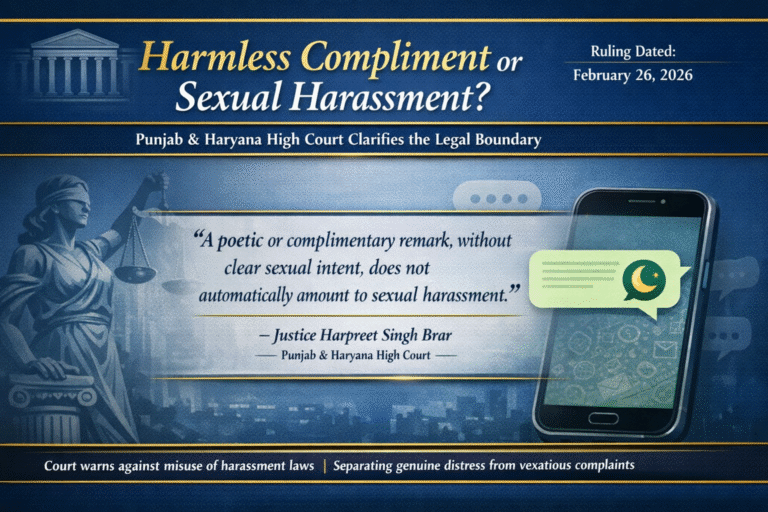
In a significant ruling dated February 26, 2026, the Punjab and Haryana High Court addressed an important question: Can a poetic compliment posted in a WhatsApp group amount to sexual harassment?
The case involved a man who commented on a woman’s photograph in a WhatsApp group, stating:
“Jaane kitne dinon ke baad society me abb chand nikla”
(Loosely translated: “After how many days has the moon finally appeared in our society?”)
The prosecution alleged sexual harassment. However, the High Court drew a clear legal distinction between a potentially unwelcome compliment and conduct that legally qualifies as sexual harassment.
The Court’s Key Findings
1️⃣ Not Every Compliment is Sexual Harassment
The Court held that a poetic or complimentary remark, by itself, does not automatically constitute sexual harassment under Indian law. While such a comment may be inappropriate or unwelcome, criminal liability requires more than mere expression.
2️⃣ Sexual Intent Must Be Clearly Established
The Court emphasized that a “concrete inference” of sexual intent cannot be drawn solely from a metaphorical or poetic statement about someone’s appearance.
This reasoning aligns with a recent decision of the Bombay High Court, which had ruled that singing “Yeh Reshmi Zulfein” in a workplace setting did not amount to sexual harassment in the absence of clear sexual intent.
The judiciary reiterated that context, intention, and surrounding circumstances are crucial in determining whether an offence is made out.
3️⃣ Protection Against Misuse of Harassment Laws
Justice Harpreet Singh Brar cautioned against the increasing trend of filing false, trivial, or exaggerated complaints.
The Court observed that:
- Baseless prosecutions impose serious psychological and reputational harm on the accused.
- Legal provisions meant to protect victims should not be misused for “nefarious designs” such as coercion or extortion.
- Courts must ensure that genuine cases are not diluted by vexatious litigation.
4️⃣ “Separate the Chaff from the Grain”
In a strong judicial observation, Justice Brar stated that while genuine harassment causes “great distress and humiliation,” courts must carefully “separate the chaff from the grain.”
This reflects a balanced judicial approach—protecting victims of real harassment while preventing the criminal justice system from being misused.
Legal Significance of the Ruling
This judgment reinforces several important legal principles:
- ✔️ Sexual harassment requires clear elements of intent and conduct.
- ✔️ Mere poetic admiration does not automatically become a criminal offence.
- ✔️ Context matters.
- ✔️ Courts must guard against both harassment and false implication.
The ruling strengthens the principle that criminal law should not be invoked lightly, particularly in matters involving personal expression unless statutory ingredients are clearly satisfied.
Conclusion
The February 26, 2026 ruling by the Punjab and Haryana High Court serves as a reminder that while dignity and safety must be protected, the law also demands careful scrutiny before branding conduct as criminal.
By clarifying the thin line between a compliment and harassment, the Court has reaffirmed the need for judicial balance—ensuring justice for genuine victims while protecting individuals from unwarranted prosecution.