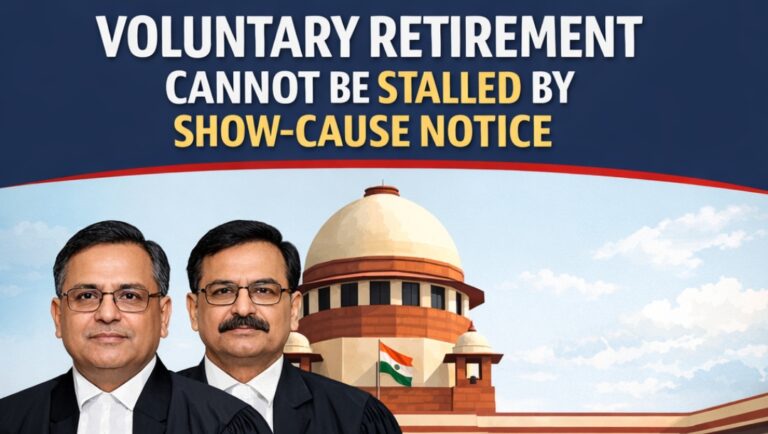
In a significant ruling reinforcing employee rights, the Supreme Court of India has held that an employer cannot block an employee’s voluntary retirement simply by issuing a show-cause notice, without initiating formal disciplinary proceedings within the prescribed notice period. The judgment, delivered by a bench comprising Justice J.K. Maheshwari and Justice Vijay Bishnoi, provides much-needed clarity on the interplay between voluntary retirement schemes (VRS) and pending employer actions.
Background of the Case
The case, titled UCO Bank & Ors. vs. S.K. Shrivastava, arose from a dispute between UCO Bank and one of its employees regarding the validity of voluntary retirement and subsequent disciplinary action.
The respondent employee had submitted a notice for voluntary retirement on October 4, 2010, under the UCO Bank (Employees’) Pension Regulations, 1995. As per these regulations, a three-month notice period was mandatory, meaning the retirement was set to take effect on January 4, 2011, unless refused by the competent authority within that period.
However, during the notice period, the bank issued a show-cause notice in November 2010, seeking clarification on certain transactions. Notably, no formal disciplinary proceedings were initiated at that stage, nor did the bank pass any order refusing or withholding permission for voluntary retirement within the stipulated time.
Delay and Subsequent Actions by the Bank
Instead of acting within the prescribed three-month window, the bank remained silent on the employee’s VRS application. It was only in June 2011—well after the expiry of the notice period—that the bank attempted to refuse the voluntary retirement request.
Further, in March 2012, the bank escalated the matter by issuing a formal chargesheet and eventually dismissing the employee from service. This sequence of actions led to litigation, with the employee challenging the validity of the disciplinary proceedings.
The Chhattisgarh High Court ruled in favour of the employee, holding that the voluntary retirement had already taken effect before any disciplinary proceedings were formally initiated. Aggrieved by this decision, the bank approached the Supreme Court.
Supreme Court’s Key Observations
Upholding the High Court’s ruling, the Supreme Court made several important observations:
- A show-cause notice alone does not amount to initiation of disciplinary proceedings.
- Unless a formal decision refusing or withholding voluntary retirement is taken within the notice period, the retirement becomes effective automatically.
- The employer must act within the prescribed timeline; failure to do so results in deemed acceptance of the VRS application.
The Court emphasized that the mere existence of a show-cause notice cannot prevent the automatic operation of a voluntary retirement notice. It observed that the bank’s inaction during the crucial three-month period was fatal to its case.
Doctrine of Deemed Approval
A central principle highlighted in this judgment is the concept of “deemed approval.” The Court clarified that if an employer does not explicitly refuse or withhold permission within the notice period, the voluntary retirement takes effect automatically upon expiry of that period.
In this case, since no such refusal was communicated by January 4, 2011, the employee stood validly retired on that date.
Impact on Disciplinary Proceedings
The Court further held that once the voluntary retirement became effective, the employer-employee relationship ceased to exist. Consequently, any disciplinary proceedings initiated thereafter—such as the chargesheet issued in March 2012—were without jurisdiction.
This rendered the dismissal order legally unsustainable and invalid.
Final Verdict
The Supreme Court dismissed the bank’s appeal and affirmed the High Court’s judgment. It directed that the employee be granted all retiral benefits, recognizing that his voluntary retirement had lawfully taken effect.
Significance of the Ruling
This judgment has far-reaching implications for both employers and employees, particularly in the banking and public sector:
- For Employees: It strengthens the enforceability of voluntary retirement rights and protects against arbitrary delays or indirect obstruction by employers.
- For Employers: It underscores the importance of adhering to procedural timelines and taking clear, formal decisions within the prescribed period.
- For Legal Practice: The ruling clarifies that disciplinary intent must be reflected through formal proceedings—not merely preliminary notices.
Conclusion
The Supreme Court’s ruling in UCO Bank vs. S.K. Shrivastava serves as a crucial precedent in employment law. It draws a clear line between preliminary inquiries and formal disciplinary action, ensuring that employees are not unfairly deprived of their right to voluntary retirement.
By emphasizing timely decision-making and procedural fairness, the Court has reinforced the principle that administrative inaction cannot be used as a tool to deny statutory or contractual rights. This decision is likely to guide future disputes involving VRS and disciplinary proceedings across sectors.