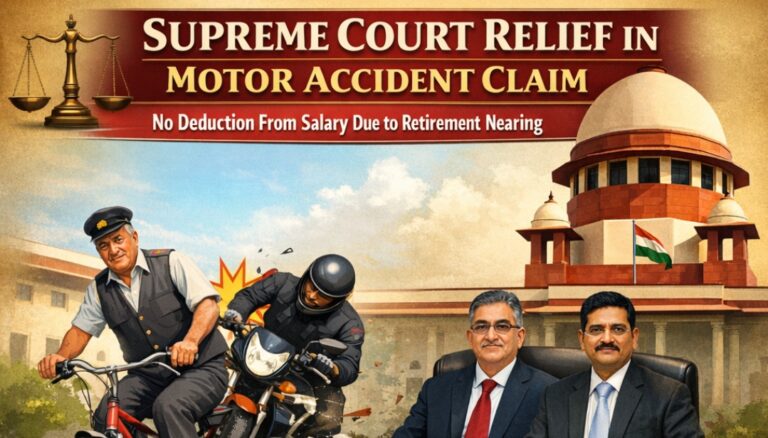
In a significant ruling reinforcing fairness in motor accident compensation cases, the Supreme Court of India has held that no arbitrary deduction can be made from the salary of a deceased person merely because they were nearing retirement. The judgment brings clarity to the method of calculating compensation and strengthens the rights of claimants under motor accident laws.
Background of the Case
The case titled Sushila & Ors. v. Sudhakar & Anr. revolved around a 59-year-old railway employee who tragically lost his life in a road accident in 2013. The deceased was riding his bicycle when he was hit from behind by a rashly driven motorcycle. He succumbed to the injuries sustained in the accident.
Following his death, the deceased’s widow and children approached the Motor Accident Claims Tribunal (MACT), seeking compensation of ₹36,16,264. They stated that the deceased was earning approximately ₹25,507 per month at the time of his death.
MACT and High Court Decisions
The MACT assessed the monthly salary at ₹25,415 but made a controversial deduction of 50%, reasoning that the deceased had only six months of service left before retirement. Additionally, one-third of the remaining income was deducted towards personal expenses. This significantly reduced the net monthly income considered for compensation to ₹8,472.
Based on this calculation, the Tribunal awarded a total compensation of ₹11,37,466.
Dissatisfied, the claimants approached the High Court seeking enhancement. While the High Court increased the compensation under conventional heads such as loss of consortium and estate, it upheld the 50% salary deduction. The revised compensation stood at ₹14,05,942.
Supreme Court’s Intervention
The matter ultimately reached the Supreme Court, where a bench comprising Justice Rajesh Bindal and Justice Vijay Bishnoi re-examined the principles applied by the lower courts.
The apex court strongly disapproved of the 50% deduction made solely on the ground that the deceased was close to retirement. It held that such a deduction is legally unsustainable and arbitrary, as it is unrelated to the accident itself.
The Court emphasized that compensation must be calculated based on established legal principles and not on speculative assumptions about future income loss due to retirement.
Reliance on Established Precedents
The Supreme Court relied heavily on the landmark judgment in Sarla Verma v. Delhi Transport Corporation, which laid down standardized guidelines for computing compensation in motor accident cases.
As per this precedent, the “multiplicand” (i.e., the income considered for compensation) must be based on the annual income of the deceased, derived from their last drawn salary. The Court reiterated that splitting income into pre-retirement and post-retirement periods is not permissible.
Further, the Court referred to National Insurance Co. Ltd. v. Pranay Sethi, which governs the addition of future prospects. Applying this ruling, the Court increased the addition for future prospects from 10% to 15%.
Key Observations by the Court
The Supreme Court made several important observations:
- Any deduction not directly related to the accident is impermissible.
- The fact that the deceased had limited service left does not diminish their earning capacity at the time of death.
- Compensation must be calculated using the last drawn salary on an annual basis.
- Uniformity and consistency in compensation calculations must be maintained.
The Court clearly stated that had the accident not occurred, the deceased would have continued earning his salary until retirement, and therefore, his full income must be considered.
Final Outcome
After correcting the errors made by the MACT and the High Court, the Supreme Court significantly enhanced the compensation to ₹23,51,362. It also removed the separate component that had been awarded for loss of income for six months, since the calculation was now based on annual income.
Legal Significance of the Judgment
This ruling is a crucial development in motor accident compensation jurisprudence. It reinforces that courts must avoid speculative deductions and adhere strictly to settled principles.
By rejecting arbitrary salary reductions due to imminent retirement, the Supreme Court has ensured greater fairness for victims’ families. The judgment also strengthens consistency in compensation awards across cases.
Conclusion
The decision marks an important step toward ensuring justice in motor accident claims. It sends a clear message that compensation must reflect the actual earning capacity of the deceased at the time of death, without being influenced by unrelated factors such as impending retirement.
For claimants and legal practitioners alike, this ruling serves as a valuable precedent in securing fair and just compensation in similar cases.