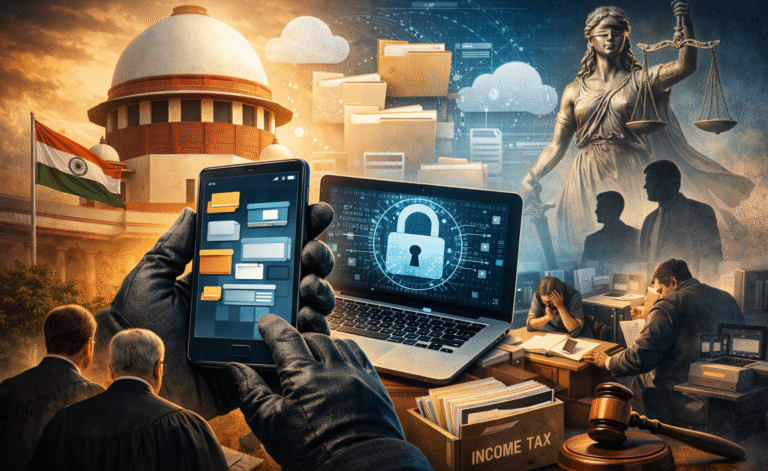
The Supreme Court of India is currently hearing a significant public interest litigation (PIL) that questions the constitutional validity of the Income Tax Department’s powers to conduct search and seizure operations—particularly involving digital devices—without prior notice.
The petition has been filed by entrepreneur Vishwaprasad Alva and raises important concerns about privacy, procedural safeguards, and the scope of state power in the digital age.
What Is Being Challenged?
The plea challenges:
- Section 132 of the Income Tax Act, 1961, which empowers tax authorities to conduct search and seizure operations.
- Section 247 of the Income Tax Act, 2025, a newly enacted provision set to come into force on April 1, 2026, which continues similar powers under the revamped legislation.
According to the petitioner, these provisions enable what he describes as “digital dragnets,” allowing authorities to access and confiscate laptops, smartphones, servers, emails, and cloud-based data—often without prior notice to the person concerned.
Key Legal Issues Raised
1. Alleged Violation of the Right to Privacy
The petition argues that modern search operations go far beyond physical documents. Seizing digital devices may expose:
- Personal emails
- Private messages
- Cloud storage data
- Confidential professional communications
It is contended that such wide access intrudes upon the fundamental right to privacy recognised under Article 21 of the Constitution in the landmark judgment of Justice K.S. Puttaswamy v. Union of India.
The petitioner submits that the 2017 ruling fundamentally changed the constitutional landscape and requires a fresh review of earlier precedents that upheld broad search powers.
2. Revisiting Earlier Precedents
The Income Tax Department’s search powers were previously upheld in Pooran Mal v. Director of Inspection (1974), where the Court validated search and seizure provisions under tax law.
However, the petitioner argues that this decision predates the recognition of privacy as a fundamental right and must now be reconsidered in light of constitutional developments post-Puttaswamy.
3. Lack of Adequate Safeguards
Another major contention is the alleged absence of sufficient checks and balances. The plea claims:
- Authorities are not required to disclose their “reasons to believe” to the assessee.
- Such reasons are not always subject to effective scrutiny before tribunals.
- There is limited transparency in authorising digital searches.
The concern is that the absence of procedural clarity could allow intrusive investigations without adequate accountability.
4. Risks to Third Parties
Senior Advocate Sanjay Hegde, appearing for the petitioner, highlighted the risk of overreach affecting third parties. For example:
- Lawyers communicating with clients
- Accountants and clerks
- Business associates
If they are in contact with a person under investigation, their devices and communications could potentially be swept into the search process, raising concerns about confidentiality and professional privilege.
Court’s Observations So Far
On February 10, 2026, a Bench comprising Chief Justice Surya Kant, Justice Joymalya Bagchi, and Justice N.V. Anjaria made important observations during the hearing.
Concern Over Destruction of Evidence
The Bench noted that requiring prior notice before a search could undermine investigations. Digital evidence can be:
- Easily deleted
- Encrypted
- Remotely wiped
- Physically destroyed
The Court indicated that advance notice might defeat the very purpose of search and seizure provisions.
Existing Safeguards Recognised
The Bench also referred to safeguards laid down in Laljibhai Kanjibhai Mandalia v. Principal Director of Income Tax (2022), where the Court held that search authorisations are subject to limited judicial review.
According to the Court, these powers are not “uncontrolled” and already operate within a legal framework.
Government’s Stand
The Union Government has defended the provisions, clarifying that:
- The Income Tax Act, 2025 does not grant “unlimited powers.”
- Digital searches are conducted only where credible evidence of serious tax evasion exists.
- Routine scrutiny of ordinary citizens is not the objective.
The Government maintains that search powers are essential tools to combat black money and complex tax evasion schemes that increasingly operate through digital channels.
Current Status of the Case
The matter has been adjourned and listed for further hearing later in February 2026. The Court is expected to examine whether additional procedural safeguards are required—particularly for digital data—while balancing:
- The State’s interest in effective tax enforcement
- The individual’s fundamental right to privacy
Why This Case Matters
This case could become a defining moment in India’s digital constitutional jurisprudence. It raises a crucial question:
How should tax enforcement powers evolve in an era where an individual’s entire personal and professional life is stored on digital devices?
The final ruling may reshape the legal boundaries of search and seizure in the digital age and clarify the extent to which privacy protections limit investigative authority.
As the hearing progresses, the outcome will be closely watched by legal professionals, taxpayers, and constitutional scholars alike.