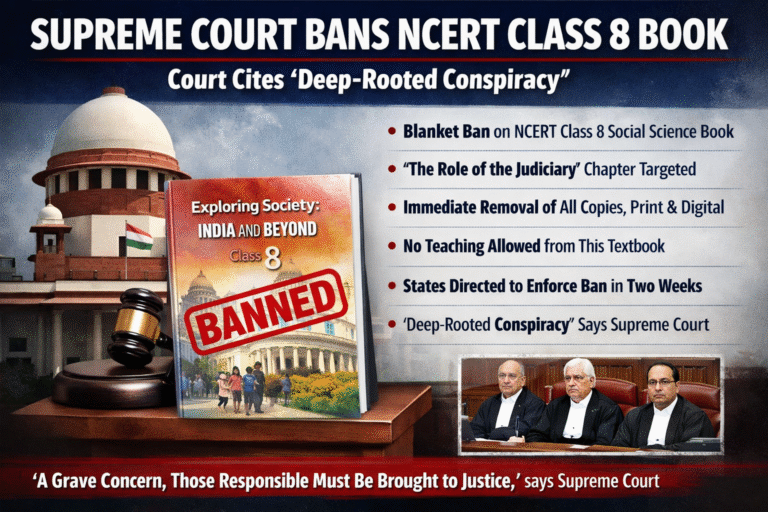
In a significant development on February 26, 2026, the Supreme Court of India ordered a blanket ban on a Class 8 Social Science textbook published by National Council of Educational Research and Training (NCERT). The book, titled Exploring Society: India and Beyond, has come under judicial scrutiny for allegedly containing content relating to “corruption in the judiciary.”
The Court described the matter as one of “grave concern” and went so far as to characterize the inclusion of such content as part of a “deep-rooted conspiracy.” Notices have been issued to the NCERT Director seeking an explanation.
The Book in Question
The affected publication is the Class 8 Social Science textbook, specifically a chapter titled “The Role of the Judiciary in Our Society.” The Court took objection to portions of the chapter that allegedly refer to corruption within the judicial system, expressing concern that such material could undermine public confidence in the institution of the judiciary.
Key Directions Issued by the Court
The Supreme Court passed a series of strict and immediate directions:
- Blanket Ban: Complete prohibition on reprinting and distribution of the physical textbook.
- Digital Removal: Immediate takedown of all digital versions of the book.
- No Classroom Instruction: Schools are barred from imparting any instruction based on the contents of the book.
- State Compliance: Principal Secretaries of all States have been directed to ensure compliance within two weeks.
The Bench emphasized that accountability must follow, observing that those responsible for the inclusion of the contentious material “must be brought to justice.”
Court’s Observations
The Court strongly remarked that the issue goes beyond academic debate and touches upon the credibility of constitutional institutions. It observed that presenting allegations of judicial corruption in a school-level curriculum could potentially erode respect for the judiciary among young students.
The Bench treated the matter with seriousness, terming it a “deep-rooted conspiracy,” and signaled that further action may follow after examining responses from NCERT officials.
Why This Matters
This ruling raises broader questions about:
- The limits of academic freedom in school curricula
- Judicial oversight over educational content
- Balancing critical discourse with institutional integrity
The decision is likely to spark nationwide debate among educators, policymakers, legal experts, and civil society regarding the appropriate framework for discussing sensitive institutional issues in school textbooks.