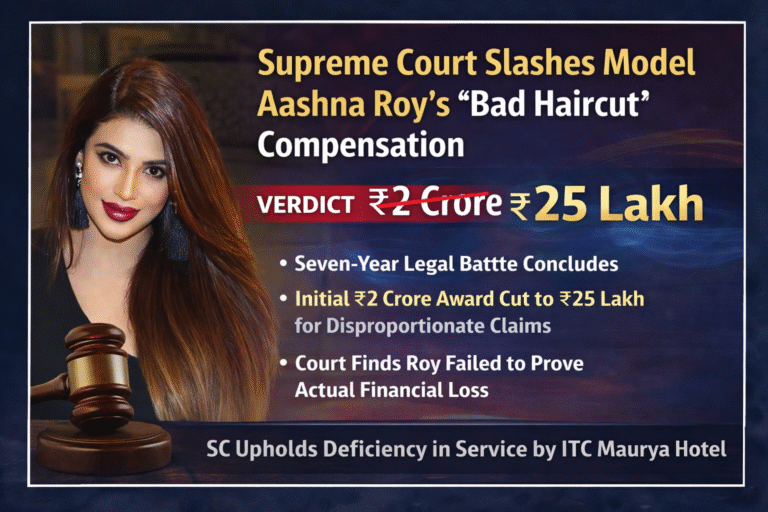
In a significant ruling dated February 6, 2026, the Supreme Court of India brought an end to a seven-year legal dispute between model Aashna Roy and the ITC Maurya hotel in New Delhi.
While the Court upheld the finding of “deficiency in service,” it drastically reduced the compensation from ₹2 crore to ₹25 lakh, holding that the earlier award was excessive and unsupported by reliable evidence.
Background of the Case
The dispute traces back to April 12, 2018, when Aashna Roy visited the salon at ITC Maurya before attending a professional interview.
She alleged that the stylist cut her hair much shorter than instructed, which allegedly caused emotional trauma and resulted in the loss of modeling assignments and professional contracts.
Roy approached consumer forums seeking substantial compensation, claiming reputational and financial damage due to the haircut.
Proceedings Before Consumer Forums
The National Consumer Disputes Redressal Commission (NCDRC) had twice awarded Roy ₹2 crore in compensation, accepting her argument that the haircut adversely affected her professional prospects.
ITC challenged the order before the Supreme Court.
Supreme Court’s Observations
A bench comprising Justices Rajesh Bindal and Manmohan carefully examined the evidence placed on record and made the following key observations:
1. Compensation Was “Extremely Excessive”
The Court held that ₹2 crore was disproportionate to the actual loss proved and could not be sustained.
2. Lack of Credible Evidence
The Court found that Roy failed to produce authentic and reliable documentary proof of actual financial loss.
Most of the documents submitted were:
- Unauthenticated photocopies
- Job offers predating the incident
- Documents lacking a clear causal link between the haircut and the alleged loss
The Court emphasized that massive compensation claims must be backed by trustworthy evidence, not presumptions.
3. Final Compensation Fixed at ₹25 Lakh
The Supreme Court restricted the compensation to ₹25 lakh — an amount already deposited by ITC during earlier proceedings — and directed that it be released to Roy.
Important Legal Principle Reinforced
The judgment reiterates a crucial consumer law principle:
While consumer forums follow flexible procedures, large damage claims must be supported by clear, reliable, and credible evidence. Compensation cannot be granted based on assumptions or speculative losses.
At the same time, the Court did not overturn the finding that there was a deficiency in service on the part of the hotel’s salon.
Why This Judgment Matters
This ruling is significant for multiple reasons:
- It balances consumer rights with evidentiary standards.
- It sends a message that exaggerated compensation claims will face strict judicial scrutiny.
- It reinforces the importance of documentary proof in claims involving professional or reputational losses.
Conclusion
The Aashna Roy vs ITC Maurya case serves as a reminder that consumer protection laws offer strong remedies — but they are not a substitute for credible proof of loss.
While the Supreme Court recognized the deficiency in service, it firmly drew the line against disproportionate damages unsupported by evidence.
After seven years of litigation, the case closes with a sharply reduced award of ₹25 lakh — marking a defining precedent in consumer compensation jurisprudence.