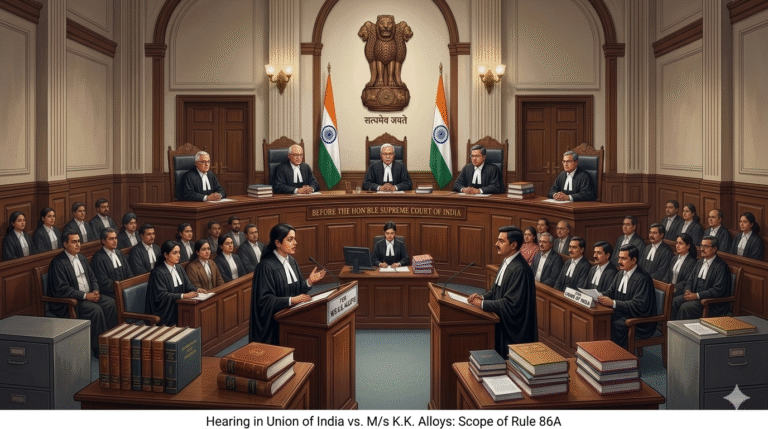
In a significant ruling safeguarding taxpayers’ rights under the Goods and Services Tax (GST) regime, the Supreme Court has affirmed that GST authorities cannot block Input Tax Credit (ITC) beyond the amount actually available in a taxpayer’s Electronic Credit Ledger (ECL) under Rule 86A of the Central Goods and Services Tax (CGST) Rules, 2017.
The decision came in the case of Union of India & Others vs. M/s K.K. Alloys (Diary No. 33451/2026), where the Revenue challenged the judgment of the Punjab and Haryana High Court.
Background of the Dispute
The controversy arose over the interpretation and extent of powers granted under Rule 86A of the CGST Rules. Rule 86A authorises GST authorities to temporarily restrict the utilisation of Input Tax Credit where the Commissioner has reasons to believe that such credit has been fraudulently availed or is otherwise ineligible.
In the present case, the tax authorities blocked an amount of ITC that exceeded the balance actually available in the taxpayer’s Electronic Credit Ledger at the time of passing the order. This administrative practice is commonly referred to as “negative blocking.”
Under negative blocking, authorities effectively create a notional negative balance in the Electronic Credit Ledger, thereby restricting not only existing ITC but also future credits that may accrue to the taxpayer.
The taxpayers challenged this action before the Punjab and Haryana High Court.
Findings of the High Court
The Punjab and Haryana High Court ruled in favour of the taxpayers and clarified the scope of Rule 86A.
The Court observed that Rule 86A is essentially a preventive provision and permits authorities only to temporarily block the utilisation of ITC that is actually available in the Electronic Credit Ledger at the relevant time.
The Court categorically held that the Rule does not authorise authorities to:
- Block ITC beyond the available credit balance;
- Create a negative balance in the Electronic Credit Ledger; or
- Restrict utilisation of future credits that are yet to accrue.
The High Court further noted that although Rule 86A does not require issuance of prior notice because of its preventive character, any attempt to recover allegedly inadmissible ITC must follow the statutory adjudication and recovery mechanism prescribed under Sections 73 and 74 of the CGST/PGST Acts.
Therefore, authorities cannot use Rule 86A as a substitute for recovery proceedings.
Supreme Court Decision
Aggrieved by the High Court’s interpretation, the Revenue approached the Supreme Court by filing Special Leave Petitions.
After condoning the delay, the Supreme Court declined to interfere with the High Court’s decision and dismissed the petitions. The Court held that no ground for interference under Article 136 of the Constitution had been made out.
Importantly, while dismissing the petitions, the Supreme Court clarified that the Revenue remains free to pursue any other remedies available under law for recovery of tax dues or reversal of ineligible credit.
Key Takeaway
With the dismissal of the Revenue’s petitions, the legal position now stands reinforced that Rule 86A is a temporary and preventive provision and not a recovery mechanism.
GST authorities may block only the ITC actually available in the Electronic Credit Ledger when there exists a legally sustainable “reason to believe” that such credit has been fraudulently obtained or wrongly availed.
However, they cannot generate a negative balance or freeze future credits that may arise later.
Where the department seeks recovery of wrongly availed or fraudulent ITC exceeding the available balance, it must proceed through the statutory adjudication and recovery provisions under Sections 73, 74, or Section 74A wherever applicable, and recover the amount strictly in accordance with law.
This ruling provides important protection to taxpayers against excessive use of Rule 86A while preserving the department’s statutory recovery powers.
Follow the Link below to watch the video: