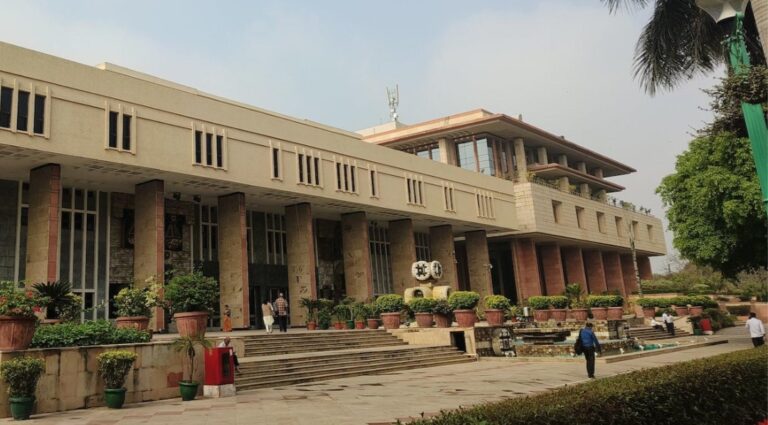
In a landmark judgment delivered in December 2025, a Division Bench of the Delhi High Court comprising Justice C. Hari Shankar and Justice Om Prakash Shukla held that the termination of an HIV-positive employee without complying with the safeguards under the Human Immunodeficiency Virus and Acquired Immune Deficiency Syndrome (Prevention and Control) Act, 2017 is unlawful and unconstitutional.
The ruling is significant not only for members of the armed forces but also for employers across sectors, as it clarifies the interplay between the HIV Act, 2017 and the Rights of Persons with Disabilities Act, 2016 (RPWD Act).
Background Facts of the Case
Appointment in BSF
The petitioner was appointed as a Constable (General Duty) in the Border Security Force (BSF) in April 2017, after successfully clearing the recruitment process.
Medical Diagnosis
In July 2017, shortly after joining service, the petitioner was diagnosed with HIV-1 infection. He was also found to be suffering from abdominal tuberculosis, for which he underwent sustained medical treatment.
Treatment and Recovery
The petitioner continued treatment under medical supervision and was discharged from the hospital in November 2018 after completing the prescribed course of treatment.
Medical Board Assessment
Despite his discharge, a BSF medical board re-examined him in November 2018 and declared him permanently unfit on the ground of an “immune compromised status”.
Discharge from Service
Based on the medical board’s opinion, the BSF issued a show-cause notice and ultimately discharged the petitioner from service on 9 April 2019 on the ground of physical unfitness.
Appeal and Writ Petition
The petitioner’s departmental appeal was rejected in October 2020, following which he approached the Delhi High Court by way of a writ petition challenging the legality of his discharge.
Key Issues Before the Court
- Whether an employee can be terminated solely on the ground of being HIV-positive
- Whether the BSF complied with the safeguards mandated under the HIV Act, 2017
- Whether an HIV-positive person qualifies as a “person with disability” under the RPWD Act, 2016
- Whether the employer is obligated to provide reasonable accommodation
Findings and Rulings of the Delhi High Court
1. Violation of the HIV Act, 2017
The Court examined Section 3(a) of the HIV Act, 2017, which expressly prohibits discrimination and termination of employment solely on the ground of HIV status.
The provision allows termination only if:
- There is a written assessment, and
- Such assessment is made by an independent and qualified healthcare provider, and
- It establishes that the employee is medically unfit to perform duties and poses a significant risk of HIV transmission.
The Court held that:
- The BSF failed to obtain any independent written assessment, and
- The decision was based merely on the medical board’s generalized conclusion regarding immune status.
Accordingly, the discharge was held to be in direct violation of the statutory mandate of the HIV Act.
2. HIV Recognised as a Disability under RPWD Act
In a landmark interpretation, the Division Bench ruled that an HIV-positive individual falls within the definition of “person with disability” under Section 2(s) of the RPWD Act, 2016.
The Court reasoned that:
- HIV is a long-term physical impairment, and
- Its impact on bodily functions squarely meets the statutory threshold under the RPWD Act.
This finding significantly expands the protective umbrella of disability law to include persons living with HIV.
3. Mandatory Reasonable Accommodation
Relying on the RPWD Act, the Court emphasized that an employer cannot dispense with the services of a disabled employee without exploring reasonable accommodation.
The Court directed that:
- The petitioner must be reinstated with continuity of service
- If found medically unfit for his original role, the BSF must:
- Offer an equivalent alternative post, or
- Place him in a supernumerary position
Termination was held to be a measure of last resort, permissible only after exhausting all statutory alternatives.
Final Directions Issued by the Court
- Discharge order set aside
- Reinstatement ordered with continuity of service
- No discrimination permitted on the ground of HIV status
- Reasonable accommodation mandated under law
Significance of the Judgment
This judgment is a milestone in service jurisprudence and disability rights, with far-reaching implications:
- Reinforces statutory protection against HIV-based discrimination
- Confirms that HIV status alone cannot be a ground for termination
- Brings HIV-positive persons within the scope of disability law
- Strengthens the concept of inclusive employment and reasonable accommodation
- Sends a clear message to government bodies and uniformed forces to strictly comply with welfare legislation
Conclusion
The Delhi High Court’s December 2025 ruling marks a decisive step towards dignity, equality, and non-discrimination for persons living with HIV. By harmoniously interpreting the HIV Act, 2017 and the RPWD Act, 2016, the Court has ensured that public employers cannot bypass statutory safeguards under the guise of medical unfitness.
The judgment stands as a constitutional affirmation of the right to livelihood and equal opportunity, reinforcing India’s commitment to human rights-based employment practices.