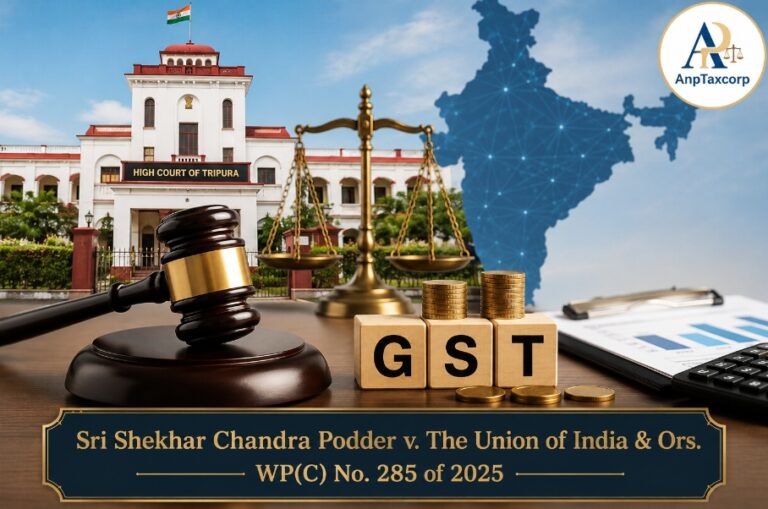
In a significant judgment reinforcing the principle against parallel tax proceedings, the Tripura High Court has ruled that the Central Goods and Services Tax (CGST) authorities cannot reopen or adjudicate issues that have already been examined by the State Goods and Services Tax (SGST) authorities concerning the same subject matter.
The ruling was delivered on June 30, 2026, by a Division Bench comprising Chief Justice M.S. Ramachandra Rao and Justice Biswajit Palit in the case of Sri Shekhar Chandra Podder v. The Union of India & Others (WP(C) No. 285 of 2025).
Background of the Dispute
The case arose from a demand-cum-show cause notice dated 22 July 2024 and an Order-in-Original dated 3 February 2025 issued by the CGST authorities under Section 74 of the Central Goods and Services Tax Act, 2017.
Section 74 empowers tax authorities to recover unpaid or short-paid GST where such non-payment or short payment is alleged to have resulted from fraud, wilful misstatement, or suppression of facts.
The CGST department alleged that the taxpayer had wrongly claimed excess Input Tax Credit (ITC) during the financial years 2018-19 and 2019-20, along with short payment of GST for those years. The proceedings also included certain issues relating to FY 2020-21.
However, the taxpayer challenged the proceedings before the Tripura High Court on the ground that the issues relating to excess ITC for FY 2018-19 and FY 2019-20 had already been investigated and dealt with by the SGST authorities. Therefore, according to the petitioner, the CGST authorities lacked the jurisdiction to initiate fresh adjudication on the very same issues.
High Court’s Findings
After examining the facts and applicable legal principles, the High Court agreed with the taxpayer’s contention. The Court observed that once the SGST authorities had already initiated proceedings and examined a particular subject matter, the CGST authorities could not simultaneously reopen or adjudicate the same issues.
The Bench relied upon the landmark judgment of the Supreme Court in Armour Security (India) Ltd., which laid down that multiple tax administrations should not conduct parallel intelligence-based enforcement proceedings on the same transaction or issue.
Reiterating this principle, the High Court observed that where one GST administration has already exercised jurisdiction over a specific issue, another GST authority should not initiate overlapping proceedings that may result in conflicting decisions or duplicate adjudication.
CGST Lacked Jurisdiction on Previously Examined Issues
The Court specifically held that the CGST authorities had no jurisdiction to investigate or adjudicate the alleged excess claim of Input Tax Credit for the financial years 2018-19 and 2019-20, since those issues had already formed the subject matter of proceedings initiated by the SGST department.
Accordingly, the Court quashed the adjudication order to the extent it dealt with matters already covered by the SGST proceedings.
Proceedings Can Continue for Independent Issues
At the same time, the High Court clarified that its decision would not prevent the CGST authorities from proceeding with issues that were not part of the earlier SGST proceedings.
Therefore, allegations relating to:
- Short payment of GST for FY 2018-19 and FY 2019-20 that were outside the scope of the SGST proceedings; and
- Independent issues concerning FY 2020-21
could continue to be adjudicated by the CGST authorities in accordance with law.
Fresh Adjudication Ordered
While setting aside the impugned Order-in-Original, the High Court directed the adjudicating authority to pass a fresh order after excluding matters already examined by the SGST authorities.
The Court further instructed that the taxpayer must be provided with a reasonable opportunity of personal hearing before any fresh order is passed. The adjudicating authority has been directed to complete the exercise within three months from the date of receipt of the Court’s order.
Significance of the Judgment
This judgment is an important precedent under the GST regime as it reinforces the principle that taxpayers should not face multiple adjudication proceedings by different GST authorities on identical issues. The decision promotes certainty, prevents duplication of enforcement actions, and ensures better coordination between CGST and SGST authorities.
By following the Supreme Court’s ruling in Armour Security (India) Ltd., the Tripura High Court has reaffirmed that parallel investigations on the same subject matter are impermissible, thereby safeguarding taxpayers from unnecessary litigation and repetitive proceedings.
Case Title: Sri Shekhar Chandra Podder v. The Union of India & Ors.
Case Number: WP(C) No. 285 of 2025
For the Petitioner: Mr. Bibhal Nandi Majumder, Senior Advocate
For the Respondents: Mr. Bidyut Majumder, Deputy Solicitor General of India