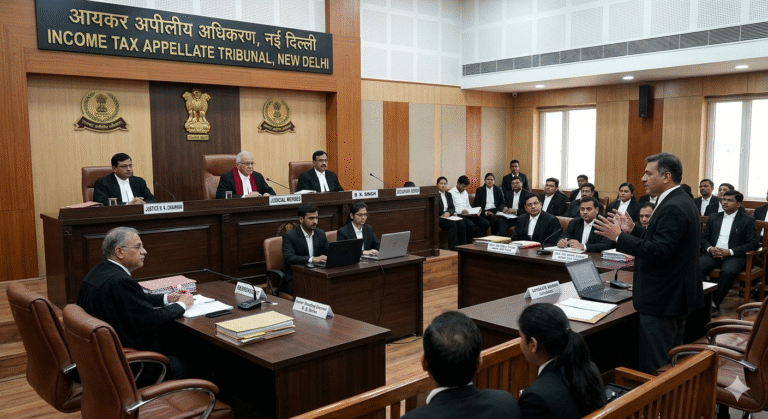
In a significant ruling that clarifies the scope of tax benefits for charitable institutions, the New Delhi Bench of the Income Tax Appellate Tribunal (ITAT) has held that a trust cannot be denied approval under Section 80G of the Income Tax Act merely because it undertakes religious activities—provided such expenditure remains within the statutory cap of 5% of its total income.
This decision in Shri 108 Gupti Sagar Dham Jain Trust v. CIT (Exemption) (ITA No. 7551/Del/2025) provides much-needed clarity for trusts that engage in a mix of charitable and limited religious activities.
Background of the Case
The dispute arose when the Commissioner of Income Tax (Exemptions), Chandigarh, rejected the application of Shri 108 Gupti Sagar Dham Jain Trust for approval under Section 80G(5) of the Income Tax Act. The rejection was primarily based on the observation that the trust was engaged in religious activities.
The Commissioner relied on the trust’s stated objectives, which included the construction of a Jain temple for worship. Additionally, the trust had acknowledged carrying out certain religious activities, which further strengthened the Commissioner’s view that it was not eligible for 80G approval.
However, the trust challenged this decision before the ITAT, arguing that its activities were largely charitable in nature and that any expenditure on religious purposes was well within the permissible statutory limit.
Key Legal Issue
The central issue before the Tribunal was whether a trust engaged in religious activities can be denied approval under Section 80G solely on that basis, without examining the extent of such expenditure.
Trust’s Contentions
The assessee trust submitted that:
- Its activities were primarily aimed at public welfare and charitable purposes.
- The expenditure incurred on religious activities was minimal and within the 5% cap prescribed under Section 80G(5B).
- During the relevant financial year, it spent:
- ₹18,500 on distribution of religious books, and
- ₹3,02,300 on charitable camps.
The trust emphasized that the law permits limited religious expenditure and that its compliance with this threshold should entitle it to approval under Section 80G.
Tribunal’s Observations
The ITAT Bench comprising Judicial Member Raj Kumar Chauhan and Accountant Member Brajesh Kumar Singh carefully examined the provisions of the Income Tax Act, particularly Section 80G(5B).
The Tribunal noted that:
- Section 80G(5B), inserted by the Finance Act, 1999, explicitly allows trusts to incur expenditure of a religious nature, provided it does not exceed 5% of the total income in a previous year.
- If this condition is satisfied, the institution is deemed eligible for benefits under Section 80G.
Importantly, the Tribunal observed that the Commissioner (Exemptions) had failed to assess whether the trust’s religious expenditure actually exceeded the prescribed limit. Instead, the application was rejected solely on the basis of the presence of religious objects in the trust deed.
ITAT Ruling
Setting aside the order of the Commissioner (Exemptions), the ITAT held that:
- Mere engagement in religious activities cannot be a ground for outright rejection of Section 80G approval.
- What is crucial is whether the expenditure on such activities exceeds 5% of the total income.
The Tribunal emphasized that:
“An institution or fund which incurs expenditure of a religious nature not exceeding five per cent of its total income shall be deemed eligible for approval under Section 80G.”
Direction for Fresh Adjudication
Rather than granting approval outright, the ITAT remanded the matter back to the Commissioner (Exemptions) with specific directions:
- To verify whether the trust’s expenditure on religious activities exceeds the 5% threshold.
- To re-evaluate the application in accordance with the provisions of Section 80G and applicable law.
Implications of the Ruling
This ruling carries important implications for charitable trusts and institutions across India:
- Balanced Interpretation: It reinforces that the law allows a blend of charitable and limited religious activities without disqualifying a trust from tax benefits.
- Objective Assessment Required: Authorities must evaluate actual financial data rather than rely solely on the objects clause of the trust.
- Clarity on Section 80G(5B): The judgment highlights the importance of the 5% cap as a decisive factor in determining eligibility.
Conclusion
The ITAT Delhi’s ruling in this case sets a precedent for a more nuanced and fair interpretation of Section 80G provisions. By emphasizing compliance with the 5% cap rather than outright exclusion due to religious elements, the Tribunal has ensured that genuine charitable institutions are not unjustly denied tax benefits.
For trusts seeking 80G approval, this decision underscores the importance of maintaining clear records and ensuring that religious expenditure remains within statutory limits. It also serves as a reminder to tax authorities to adopt a more evidence-based approach while evaluating such applications.
Follow the Link below to watch the video: