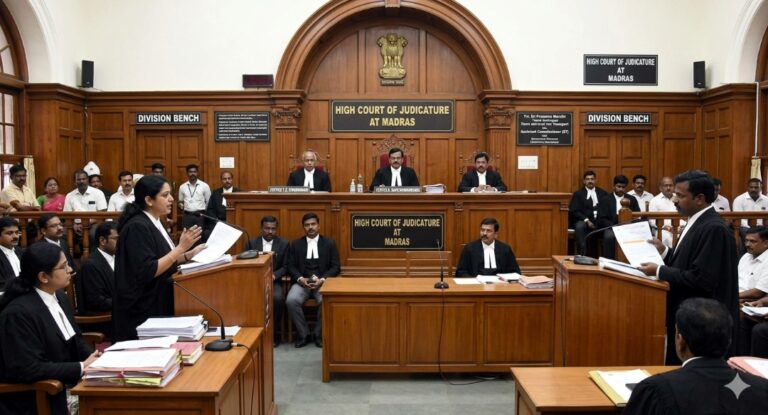
In a significant judgment dealing with GST adjudication and Input Tax Credit (ITC) disputes, the Madras High Court has held that a mere typographical error in a Show Cause Notice (SCN) does not automatically invalidate proceedings if the notice, when read as a whole, clearly communicates the allegations against the taxpayer. At the same time, the Court emphasized that disputes involving denial of ITC must be decided on merits after considering the taxpayer’s evidence and explanations.
The ruling came in Tvl. Sri Prasanna Maruthi Tours and Transport vs. Assistant Commissioner (ST), where the Court balanced procedural compliance with principles of natural justice by directing fresh adjudication subject to certain conditions.
Background of the Case
The petitioner challenged an adjudication order dated 21.01.2026 passed under Section 74A of the Central Goods and Services Tax (CGST) Act. The department alleged that the petitioner had wrongly availed Input Tax Credit on purchases made from M/s. Rabin Traders during May 2024.
Based on these allegations, a demand of ₹7,19,820 towards tax, interest, and penalty was confirmed. The demand originated from a Show Cause Notice issued in Form DRC-01 on 15.07.2025.
The taxpayer, however, argued that the notice itself was defective because it incorrectly mentioned the tax period as FY 2020-21 instead of the relevant period relating to May 2024. According to the petitioner, this error created confusion and prevented an effective response to the notice.
The petitioner also contended that the disputed ITC was duly reflected in GSTR-2A and GSTR-2B and that the supplier had discharged the corresponding GST liability.
Key Arguments Raised by the Taxpayer
The petitioner relied on several grounds to challenge the demand:
- The Show Cause Notice contained a typographical error regarding the relevant tax period.
- The Input Tax Credit was supported by valid tax invoices.
- The ITC appeared in GSTR-2A and GSTR-2B, indicating reporting by the supplier.
- The supplier had allegedly paid the GST due on the transactions.
- An earlier DRC-01 proceeding initiated on the same issue had been dropped.
- The petitioner claimed that departmental officials had orally indicated that the proceedings would not continue.
The taxpayer also relied on judicial precedents supporting the proposition that a bona fide purchaser should not be denied ITC merely because of alleged lapses committed by the supplier.
Department’s Stand
The department defended the validity of the Show Cause Notice and argued that the petitioner was fully aware of the allegations.
According to the department, the annexures attached to the notice contained complete invoice-wise details, including:
- Supplier GSTIN
- Invoice numbers
- Invoice dates
- Tax amounts involved
- Transaction details relating to May 2024
Therefore, despite the incorrect reference to FY 2020-21 in one part of the notice, the taxpayer could not claim ignorance regarding the nature of the allegations.
The department further argued that since no reply had been filed in response to the Show Cause Notice, the adjudicating authority was justified in passing the demand order.
Findings of the Madras High Court
After examining the records, the Madras High Court acknowledged that the Show Cause Notice did contain a typographical error relating to the tax period. However, the Court held that such an error could not be viewed in isolation.
The Court observed that the notice contained detailed invoice-wise particulars clearly identifying the disputed transactions. These details were sufficient to inform the taxpayer about the case that needed to be answered.
As a result, the Court concluded that the petitioner ought to have filed a reply rather than remaining silent.
Importantly, the Court found no procedural irregularity or illegality in the actions of the GST department. The adjudication process itself was not defective.
Nevertheless, the Court also recognized that the dispute involved substantive questions regarding ITC eligibility and the genuineness of transactions. Such issues required examination on merits after considering the taxpayer’s evidence.
Relief Granted by the Court
While refusing to invalidate the proceedings solely on account of the typographical error, the Court granted the taxpayer another opportunity to present its case.
The matter was remanded to the adjudicating authority for fresh adjudication subject to the following conditions:
- The petitioner must deposit 10% of the disputed tax amount.
- A detailed reply to the Show Cause Notice must be filed within 30 days.
- The adjudicating authority must thereafter pass a fresh order after considering the taxpayer’s submissions and supporting documents.
The Court further clarified that if these conditions were not complied with, the writ petition would stand dismissed automatically and the department would be at liberty to recover the outstanding demand.
Important Legal Principles Emerging from the Judgment
1. Typographical Errors Do Not Automatically Invalidate an SCN
The judgment reiterates that minor clerical mistakes in a Show Cause Notice do not render the proceedings void if the notice substantially conveys the allegations and enables the taxpayer to understand the case against him.
2. Substance Prevails Over Technical Defects
Courts are likely to examine the overall contents of the notice rather than focusing on isolated drafting errors. If invoice details and transaction particulars are clearly available, the notice may still be considered valid.
3. Taxpayers Must Respond to Show Cause Notices
The decision highlights that taxpayers should not ignore a Show Cause Notice merely because they believe it contains defects. A detailed reply should be filed to protect their legal rights.
4. ITC Disputes Require Merits-Based Examination
The Court emphasized that denial of Input Tax Credit cannot be sustained merely on allegations against the supplier. Authorities must examine invoices, return filings, GSTR-2A, GSTR-2B records, and other evidence produced by the recipient.
5. Natural Justice Remains Paramount
Even where procedural compliance exists, courts may still order fresh adjudication if substantial rights are involved and the dispute requires a proper examination of facts.
Conclusion
The Madras High Court’s ruling serves as an important reminder that taxpayers must actively participate in GST proceedings and cannot rely solely on technical defects in a Show Cause Notice to challenge demands. At the same time, the judgment reinforces that denial of Input Tax Credit must be based on a reasoned examination of evidence and cannot be sustained without giving the recipient a fair opportunity to establish the genuineness of the transactions.
The decision strikes a balanced approach by upholding the validity of the proceedings while ensuring that the taxpayer receives a meaningful opportunity to contest the ITC denial on merits. For GST professionals, businesses, and litigators, the case provides valuable guidance on handling defective SCNs, ITC disputes, and principles of natural justice in GST adjudication.
Follow the Link below to watch the video: