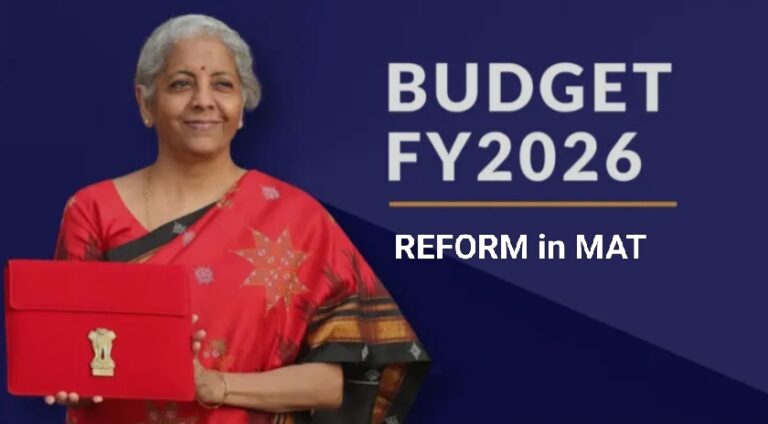
The Union Budget 2026 has introduced a major reform in the way Minimum Alternate Tax (MAT) is treated under India’s corporate taxation framework. In a move aimed at simplifying compliance and ensuring greater tax certainty, the government has proposed to convert MAT into a final, non-creditable tax at a reduced rate of 14%, effective from 1 April 2026 (Assessment Year 2026-27).
This shift marks a significant departure from the earlier MAT structure, where companies could carry forward MAT credit and adjust it against future tax liabilities.
Let’s break down the key changes and what they mean for corporates and foreign investors.
MAT in Budget 2026: A Structural Overhaul
MAT was originally designed to ensure that companies reporting high book profits do not avoid paying taxes through exemptions and deductions. Under the existing system, MAT paid could later be claimed as MAT credit, making it a deferred tax mechanism.
However, Budget 2026 proposes a complete transformation.
Key Income Tax Updates on MAT / AMT (Budget 2026)
1. MAT Becomes a Final Tax from April 1, 2026
One of the most impactful proposals is that MAT will no longer operate as a deferred tax.
What changes?
- MAT will now be treated as a final tax liability
- Companies will not be allowed to accumulate new MAT credit going forward
This means that companies paying MAT after April 2026 cannot carry it forward for future adjustment, making the tax structure more straightforward.
Impact: Corporate taxation becomes simpler, but companies must plan cash flows accordingly since MAT will no longer provide future credit benefits.
2. MAT Rate Reduced from 15% to 14%
To soften the impact of MAT becoming final, the Budget proposes a reduction in MAT rate:
- Earlier MAT rate: 15%
- New MAT rate (from AY 2026-27): 14% of book profits
This reduction provides marginal relief to companies still falling under MAT provisions.
Objective: Encourage companies to transition into concessional tax regimes while reducing tax burden for MAT-paying entities.
3. Existing MAT Credit Can Still Be Used (With Limits)
Although new MAT credit will not arise, the government has provided relief for companies holding accumulated MAT credit up to 31 March 2026.
Key provision:
- MAT credit accumulated before April 2026 will remain valid
- Set-off is allowed only for companies shifting to the new corporate tax regime
Annual cap introduced:
- MAT credit adjustment will be limited to 25% of the annual tax liability
This ensures gradual utilization of old credits without significantly reducing tax collections in a single year.
Example:
If a company’s annual tax liability is ₹100 crore, MAT credit set-off allowed will be capped at ₹25 crore for that year.
4. Exemption for Certain Non-Residents Under Presumptive Taxation
Budget 2026 also proposes an important exemption for foreign taxpayers.
MAT will not apply to:
- Non-residents opting for presumptive taxation schemes
- Businesses such as:
- Cruise ship operators
- Foreign entities providing services or technology for electronics manufacturing under Section 44BBD
This exemption is aimed at improving India’s attractiveness as an investment destination.
Benefit: Enhanced tax certainty and reduced compliance burden for foreign investors.
Why This MAT Reform Matters
The MAT changes proposed in Budget 2026 are aligned with broader tax policy goals:
✅ Simplification of corporate tax compliance
By removing the MAT credit mechanism, taxation becomes more direct and transparent.
✅ Encouraging adoption of the 22% concessional corporate tax regime
The government wants more companies to shift to the simplified lower tax regime.
✅ Providing certainty to foreign investors
Exempting non-residents under presumptive schemes strengthens India’s position as a global manufacturing and services hub.
✅ Reducing litigation and disputes
MAT credit calculations have historically led to interpretational issues and tax litigation. Final MAT may reduce such conflicts.
Conclusion: MAT Moves Towards Simpler Corporate Taxation
The Union Budget 2026 proposal to convert MAT into a final tax at 14% represents a significant corporate tax reform. While companies will no longer accumulate MAT credit, the reduced rate and transitional relief for existing credit balances offer a balanced approach.
With exemptions for certain non-residents and caps on MAT credit utilization, the government aims to promote tax certainty, simplify compliance, and encourage the adoption of concessional tax regimes.