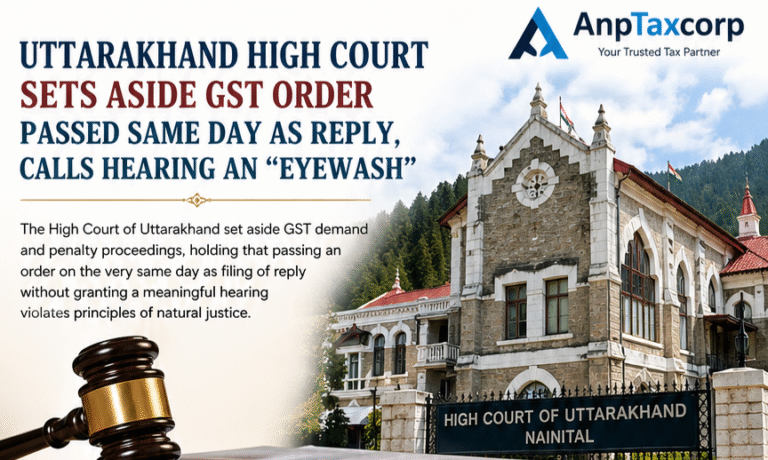
In a significant ruling reinforcing the principles of natural justice under GST law, the Uttarakhand High Court has set aside a demand and penalty order passed without granting a meaningful opportunity of personal hearing. The Court held that merely recording that a hearing took place on the same day as the filing of a reply does not satisfy the statutory requirement, calling such a process an “eyewash.”
Background of the Case
The matter arose from a writ petition filed by M/s Poddar Ispat Pvt. Ltd., challenging an order dated 26 December 2025 issued under Section 74(9) of the Uttarakhand GST Act. The case involved allegations of wrongful availment of Input Tax Credit (ITC) amounting to ₹8.49 crore for the financial year 2023–24.
The petitioner also contested the validity of the show cause notice, Form DRC-01, and subsequent recovery proceedings initiated by the department. A key grievance raised was that despite specifically requesting a personal hearing, the adjudicating authority passed the order on the very same day the reply was submitted, without providing prior notice of any hearing.
Core Issue Before the Court
The primary legal issue revolved around compliance with Section 75(4) of the GST Act, which mandates that an opportunity of personal hearing must be granted where requested by the taxpayer. The question was whether conducting (or merely recording) a hearing on the same day as filing the reply fulfills this requirement.
Observations of the Court
The division bench, comprising Chief Justice Manoj Kumar Gupta and Justice Subhash Upadhyay, took a strict view of procedural fairness. The Court emphasized that a personal hearing must be real, effective, and not a mere procedural formality.
It observed that:
- The show cause notice only required submission of a written reply and did not indicate that the same date would be treated as the date of personal hearing.
- There was no prior intimation given to the petitioner regarding the hearing date.
- Passing the order on the same day as the reply strongly suggested that no meaningful hearing had actually taken place.
The Court categorically held that such a practice violates the principles of natural justice. It further noted that an assessee cannot reasonably be expected to prepare and present oral arguments on the same day as submitting a written reply, especially in complex tax matters.
“Eyewash” Hearing Not Acceptable
In strong terms, the Court described the alleged hearing as an “eyewash.” It clarified that merely mentioning in the order that the taxpayer was heard does not amount to compliance with legal requirements. A valid hearing must involve:
- Prior notice of the date and time,
- Adequate opportunity to prepare,
- A genuine chance to present arguments.
Anything short of this undermines the fairness of the adjudication process.
Revenue’s Argument Rejected
The Revenue authorities argued that the order itself recorded that an opportunity of hearing had been granted and the reply was duly considered. However, they did not dispute that the order was passed on the same day the reply was filed.
The Court rejected this contention, stating that procedural compliance cannot be presumed based on mere recitals in the order. The substance of the opportunity matters more than its form.
Violation of Natural Justice
Reiterating the importance of natural justice, the Court held that Section 75(4) embodies these principles within the GST framework. Denial of a fair hearing renders the entire adjudication process legally unsustainable.
The Court emphasized that:
- The right to be heard is not an empty formality.
- Authorities must ensure transparency and fairness in proceedings.
- Procedural lapses of this nature cannot be cured by post-facto justifications.
Final Ruling
Based on these findings, the Uttarakhand High Court set aside the impugned order dated 26 December 2025. It also quashed the consequential proceedings arising from the defective adjudication.
However, the Court granted liberty to the department to initiate fresh proceedings in accordance with law. It directed the adjudicating authority to:
- Issue proper notice of personal hearing,
- Provide adequate time for preparation,
- Pass a reasoned order after considering the taxpayer’s submissions.
Key Takeaways for Taxpayers and Authorities
This ruling serves as an important reminder for both taxpayers and tax अधिकारियों:
For Tax Authorities:
- Strict adherence to procedural requirements is essential.
- Personal hearings must be meaningful and not symbolic.
- Proper communication of hearing dates is mandatory.
For Taxpayers:
- Always request a personal hearing in contentious matters.
- Challenge orders where procedural fairness is compromised.
- Maintain proper documentation of all communications with authorities.
Conclusion
The Uttarakhand High Court’s decision underscores that justice must not only be done but must also be seen to be done. In the GST regime, where significant financial implications are involved, ensuring a fair and transparent adjudication process is critical.
By striking down an order passed in haste and without genuine hearing, the Court has reinforced taxpayer rights and sent a clear message against procedural shortcuts. This judgment will likely serve as a precedent in similar cases where authorities fail to provide adequate opportunity of hearing under GST law.
Case Title: M/s Poddar Ispat Pvt. Ltd. v. Office of the Deputy Commissioner & Another
Case Number: Writ Petition (M/B) No. 286 of 2026