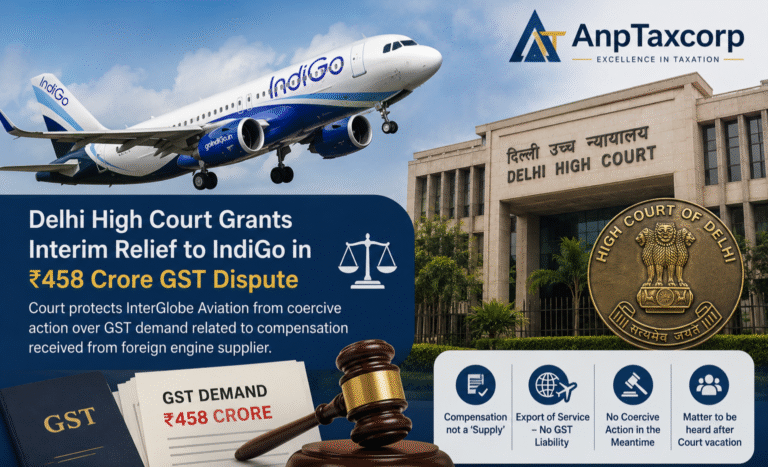
In a significant development for the aviation and tax sectors, the Delhi High Court has granted interim protection to InterGlobe Aviation, the parent company of IndiGo, against coercive action in a high-stakes Goods and Services Tax (GST) dispute involving a demand of approximately ₹458 crore.
Background of the Case
The dispute revolves around whether compensation received by IndiGo from a foreign aircraft engine manufacturer can be classified as a taxable “supply” under GST law. The tax authorities alleged that the airline was liable to pay GST on the amount received, along with an equivalent penalty, under the reverse charge mechanism.
However, IndiGo challenged this position before the High Court, arguing that the amount received was purely compensatory in nature and not consideration for any service rendered.
Court’s Prima Facie Observation
A Division Bench comprising Justices Nitin Wasudeo Sambre and Ajay Digpaul observed that, prima facie, the payment received by IndiGo appeared to be “compensation” rather than consideration for a supply. Based on this observation, the Court granted interim relief by directing that no coercive action be taken against the airline until further proceedings.
This interim protection is crucial, as it shields the company from recovery actions while the legal issue is being examined in detail.
Facts Leading to the Dispute
The issue dates back to the financial years 2018–19 and 2019–20, when certain aircraft engines supplied to IndiGo malfunctioned. Due to safety concerns, the airline was compelled to ground several aircraft, resulting in substantial operational and financial losses.
To address these losses, IndiGo entered into a supplementary agreement with the foreign supplier. Under this arrangement, the supplier issued credit notes amounting to nearly ₹2,000 crore as compensation for loss of flying hours and business disruptions.
Tax Department’s Stand
The GST department took the position that the compensation received by IndiGo amounted to consideration for a service. According to the authorities, by accepting the payment, IndiGo had effectively agreed to “tolerate” the supplier’s failure to meet contractual performance standards.
On this basis, the department invoked GST liability under reverse charge, treating the transaction as a taxable supply of service.
IndiGo’s Legal Arguments
IndiGo strongly contested this interpretation, relying on Section 7 of the CGST Act, which defines “supply.” The airline argued that not every monetary transaction qualifies as a supply unless it meets specific legal criteria.
The airline also placed reliance on a circular issued by the Central Board of Indirect Taxes and Customs (CBIC) dated August 3, 2022. This circular clarifies that for a transaction to qualify as a taxable supply involving “tolerating an act,” there must be a clear agreement—either express or implied—to tolerate such an act in exchange for consideration.
IndiGo emphasized that:
- The compensation was paid due to the supplier’s failure to perform contractual obligations.
- There was no agreement to tolerate the breach.
- The contract was intended for performance, not for breach.
The airline further argued that payments such as liquidated damages or compensation for non-performance are not taxable, as they are meant to indemnify losses rather than serve as consideration for a service.
Alternative Argument: Export of Service
In addition to its primary argument, IndiGo contended that even if the transaction were to be treated as a service, it would qualify as an “export of service” under GST law. Since the supplier was located outside India and payment was received in foreign exchange, such a transaction would be zero-rated, resulting in no GST liability.
Court Proceedings and Interim Relief
During the hearing, the Court sought assurance regarding the protection of revenue interests. IndiGo responded by highlighting its strong financial standing, stating that it is a well-established airline paying over ₹20,000 crore annually in taxes and is not a “fly-by-night operator.”
Taking these submissions into account, the Delhi High Court granted interim protection, directing that no coercive action be taken against the airline until the matter is adjudicated further.
Key Takeaways
This case raises important questions about the taxability of compensation under GST, particularly in complex commercial arrangements involving cross-border transactions. The ruling underscores the distinction between “compensation for loss” and “consideration for service,” which is critical for determining GST liability.
The High Court’s interim relief provides much-needed clarity and reassurance to businesses dealing with similar disputes, especially in sectors where contractual breaches and compensatory payments are common.
What Lies Ahead
The matter is expected to be heard in detail after the Court’s vacation. The final outcome will likely have far-reaching implications for GST jurisprudence, particularly in interpreting the scope of “supply” and the applicability of tax on compensatory payments.
For now, IndiGo has secured temporary relief, but the final verdict will be closely watched by tax professionals, corporates, and policymakers alike.