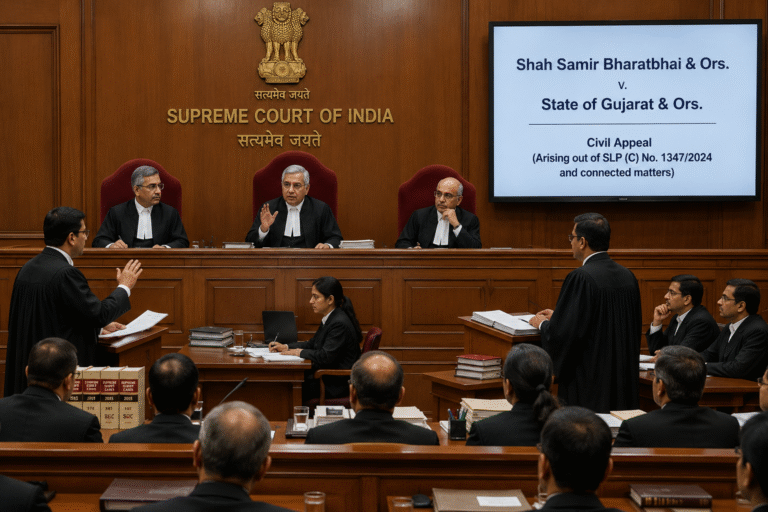
In a significant judgment reinforcing the constitutional principle of “equal pay for equal work,” the Supreme Court of India delivered a major ruling in Shah Samir Bharatbhai & Ors. v. State of Gujarat & Ors. (2025 INSC 1026). The Court held that contractual Assistant Professors serving in Government Engineering and Polytechnic Colleges in Gujarat are entitled to receive at least the minimum pay scale applicable to regular Assistant Professors, along with arrears and interest.
The decision goes beyond a dispute over salary and addresses a broader question: whether educators performing identical duties can be denied fair remuneration merely because of the nature of their appointment.
Background of the Dispute
The controversy originated from the long-standing shortage of faculty members in Government Engineering and Polytechnic Colleges across Gujarat.
To address vacant teaching positions, the State Government made appointments through two methods:
- Ad hoc appointments; and
- Contractual appointments.
Several Assistant Professors appointed on a contractual basis challenged the salary structure, arguing that despite possessing the required qualifications and performing identical academic functions, they were receiving significantly lower fixed remuneration compared to regular and ad hoc faculty.
The contractual faculty approached the Gujarat High Court seeking parity in compensation.
Proceedings Before the Gujarat High Court
The litigation progressed through multiple stages.
Initially, the Single Judge of the Gujarat High Court held that contractual Assistant Professors should receive the minimum of the pay scale applicable to Assistant Professors, together with admissible allowances.
The State challenged this decision before the Division Bench.
In one set of cases, the High Court upheld the benefit granted to contractual faculty. However, in another batch involving similarly situated Assistant Professors, the Division Bench reversed the relief entirely.
This conflicting approach ultimately brought the matter before the Supreme Court.
Key Arguments Raised by the State
The State of Gujarat argued that contractual employees cannot claim parity with regular employees because:
- Their appointments were contractual in nature;
- Terms and remuneration were governed by contract;
- Recruitment procedures differed from regular appointments; and
- Equal salary cannot automatically follow from similar work.
The State also opposed payment of arrears and interest.
Supreme Court’s Analysis
The Supreme Court rejected the State’s arguments and emphasized that the issue was not regularization of service but fair compensation for identical work.
The Court carefully examined the recruitment process and observed that contractual Assistant Professors were selected through a structured and merit-based process involving:
- Public advertisements;
- Eligibility verification;
- Written examinations;
- Interviews; and
- Selection committees constituted under government resolutions.
Importantly, the Court noted that the State failed to establish any functional distinction between contractual Assistant Professors and their regular counterparts.
Both categories:
- Taught the same students;
- Worked in the same institutions;
- Performed the same teaching responsibilities; and
- Undertook similar academic and administrative duties.
Therefore, denying equal minimum pay lacked justification.
Strong Observations on Treatment of Teachers
One of the most striking aspects of the judgment was the Court’s concern regarding the condition of educators.
The Bench observed that teachers form the intellectual foundation of society and their contribution extends beyond classroom instruction to mentoring, research, and nation-building.
The Court remarked that merely praising teachers in public discourse is insufficient if their compensation does not reflect respect for their role.
The judgment highlighted that many contractual Assistant Professors continued receiving approximately ₹30,000 per month for years, despite performing duties comparable to employees receiving substantially higher salaries.
According to figures discussed before the Court:
- Contractual Assistant Professors continued receiving around ₹30,000 per month;
- Ad hoc faculty salaries had increased substantially; and
- Regular Assistant Professors received significantly higher compensation.
The Court expressed concern that such disparity was inconsistent with constitutional principles.
Reliance on the Doctrine of “Equal Pay for Equal Work”
The Supreme Court relied upon earlier precedents including:
- State of Punjab v. Jagjit Singh
- Sabha Shanker Dube v. Divisional Forest Officer
- Shivdas v. Union of India
These decisions recognized that temporary or contractual employees performing identical functions cannot automatically be denied minimum pay scales merely due to the mode of appointment.
The Court clarified that seeking equal pay is different from seeking permanent absorption or regularization.
Final Directions Issued by the Supreme Court
Allowing the appeals in part, the Supreme Court directed that:
- Contractually appointed Assistant Professors shall receive the minimum pay scale admissible to Assistant Professors.
- Arrears shall be paid for three years preceding the filing of the writ petitions.
- Such arrears shall carry interest at the rate of 8%.
However, the Court did not grant full parity with all service benefits available to regular employees.
Conclusion
The ruling in Shah Samir Bharatbhai v. State of Gujarat represents an important development in Indian service jurisprudence. It reinforces that contractual employment cannot become a mechanism for institutionalized pay discrimination when employees perform substantially identical work.
For educational institutions and governments across India, the judgment sends a clear message: contractual arrangements cannot override constitutional principles of fairness, dignity, and equal treatment.
As debates around contractual employment continue to grow, this decision is likely to influence future claims involving teachers and other public sector professionals.
Follow the Link below to watch the video: