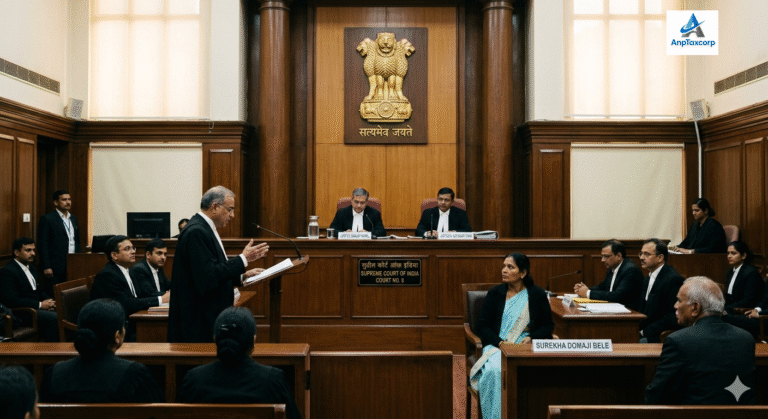
In a significant judgment strengthening employee protection under service jurisprudence, the Supreme Court of India has ruled that dismissal from service should be imposed only in cases involving grave misconduct and only after carefully evaluating all relevant circumstances.
The Court emphasized that dismissal is the most severe disciplinary penalty available to an employer and should not become a routine consequence of every proven misconduct. Authorities must assess factors such as the seriousness of allegations, length of service, employee’s past record, age, financial impact on the employer, and whether a lesser punishment could achieve the objectives of discipline.
The ruling came in Surekha Domaji Bele v. Executive Engineer, Testing Division, Maharashtra State Electricity Distribution Company Limited (MSEDCL) [Diary No. 11294 of 2025], decided on 12 June 2026 and reported as 2026 LiveLaw (SC) 624.
Background of the Case
The appellant, Surekha Domaji Bele, joined Maharashtra State Electricity Distribution Company Limited (MSEDCL) in 1985. In 2006, she was placed under suspension pending disciplinary proceedings.
Subsequently, in 2008, a show-cause notice was issued following a domestic inquiry. According to the employee, the disciplinary proceedings were initiated as retaliation after she pursued legal remedies under the Payment of Wages Act and challenged her transfer from Ballarsha to the Warora pole factory.
The fairness of the domestic inquiry later came under judicial scrutiny.
Initially, the Industrial Court found that the domestic inquiry had not been conducted fairly and remanded the matter to the Labour Court for fresh adjudication. The Labour Court independently examined evidence and ultimately concluded that misconduct had been established.
Based on these findings, MSEDCL dismissed the employee from service in 2017.
However, complications arose because the dismissal was based largely on the earlier 2008 show-cause notice that had originated from the defective inquiry proceedings.
Supreme Court: Dismissal Cannot Be Automatic
A Bench comprising Justice Sanjay Karol and Justice N.K. Singh examined whether dismissal was proportionate to the proven misconduct.
The Court acknowledged that misconduct had indeed been established. However, it observed that the allegations primarily involved:
- Indiscipline
- Insubordination
- Tampering with documents
Importantly, the misconduct did not involve:
- Corruption
- Illegal gratification
- Moral turpitude
- Financial misappropriation
- Proven financial loss to the employer
The Court held that these distinctions matter significantly while determining punishment.
According to the judgment, dismissal is justified where continued employment becomes incompatible with institutional trust, discipline, or functioning. Cases involving corruption, dishonesty, serious financial irregularities, or conduct demonstrating complete unfitness for employment stand on a different footing.
But where such aggravating circumstances are absent, disciplinary authorities must evaluate whether a lesser punishment would sufficiently serve the interests of justice.
Why Dismissal Requires Greater Judicial Caution
The Supreme Court delivered important observations on the consequences of dismissal from service.
The Court stated that dismissal does not merely terminate employment—it permanently severs the employer-employee relationship and often deprives the employee of retirement and service-related benefits.
Beyond financial consequences, dismissal also leaves a lasting stigma on the employee’s professional record.
The Court recognized that such punishment extends beyond the employee and directly affects dependent family members who rely on that income.
For this reason, disciplinary authorities are expected to exercise extreme caution before imposing dismissal and should reserve it for only the most serious cases.
Defective Inquiry and Requirement of Fresh Show-Cause Notice
Another major question before the Court was whether MSEDCL could legally dismiss the employee in 2017 using the earlier show-cause notice issued in 2008.
The Supreme Court answered in the negative.
The Court observed that the original domestic inquiry had already been held defective. Once the Labour Court conducted a fresh adjudication and arrived at independent findings, the disciplinary authority was obligated to reconsider punishment independently.
Merely relying upon an old show-cause notice issued under invalid proceedings was impermissible.
The Court clarified that although the absence of a fresh notice did not invalidate the findings of misconduct themselves—because the employee had participated in subsequent proceedings—the authority was still required to issue a new show-cause notice specifically addressing the proposed punishment.
Therefore, the dismissal order was held unsustainable.
The matter was remitted back to the competent authority for fresh consideration regarding the appropriate penalty other than dismissal.
Suspension Pending Inquiry Cannot Become an Additional Punishment
The Supreme Court also dealt with an important issue concerning suspension.
The employee had remained under suspension for approximately 11 years.
Although the employer initially stated that subsistence allowance would be paid, the suspension period was later treated as punishment, resulting in denial of monetary benefits.
The Court strongly disapproved this approach.
It clarified that suspension pending inquiry is distinct from substantive punishment.
If service rules prescribe separate penalties, authorities cannot combine suspension and dismissal into a double punishment unless expressly permitted under applicable regulations.
Treating the entire suspension period as punishment effectively deprived the employee of service and monetary benefits for over a decade.
The Court held that such action was legally unsustainable.
Supreme Court on Subsistence Allowance During Long Suspension
The Court also examined whether the employee remained entitled to subsistence allowance.
Under the applicable regulations, suspension was required to be reviewed within six months.
However, no proper review of continued suspension beyond that period was demonstrated.
The Court divided the suspension period into two segments:
First Six Months
For the initial six-month period, authorities may examine compliance with reporting requirements and determine entitlement accordingly.
Remaining Suspension Period
For the period after six months until dismissal in July 2017, the Court held that the employee could not be denied subsistence allowance due to the absence of valid review and extension orders.
The Court observed that denying subsistence allowance affects not only livelihood but also the employee’s ability to effectively defend disciplinary proceedings.
Final Directions of the Supreme Court
Allowing the appeal in part, the Supreme Court:
- Set aside the Bombay High Court judgment that upheld dismissal
- Directed MSEDCL to issue a fresh show-cause notice on punishment
- Held that dismissal must be reconsidered independently
- Directed that suspension should not operate as an additional penalty
- Ordered reconsideration of subsistence allowance claims
- Confirmed eligibility for subsistence allowance beyond the initial six-month period
Conclusion
This judgment marks an important development in Indian service law and reinforces the constitutional principle of proportionality in disciplinary proceedings.
The Supreme Court has reiterated that punishment must correspond to the gravity of misconduct and that dismissal should remain an exceptional remedy rather than a default disciplinary response.
The ruling also sends a strong message that prolonged suspension, procedural unfairness, and denial of subsistence benefits cannot be used to indirectly punish employees.
For employers and disciplinary authorities, the decision serves as a reminder that fairness, independent application of mind, and procedural compliance remain essential components of lawful disciplinary action.
Follow the Link below to watch the video: