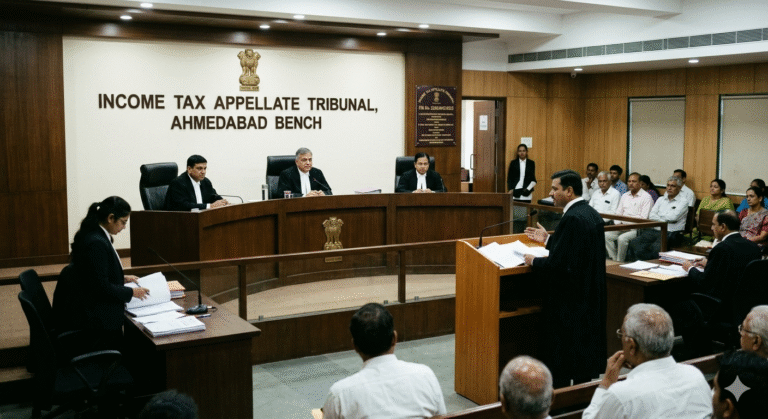
In a significant ruling reinforcing procedural accountability in tax litigation, the Income Tax Appellate Tribunal (ITAT), Ahmedabad Bench, held that a taxpayer cannot seek relief from earlier instances of non-compliance merely because the final appellate notice was sent to a different email address.
The decision came in the case of Arvind Mevalal Panchal v. Income Tax Officer (ITA No. 2203/AHD/2025), where the Tribunal emphasized that once an assessee is aware of ongoing proceedings, procedural lapses cannot be ignored solely on technical grounds related to communication.
Background of the Case
The dispute arose for Assessment Year (AY) 2018–19.
The taxpayer had originally filed his income tax return declaring a total income of ₹2.98 lakh. He also reported business turnover of approximately ₹34.33 lakh and opted for taxation under the presumptive taxation scheme, declaring profits at the prescribed rate of 8%.
However, during examination of financial records, the Income Tax Department identified substantial cash and banking transactions that appeared inconsistent with the declared turnover.
According to the assessment findings:
- Deposits amounting to approximately ₹1.37 crore were found in the taxpayer’s bank account.
- Around ₹1 crore of turnover was allegedly not reflected in the reported business income.
- Based on these findings, the assessment proceedings were reopened.
- The Assessing Officer (AO) eventually treated the bank deposits as unexplained money and made an addition of ₹1.37 crore to the taxpayer’s income.
Aggrieved by the assessment order, the taxpayer challenged the addition before the Commissioner of Income Tax (Appeals) [CIT(A)], functioning through the National Faceless Appeal Centre (NFAC).
Taxpayer’s Argument Before ITAT
Before the Tribunal, the taxpayer argued that he could not effectively participate in the appellate proceedings because notices issued by the CIT(A) had allegedly been sent to an email address different from the one mentioned in Form No. 35 (the prescribed appeal form).
Based on this contention, the taxpayer requested another opportunity to present his case before the appellate authority.
The taxpayer maintained that the communication issue prevented proper compliance and therefore justified restoration of the appeal.
Revenue’s Stand
The Revenue strongly opposed the request.
The department argued that the taxpayer was fully aware of the pending appellate proceedings and had actively participated to some extent.
Revenue highlighted that:
- The taxpayer had already sought adjournments on two separate occasions.
- Such requests demonstrated actual knowledge of the ongoing appeal process.
- Therefore, the argument that proceedings were entirely unknown due to email communication issues lacked merit.
Tribunal’s Findings
After reviewing the records, the Ahmedabad Bench comprising Judicial Member T.R. Senthil Kumar and Accountant Member Narendra Prasad Sinha made important observations.
The Tribunal noted that the appellate authority had granted multiple opportunities to the taxpayer.
The dates fixed for compliance included:
- July 22, 2024
- June 2, 2025
- June 26, 2025
- August 18, 2025
The Tribunal observed that:
- The taxpayer sought adjournments on two occasions.
- No effective compliance was made on the remaining opportunities.
- The email address used for the final communication existed in the Income Tax Department’s database and had originally been furnished by the taxpayer.
Based on these facts, the Bench held that the taxpayer’s plea could not completely justify previous inaction.
The Tribunal observed:
“The assessee was aware of the on-going proceeding before the Ld. CIT(A). Merely because the last notice of the CIT(A) was sent on a different e-mail Id, the assessee cannot be absolved of his earlier lapses.”
Relief Granted Despite Taxpayer’s Lapses
Although the Tribunal did not accept the taxpayer’s explanation entirely, it also expressed reservations regarding the approach adopted by the Assessing Officer.
The Bench observed that treating every credit entry in the bank account as taxable income may not automatically be legally sustainable.
Accordingly, the Tribunal considered it appropriate to provide one final opportunity to the taxpayer.
The matter was therefore set aside to the file of the CIT(A) with directions to re-examine the case.
The Tribunal also directed:
- The taxpayer must produce evidence explaining the source and nature of bank credits.
- The taxpayer must fully cooperate during fresh proceedings.
- The appellate authority may seek a remand report from the Assessing Officer, if required.
Cost Imposed by ITAT
While granting another opportunity, the Tribunal imposed a condition.
The taxpayer was directed to deposit ₹10,000 as costs to the Prime Minister National Relief Fund within 15 days from receipt of the order.
This condition reflected the Tribunal’s view that procedural negligence should not go without consequences.
Key Takeaway
This ruling highlights an important principle in faceless tax administration: taxpayers must actively monitor and respond to proceedings once they are aware of them.
At the same time, the judgment also reinforces that tax authorities cannot mechanically treat entire bank deposits as taxable income without proper examination.
The decision serves as a reminder that procedural compliance and substantive justice must operate together in income tax litigation.
Case Number: ITA No. 2203/AHD/2025
Forum: Income Tax Appellate Tribunal (ITAT), Ahmedabad
Follow the Link below to watch the video: