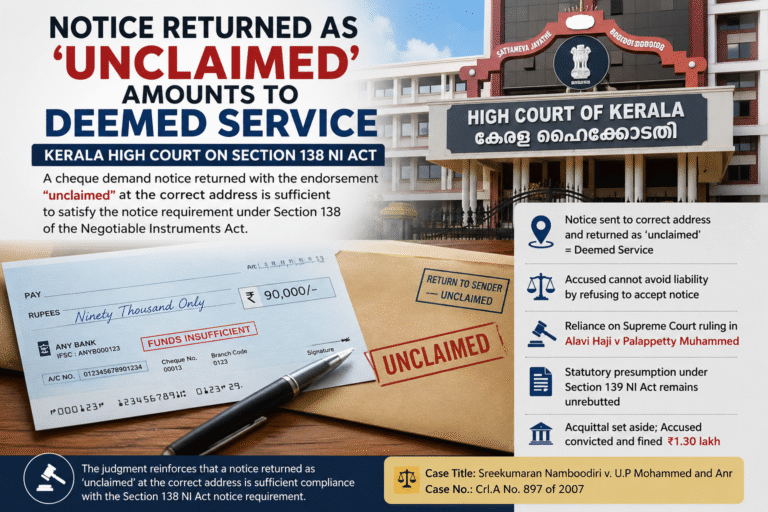
In a significant ruling strengthening the legal framework governing cheque dishonour disputes, the Kerala High Court has reiterated that a demand notice returned with the postal endorsement “unclaimed” can still satisfy the statutory notice requirement under Section 138 of the Negotiable Instruments Act, 1881.
The judgment highlights that once a notice is dispatched to the correct and known address of the cheque drawer, the sender is not expected to ensure actual physical receipt. If the recipient avoids accepting delivery, the law may treat the notice as effectively served.
Background of the Case
The matter arose from a complaint filed alleging that the accused had borrowed ₹90,000 from the complainant and later issued a cheque of the same amount towards repayment of the liability.
When the cheque was deposited for encashment, it was dishonoured due to insufficiency of funds.
Following the cheque bounce, the complainant issued the mandatory legal demand notice under Section 138(b) of the Negotiable Instruments Act seeking payment within the prescribed period. However, the postal department returned the notice with the endorsement “unclaimed.”
The complainant thereafter initiated criminal proceedings under the cheque dishonour provisions.
Trial Court Acquittal
The trial court in Kozhikode acquitted the accused.
The Magistrate concluded that:
- The complainant failed to establish the underlying loan transaction and execution of the cheque.
- The statutory notice requirement had not been fulfilled because the notice had not actually reached the accused.
Aggrieved by the acquittal, the complainant challenged the decision before the Kerala High Court.
Arguments Before the High Court
The complainant argued that the legal notice had been sent to the accused’s correct address and therefore the statutory obligation stood complied with.
It was also submitted that the trial court had wrongly relied upon minor inconsistencies in oral testimony while ignoring the broader evidence supporting the transaction.
On the other hand, the defence attempted to dispute the transaction but did not produce independent evidence to substantiate its version.
Kerala High Court’s Observations
Justice A. Badharudeen examined the evidence and found that the complainant’s testimony regarding the loan and issuance of the cheque remained substantially unchallenged during cross-examination.
Importantly, the Court noted that:
- The accused had not produced evidence disproving the address used for issuing the notice.
- The accused failed to examine witnesses who could support the defence case.
- Court summons later served at the same address were accepted by the accused.
The Court held that these circumstances strongly indicated that the demand notice had indeed been sent to the correct location.
The High Court observed that when a notice is dispatched to the known address of the cheque drawer and is returned with the endorsement “unclaimed,” such return may be treated as deemed acceptance unless the accused proves otherwise.
According to the Court, avoiding delivery cannot become a strategy to defeat statutory compliance under Section 138.
Reliance on Supreme Court Precedent
While deciding the issue, the High Court relied upon the Supreme Court’s landmark ruling in Alavi Haji v. Palappetty Muhammed, which laid down that a notice sent through registered post to the correct address is presumed to be served.
The principle recognises that a person cannot deliberately avoid receiving communication and later claim absence of notice as a defence.
This precedent continues to play an important role in cheque bounce litigation across India.
Minor Inconsistencies Cannot Defeat Genuine Claims
The High Court also addressed another aspect relied upon by the trial court.
The complaint had stated that the accused was “known” to the complainant, while during oral evidence the complainant referred to him as a “friend.”
The Court held that such minor variations do not affect the substance of the case. Both descriptions merely established acquaintance and did not undermine the existence of the financial transaction.
Conviction Restored
After analysing the evidence, the Kerala High Court concluded that the complainant had successfully proved the transaction and execution of the cheque.
Since the statutory presumption under the Negotiable Instruments Act remained unrebutted, the Court set aside the acquittal and convicted the accused.
The accused was sentenced to imprisonment till the rising of the court and directed to pay a fine of ₹1.30 lakh. In case of default in payment, the accused would undergo four months of imprisonment.
Key Takeaway
This judgment reinforces an important legal principle in cheque dishonour matters: once a demand notice is sent to the correct address, an accused cannot escape liability merely by avoiding receipt.
For businesses, professionals, and individuals dealing with cheque transactions, the ruling underlines the importance of maintaining accurate address records and responding promptly to legal communications.
Case Number: Criminal Appeal No. 897 of 2007
Follow the Link below to watch the video: