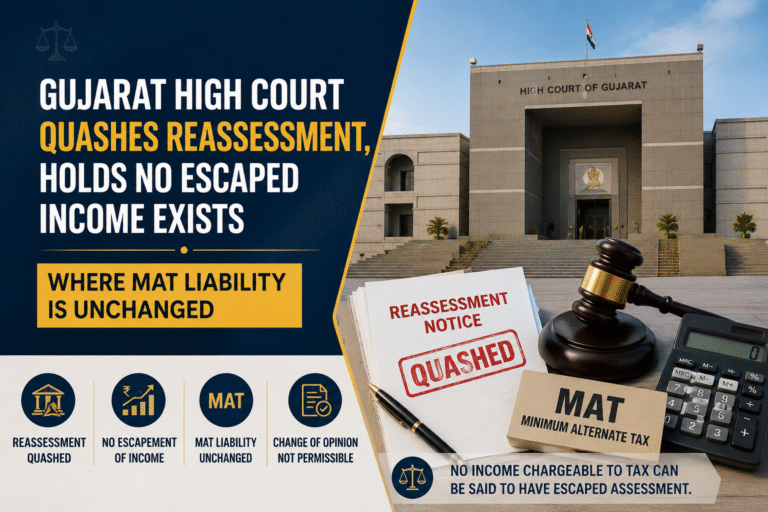
In a significant ruling on reassessment proceedings under the Income Tax Act, the Gujarat High Court has held that reassessment cannot be sustained where the alleged recomputation does not result in any actual income escaping assessment. The Court quashed reopening proceedings initiated against Pandesara Infrastructure Limited for Assessment Year (AY) 2020–21 after finding that the company’s tax liability remained unchanged under the Minimum Alternate Tax (MAT) provisions.
The judgment reinforces two important principles of tax jurisprudence—first, reassessment requires actual escapement of taxable income, and second, reopening based merely on a change of opinion is impermissible.
Background of the Dispute
The case arose from reassessment proceedings initiated against Pandesara Infrastructure Limited, a company engaged in providing waste effluent management services to industries located in Pandesara, Surat.
For AY 2020–21, the company filed its income tax return declaring Nil taxable income after claiming deduction under Section 80IA(4)(i) of the Income Tax Act. At the same time, it declared book profits of approximately ₹23.50 crore and paid tax under the Minimum Alternate Tax (MAT) regime.
The return was selected for scrutiny under the Computer Assisted Scrutiny Selection (CASS) mechanism, and after examination of records, the Assessing Officer completed assessment under scrutiny proceedings on 30 August 2022, accepting the returned income.
However, the matter did not end there.
Why the Revenue Reopened the Assessment
Subsequently, the Revenue initiated reassessment proceedings through a notice dated 28 June 2025.
The Revenue alleged that the company had claimed depreciation at lower rates—10% on buildings and 15% on plant and machinery—whereas according to the department, depreciation should have been allowed at 40%.
On that basis, the department claimed that income amounting to approximately ₹15.91 crore had escaped assessment and sought to reopen the completed assessment.
According to the Revenue, incorrect depreciation directly impacted business income computation under the head “Profits and Gains of Business or Profession.”
The tax department further argued that availability of depreciation details during original scrutiny did not automatically mean that the Assessing Officer had formed any conscious opinion on the issue.
Company’s Defence: Higher Depreciation Means Lower Income
Pandesara Infrastructure Limited challenged the reassessment before the Gujarat High Court.
The company made an interesting argument.
It contended that claiming depreciation at lower rates had actually increased its taxable business profits in the original return. Therefore, if depreciation were recomputed upward to 40%, business profits would reduce rather than increase.
Since the company was eligible for 100% deduction under Section 80IA(4)(i) on eligible profits, any reduction in business profits would proportionately reduce the deduction as well.
As a result, the final taxable income would continue to remain Nil.
The company also highlighted an even more crucial point—the tax had ultimately been paid under the MAT provisions on book profits, and the alleged depreciation adjustment had absolutely no impact on MAT computation.
Therefore, there could not be any income chargeable to tax escaping assessment.
Gujarat High Court’s Observations
The Division Bench comprising Justice A.S. Supehia and Justice Vaibhavi D. Nanavati carefully examined the records and accepted the company’s position.
The Court noted that it was undisputed that the company had originally claimed lower depreciation and consequently offered comparatively higher income.
If depreciation was recomputed at the higher rate suggested by the department, business income would actually decrease.
The Bench observed that under such circumstances, it was impossible to conclude that any income chargeable to tax had escaped assessment.
The Court specifically recorded that:
“There would be no escapement of income chargeable to tax.”
The Court also emphasised that the company’s book profit computation under MAT had already been examined and accepted during original scrutiny proceedings.
Since the proposed depreciation adjustment had no effect on MAT liability, reopening lacked any real tax consequence.
Reliance on Earlier Judicial Precedents
While setting aside the reassessment, the Court relied on its earlier decisions including:
- India Gelatine and Chemicals Ltd. v. ACIT
- Moto Tiles (P.) Ltd. v. ACIT
Referring particularly to the ruling in Moto Tiles, the Bench reiterated that where an assessee continues to remain taxable on the same MAT book profit despite the proposed adjustment, there is insufficient material to form a valid belief that income has escaped assessment.
The Court further observed that all depreciation-related details were already available during the original assessment proceedings.
Accordingly, reopening the assessment later on the same material amounted to nothing more than a mere change of opinion, which is not legally permissible under reassessment provisions.
Final Verdict
Holding that the statutory conditions required for invoking reassessment jurisdiction were absent, the Gujarat High Court quashed:
- The reassessment notice dated 28 June 2025
- The consequential order passed on the same date
The writ petition filed by Pandesara Infrastructure Limited was therefore allowed.
Key Takeaway
This judgment serves as an important reminder that reassessment powers cannot be exercised mechanically. Merely identifying an alternate method of computation is not enough. The Revenue must demonstrate actual escapement of income resulting in additional tax exposure.
The ruling also strengthens the principle that where MAT liability remains unchanged and reopening is based on material already examined during scrutiny, reassessment proceedings may fail as being without jurisdiction.
Case Title: Pandesara Infrastructure Limited v. Assistant Commissioner of Income Tax, Central Circle-2(1)(1), Surat
Case Number: R/Special Civil Application No. 11005 of 2025
Follow the Link below to watch the video: