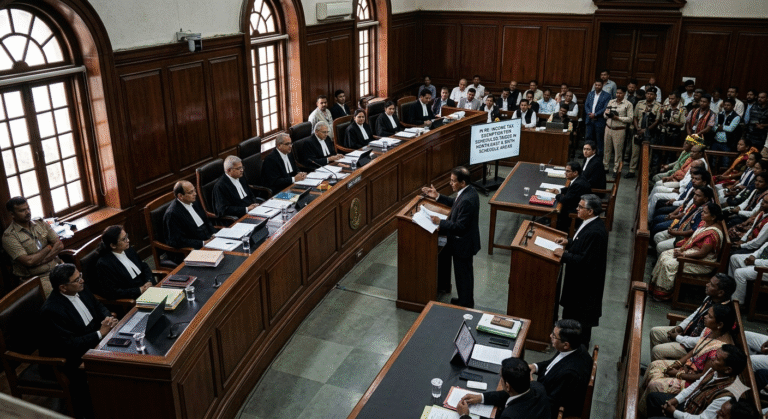
In a significant development concerning tax policy and constitutional governance, the Supreme Court of India declined to entertain a petition seeking the introduction of a “creamy layer” mechanism in the income-tax exemption available to Scheduled Tribes (STs) residing in specified North-Eastern States and Sixth Schedule areas under the Income Tax Act, 2025.
The Court observed that the relief sought by the petitioner involved legislative policy decisions and therefore fell outside the scope of judicial intervention at this stage.
Background of the Case
The petition was filed by advocate and public interest litigant Ashwini Kumar Upadhyay through Writ Petition (Civil) No. 684 of 2026 (Diary No. 32032/2026).
The challenge was directed against Section 11 read with Schedule III, Serial No. 19 of the Income Tax Act, 2025. This provision grants income-tax exemption to eligible members of Scheduled Tribes residing in notified areas covered under the Sixth Schedule and certain North-Eastern States including Arunachal Pradesh, Manipur, Mizoram, Nagaland, and Tripura.
According to the petitioner, the existing framework extends tax benefits uniformly to all eligible tribal individuals without considering economic status, resulting in affluent beneficiaries receiving the same exemption as economically weaker tribal communities.
Petitioner’s Argument: Introduce Creamy Layer Criteria
The central argument advanced before the Supreme Court was that the present exemption structure creates inequality by treating economically unequal individuals in the same manner.
The petitioner argued that wealthy tribal individuals who own substantial commercial enterprises, educational institutions, hospitals, hotels, and other high-value assets continue to enjoy complete income-tax exemption despite possessing significant financial capacity.
It was submitted that the exemption was historically justified under the Income Tax Act, 1961 because tribal communities were then economically and educationally disadvantaged. However, the petitioner contended that social and economic conditions in several North-Eastern regions have evolved considerably over time.
The plea highlighted:
- Rising literacy levels in tribal areas;
- Improved educational and economic infrastructure;
- Emergence of financially affluent tribal households;
- Large-scale business ownership among certain beneficiaries;
- Absence of income thresholds or asset-based exclusions.
The petitioner therefore sought implementation of a creamy layer principle similar to mechanisms adopted in certain reservation-related contexts.
Constitutional Concerns Raised
The petition alleged that continuation of blanket tax exemption violated constitutional principles under Articles 14, 19, and 27.
According to the petitioner:
- Article 14 (Right to Equality) was violated because affluent and economically weaker ST members received identical benefits.
- Article 19 concerns arose due to unequal business competition between tax-exempt tribal traders and taxable non-tribal traders.
- Article 27 concerns were also raised in relation to continued benefits despite alleged social and cultural transitions among certain beneficiaries.
Additionally, the petitioner argued that unlimited tax exemption without financial thresholds had become arbitrary in present circumstances.
Allegations Regarding Misuse of Tax Exemption
During arguments, the petitioner also referred to reports suggesting that tax-exempt accounts in North-Eastern States had allegedly been misused for routing unaccounted funds, including during the demonetisation period.
It was argued that such exemptions may create opportunities for laundering undisclosed income under the guise of legitimate tax-free earnings.
However, the Court did not accept this as a valid reason to reconsider the exemption itself.
Supreme Court’s Observations
The Bench comprising Chief Justice of India Surya Kant and Justice V. Mohana made it clear that the issue raised by the petitioner primarily concerns public policy and legislative wisdom rather than judicial review.
The Court observed that formulation, amendment, or revision of tax policy falls within Parliament’s domain.
During the hearing, Justice Surya Kant remarked that even if the petitioner’s concerns were entirely correct, the constitutional forum chosen was inappropriate for seeking such changes.
The Bench advised the petitioner to approach Parliament’s Committee on Petitions, which exists to examine requests relating to enactment, amendment, or repeal of laws.
The Court observed in substance that elected representatives are better positioned to evaluate whether existing statutory benefits require modification based on changing socio-economic realities.
Court Allows Withdrawal with Liberty
Recognising that the issue may still be pursued through democratic channels, the Supreme Court permitted withdrawal of the petition.
The petitioner was granted liberty to:
- Submit a comprehensive representation before Parliament’s Committee on Petitions;
- Forward copies of the writ petition to the Union Government;
- Present the issue before appropriate policy-making authorities.
Importantly, the Court clarified that allegations of misuse by individual beneficiaries could always be addressed through separate legal proceedings against those individuals rather than withdrawing benefits from genuine beneficiaries.
Conclusion
The Supreme Court’s decision reinforces the principle of separation of powers and highlights judicial restraint in matters involving taxation and public policy.
While the debate over introducing a creamy layer mechanism for income-tax exemptions available to Scheduled Tribes may continue in legislative and policy circles, the Court has made it clear that such reform, if considered necessary, must emerge through Parliament rather than judicial directions.
The case serves as an important reminder that constitutional courts generally avoid entering domains reserved for elected lawmakers, especially where economic and social policy choices are involved.
Case Title: Ashwini Kumar Upadhyay v. Union of India
Case Number: W.P.(C) No. 684/2026 | Diary No. 32032/2026
Follow the Link below to watch the video: