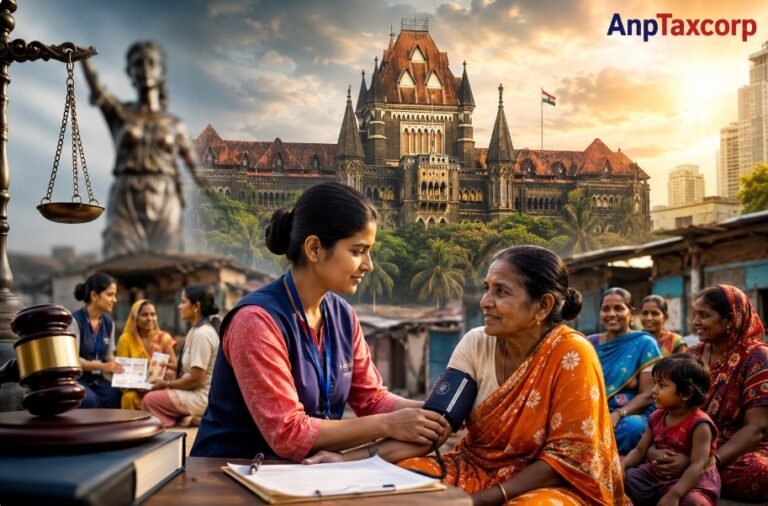
The Bombay High Court has delivered an important judgment protecting the wage rights of Community Health Volunteers (CHVs) engaged by the Municipal Corporation of Greater Mumbai (MCGM). The Court held that merely describing payments made to workers as an “honorarium” or characterising them as “volunteers” cannot be used to deny them minimum wages under the Minimum Wages Act, 1948.
The judgment reinforces an important principle of labour law: the actual nature of the work and remuneration must be considered rather than merely the terminology used by an employer or public authority.
Bombay High Court Upholds Minimum Wage Rights of CHVs
Justice Sandeep V. Marne was hearing a batch of writ petitions filed by the Municipal Corporation of Greater Mumbai challenging the common order dated September 7, 2020, passed by the Authority under the Minimum Wages Act, 1948 and the Assistant Commissioner of Labour, Mumbai City.
The Authority had allowed applications filed by Community Health Volunteers and their unions and directed the Municipal Corporation to pay them the difference between the minimum wages, including special allowance, and the honorarium already paid.
The MCGM challenged this decision before the Bombay High Court, arguing that CHVs were not its employees and, therefore, could not claim minimum wages.
MCGM’s Argument Before the High Court
The Municipal Corporation contended that there was no employer-employee relationship between MCGM and the Community Health Volunteers. According to the Corporation, CHVs were engaged as volunteers and the amount paid to them was only an honorarium rather than wages.
It was also argued that the question concerning the precise status of CHVs as workmen was pending before the Supreme Court. Therefore, according to MCGM, the Authority under the Minimum Wages Act should not have directed payment of minimum wages.
The High Court, however, rejected the attempt to link the demand for minimum wages with the separate question of permanent absorption into municipal service.
Demand for Minimum Wages Is Different From Demand for Regularisation
The Court made an important distinction between regularisation or absorption into municipal service and entitlement to minimum wages.
According to the Court, a person does not necessarily have to establish a claim for permanent employment in order to claim minimum wages for the work actually performed.
The Court examined the definition of “employee” under the Minimum Wages Act and observed that persons receiving remuneration for services rendered to a municipal corporation can fall within the scope of the statutory definition.
The Court noted that an employee for the purposes of the Minimum Wages Act may be permanent, temporary, casual, ad hoc, work-charged, contractual or employed in another such capacity.
Thus, the nature of employment cannot be determined merely by the label attached to it.
‘Honorarium’ Cannot Override the Reality of Employment
One of the most significant observations of the judgment concerns the use of the term “honorarium.”
The Bombay High Court held that merely calling the payment made to CHVs an honorarium would not take it outside the definition of “wages” under Section 2(h) of the Minimum Wages Act.
The Court essentially adopted a substance-over-form approach. Where a person performs services and receives remuneration for those services, the terminology used to describe the payment cannot by itself defeat a statutory entitlement to minimum wages.
This principle is particularly relevant to workers engaged under contractual, temporary, casual or volunteer-like arrangements, where organisations may use different descriptions for payments made for services.
CHVs Perform an Important Public Service
The Court also took into consideration the nature and importance of the work performed by Community Health Volunteers.
CHVs play a significant role in delivering healthcare services at the community level. They act as an important bridge between the community and medical professionals such as doctors and nurses working at health posts.
Their work therefore cannot be viewed merely through the label of “voluntary service” when determining their entitlement to statutory minimum wages.
The Court observed that although CHVs were branded as volunteers, they were substantially performing functions similar to workers of the Municipal Corporation.
Dignified Wages and the Principle in Jagjit Singh
The High Court also relied upon the Supreme Court’s landmark decision in State of Punjab v. Jagjit Singh, which emphasised the principle that government authorities and instrumentalities cannot exploit casual or temporary workers by paying them wages according to arbitrary considerations.
The Supreme Court had recognised that even casual and temporary employees are entitled to fair and dignified wages, subject to the applicable legal framework.
Applying this principle, the Bombay High Court held that CHVs must be paid at least the minimum rates prescribed under the relevant notification issued under the Minimum Wages Act for the hours they actually work.
Importantly, the Court clarified that its conclusion did not mean that MCGM was necessarily guilty of exploiting the CHVs. Rather, the statutory minimum wage protection must operate independently of such a finding.
Five Hours of Work Cannot Be Paid Below the Statutory Minimum
The Court specifically considered the fact that CHVs were working for approximately five hours.
It held that they were required to receive the minimum wages prescribed under the applicable notification for the period of duty performed by them.
Therefore, the argument that CHVs were not full-time municipal employees could not, by itself, justify payment below the statutory minimum.
The judgment thus highlights that minimum wage protection is concerned with remuneration for work performed and not merely with the nomenclature or employment status assigned by the employer.
Financial Burden Is Not a Ground to Deny Minimum Wages
Another important observation was that the financial burden on the Municipal Corporation could not be used as a justification for denying statutory minimum wages.
The purpose of minimum wage legislation is to ensure that workers receive at least the legally prescribed level of remuneration for their labour.
The Court therefore held that denial of minimum wages to CHVs would run contrary to the legislative objective of the Minimum Wages Act.
Key Takeaway for Employers and Public Authorities
The Bombay High Court’s ruling has broader implications for employers, government departments, municipal bodies and other public authorities engaging workers under contractual, temporary, casual or honorary arrangements.
Calling a payment “honorarium” does not automatically prevent it from being treated as wages. Similarly, calling a person a “volunteer” does not by itself eliminate statutory wage protections where the person is actually performing services for remuneration.
The substance of the engagement, the work performed and the statutory provisions governing minimum wages remain crucial.
Conclusion
In Municipal Corporation of Greater Mumbai v. Sangeeta Devdas Salvi, Writ Petition No. 1156 of 2021 and connected petitions, the Bombay High Court reaffirmed the principle that workers performing genuine services cannot be deprived of statutory minimum wage protection merely because their remuneration is labelled as an honorarium.
The judgment sends a strong message that dignified wages cannot be defeated by terminology. For the limited purpose of determining entitlement to minimum wages, Community Health Volunteers were required to be treated as employees under the Minimum Wages Act.
The decision is therefore significant not only for CHVs but also for the wider interpretation and enforcement of minimum wage protections applicable to workers engaged under non-traditional employment arrangements.