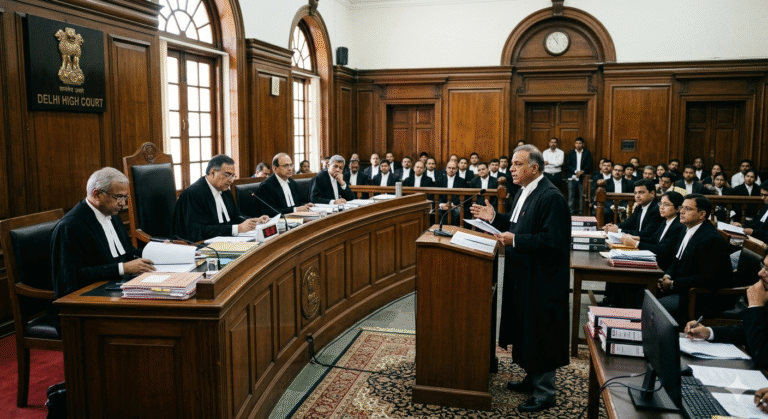
In a significant ruling reinforcing the constitutional separation of powers, the Delhi High Court dismissed a Public Interest Litigation (PIL) that sought judicial directions to impose tax on agricultural income in Delhi. The Court held that taxation policy and legislative decisions fall exclusively within the domain of the legislature and executive, and courts cannot compel the government to enact laws.
The decision came in the matter titled Aakash Goel v. Government of National Capital Territory of Delhi (GNCTD) and highlights an important constitutional principle regarding the limits of judicial intervention in matters of policy and taxation.
Background of the Case
The petition was filed by Aakash Goel, who questioned the continued exemption granted to agricultural income from income tax. According to the petitioner, the blanket exemption allows certain high-income agricultural earners to remain outside the tax framework, resulting in unequal treatment among taxpayers.
The petitioner argued that salaried employees, traders, professionals, and other categories of taxpayers continue to bear income tax liability, whereas individuals earning substantial agricultural income remain exempt. This, according to the plea, created fiscal inequality and an arbitrary distinction among citizens.
The PIL further stated that representations and reminder communications had been submitted to authorities requesting legislative measures to bring high agricultural income within the tax net. Since no action was taken, judicial intervention was sought.
Legal Arguments Raised in the Petition
The petitioner relied on constitutional provisions to support the challenge.
It was argued that the exemption of agricultural income violated:
- Article 14 of the Constitution of India, which guarantees equality before law;
- Article 38, which directs the State to promote social and economic justice; and
- Article 265, which provides that taxes can only be imposed by authority of law.
According to the petitioner, allowing agricultural income to remain fully exempt while other categories of income are taxed resulted in discriminatory treatment and undermined constitutional principles of equality.
The PIL sought directions from the Court to require authorities to frame a law or policy enabling taxation of agricultural income, particularly in cases involving substantial earnings.
Delhi High Court’s Observations
A Division Bench comprising Justices D.K. Upadhyaya and Tejas Karia rejected the petition and termed it “highly misconceived.”
The Court categorically observed that the judiciary cannot issue a writ of mandamus directing the legislature or executive to enact a particular law.
The Bench stated:
“We cannot issue a mandamus asking them to legislate.”
The Court emphasized that decisions relating to taxation involve economic policy, legislative judgment, and governance considerations, which are outside the scope of judicial law-making.
Accordingly, the petition was dismissed.
Why the Judgment Matters
This ruling is important because it reaffirms the constitutional doctrine of separation of powers.
Under India’s constitutional framework:
- The Legislature makes laws;
- The Executive implements laws; and
- The Judiciary interprets laws.
Courts can examine whether enacted laws violate constitutional provisions, but they generally cannot direct the government to create new legislation.
The judgment also underlines an established legal principle that policy choices—including whether to tax a particular category of income—remain matters for elected governments and lawmakers.
Agricultural Income and Taxation in India
Agricultural income currently enjoys exemption under India’s income tax framework, subject to applicable legal provisions. Historically, this exemption has been linked to constitutional and policy considerations concerning agriculture and rural economic support.
However, debates periodically emerge regarding whether large agricultural earnings should continue to receive complete exemption, especially in discussions around tax equity and revenue generation.
The Delhi High Court’s ruling does not examine the merits of whether agricultural income should be taxed. Instead, it clarifies that any such reform must originate through legislative action rather than judicial directions.
Conclusion
The Delhi High Court’s decision in Aakash Goel v. GNCTD serves as a reminder that courts cannot substitute legislative functions, even where policy debates involve taxation and economic equality.
While concerns regarding tax treatment of agricultural income may continue to attract public and policy discussions, the authority to introduce or amend tax laws remains with the legislature—not the judiciary.
Case Title: Aakash Goel v. GNCTD
Follow the Link below to watch the video: