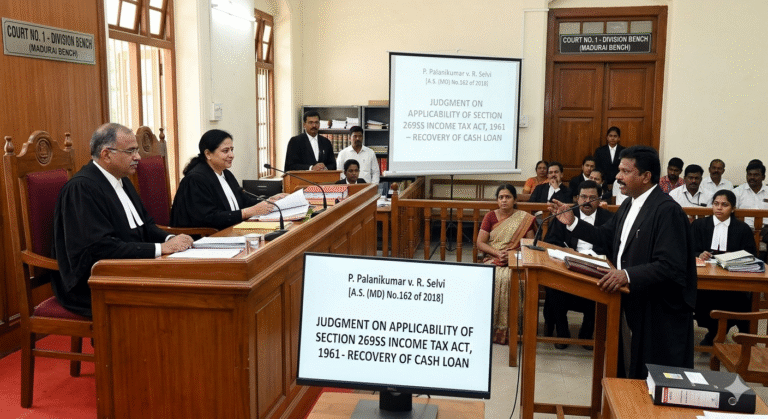
In an important ruling concerning cash transactions and recovery of debts, the Madras High Court has held that a loan advanced in cash, even if it violates the provisions of the Income Tax Act, does not automatically become illegal or unenforceable. The Court clarified that breach of tax provisions may attract action from tax authorities, but it does not extinguish the lender’s civil right to recover the money.
The judgment was delivered by a Division Bench comprising Justice G.R. Swaminathan and Justice R. Poornima while deciding an appeal filed in the case of P. Palanikumar v. R. Selvi [A.S. (MD) No.162 of 2018].
Background of the Dispute
The dispute arose from a financial transaction between the parties in which the appellant, P. Palanikumar, claimed that he had advanced a loan of ₹25 lakh in cash to the respondent, R. Selvi, on 5 June 2015.
According to Palanikumar, the amount was lent against a promissory note executed by Selvi. Despite repeated requests and issuance of a legal notice demanding repayment, the respondent allegedly failed to repay the amount.
Consequently, Palanikumar instituted a civil suit seeking recovery of ₹31.54 lakh, which included the principal amount along with interest calculated at 12% per annum.
However, the trial court dismissed the suit.
Why Did the Trial Court Reject the Recovery Claim?
The IV Additional District Judge, Madurai dismissed the lender’s suit primarily on the ground that Palanikumar had failed to establish his financial capacity to advance such a substantial amount.
The lower court noted that:
- The plaintiff had not produced his Income Tax Returns (ITRs).
- There was no evidence showing that the cash transaction was disclosed in his tax records.
- The absence of documentary proof raised doubts regarding whether the loan had actually been advanced.
Based on these observations, the trial court concluded that the plaintiff failed to prove the transaction and rejected the recovery claim.
High Court Reverses Trial Court’s Decision
Upon appeal, the Madras High Court took a different view and overturned the findings of the trial court.
The Court observed that the trial judge adopted an incorrect approach by assuming that absence of disclosure in income tax records automatically disproved the existence of the transaction.
The Bench emphasized that tax non-compliance and civil enforceability are separate legal issues.
According to the Court, merely because a transaction was not reflected in Income Tax Returns, it cannot be presumed that the transaction never occurred.
The Court held that if the trial court had any genuine doubts regarding the lender’s financial capability, it should have questioned the plaintiff during proceedings and sought clarification instead of drawing adverse conclusions.
Interpretation of Section 269SS of the Income Tax Act
A central issue before the Court was the applicability of Section 269SS of the Income Tax Act, 1961.
Section 269SS restricts acceptance of loans or deposits beyond a prescribed threshold otherwise than through specified banking channels. The objective behind this provision is to discourage unaccounted cash transactions and curb tax evasion.
In the present case, the loan amount of ₹25 lakh was admittedly advanced in cash, which exceeded the statutory threshold.
Even so, the Court clarified that violation of Section 269SS does not render the underlying transaction void or unlawful.
The Bench categorically stated that the Income Tax Department remains free to initiate proceedings for any tax violation, impose penalties where applicable, and enforce compliance with tax laws.
However, such violation alone does not prevent the lender from approaching a civil court to recover the amount advanced.
Conduct of the Borrower Also Influenced the Court
Another important factor considered by the High Court was the conduct of the respondent.
The Court noted several significant circumstances:
- Selvi did not file a written statement.
- She did not lead any evidence to dispute the claim.
- She did not cross-examine the plaintiff.
- She did not deny receipt of money.
- She did not dispute the execution of the promissory note.
Additionally, the Court observed that title documents belonging to Selvi had been produced by Palanikumar.
The respondent failed to explain how these documents had reached the plaintiff’s possession.
These surrounding circumstances strengthened the lender’s case and persuaded the Court that the trial court’s findings could not be sustained.
Key Takeaway From The Judgment
This ruling draws a clear distinction between tax law violations and contractual enforceability.
The judgment reiterates that non-compliance with procedural requirements under the Income Tax Act may invite tax consequences but does not automatically invalidate an otherwise genuine financial transaction.
For lenders and borrowers, the decision serves as an important reminder that:
- Cash transactions above prescribed limits may attract scrutiny under tax laws.
- Failure to disclose a transaction in tax records does not necessarily destroy civil remedies.
- Courts will examine the surrounding facts and evidence before rejecting a recovery claim.
Conclusion
The Madras High Court’s decision in P. Palanikumar v. R. Selvi reinforces an important legal principle: a breach of tax provisions does not automatically make a transaction unenforceable in civil law.
While tax authorities retain the power to investigate and penalize violations under the Income Tax Act, parties involved in genuine loan transactions cannot be denied legal remedies solely on that basis.
The judgment highlights the need to distinguish between tax compliance obligations and the broader principles governing recovery of money under civil law.
Follow the Link below to watch the video: