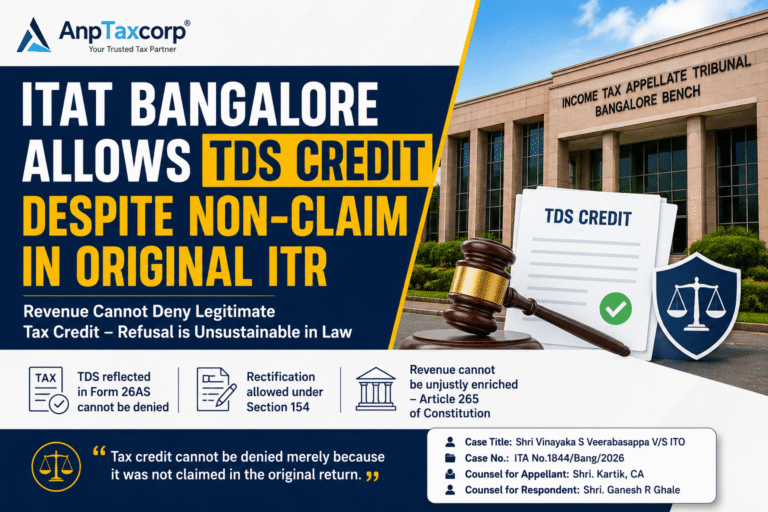
The Bangalore Bench of the Income Tax Appellate Tribunal (ITAT) has delivered an important ruling in favour of taxpayers by holding that Tax Deducted at Source (TDS) credit cannot be denied merely because it was not claimed in the original Income Tax Return (ITR). The Tribunal emphasized that where the TDS is duly reflected in Form 26AS and the corresponding income has already been offered to tax, refusing such credit would be contrary to law and would result in unjust enrichment of the Revenue.
The decision came in the case of Shri Vinayaka S Veerabasappa v. Income Tax Officer (ITA No. 1844/Bang/2026) and is expected to provide significant relief to taxpayers who inadvertently fail to claim TDS credit while filing their original returns.
Background of the Case
The taxpayer, Shri Vinayaka S. Veerabasappa, filed his income tax return for the Assessment Year (AY) 2020-21, declaring a total income of ₹17,78,409. However, while filing the original return under Section 139(1) of the Income Tax Act, he inadvertently failed to claim credit for the tax deducted at source (TDS).
Since the TDS credit was omitted, the Centralised Processing Centre (CPC) processed the return under Section 143(1) and raised a tax demand of ₹3,31,870.
Recognizing the mistake, the taxpayer filed a rectification application under Section 154 of the Income Tax Act seeking correction of the intimation issued under Section 143(1) and requesting that the TDS credit be granted.
The Assessing Officer subsequently passed a rectification order under Section 154 after reprocessing the return. However, the rectification did not provide the taxpayer with the desired relief.
Appeal Before the Commissioner (Appeals)
Aggrieved by the rectification order, the taxpayer approached the Commissioner of Income-tax (Appeals) [CIT(A)].
The CIT(A), however, dismissed the appeal by observing that the rectification order neither enhanced the assessed income nor altered the refund or demand in a manner appealable under Section 246A of the Income Tax Act. Consequently, the appeal was held to be not maintainable.
Dissatisfied with this decision, the taxpayer carried the matter before the Bangalore Bench of the ITAT.
Taxpayer’s Arguments Before the Tribunal
Before the Tribunal, the taxpayer submitted that the omission to claim TDS credit in the original return was purely inadvertent.
It was argued that:
- The entire income on which TDS had been deducted had already been offered to tax in AY 2020-21.
- The corresponding TDS was duly reflected in Form 26AS.
- There was no dispute regarding either the taxability of the income or the availability of the TDS credit.
- A rectification application under Section 154 had been filed immediately after discovering the mistake.
- Denying the legitimate credit solely because it was not claimed in the original return would be unjust and contrary to the provisions of the Income Tax Act.
The taxpayer also relied upon the earlier decision of the Coordinate Bench in DCIT v. Ravi Integrated Logistics (India) Pvt. Ltd., wherein similar relief had been granted.
ITAT’s Findings
After examining the facts of the case, the Bangalore Bench comprising Accountant Member Balakrishnan S. and Judicial Member Soundararajan K. ruled in favour of the taxpayer.
The Tribunal observed that there was absolutely no dispute regarding the following facts:
- The TDS was deducted from the taxpayer’s income.
- The corresponding income had already been offered for taxation.
- The TDS was duly reflected in Form 26AS.
- The taxpayer had subsequently claimed the credit through a rectification application under Section 154.
The Bench held that merely because the taxpayer failed to claim the TDS credit while filing the original return, such omission could not become a valid ground for denying a lawful tax credit.
The Tribunal categorically held that the Revenue cannot retain tax that legally belongs to the taxpayer simply because of an inadvertent procedural lapse.
Tribunal’s Significant Observation
The Tribunal made a noteworthy constitutional observation while allowing the appeal. It stated:
“Since the assessee has not claimed while filing the original return of income, the tax credit cannot be denied to the assessee who has claimed while filing the rectification petition under Section 154 of the Income Tax Act. The Revenue cannot be unjustly enriched by denying the tax credit to the assessee, which violates Article 265 of the Constitution, which prohibits the levy or collection of tax except by authority of law.”
The reference to Article 265 of the Constitution of India reinforces the long-established legal principle that the Government cannot collect or retain taxes beyond what is legally due.
Why This Judgment Matters
This ruling is highly significant for taxpayers who unintentionally omit claiming TDS while filing their original income tax returns.
The decision makes it clear that substantive justice should prevail over procedural lapses. Where the income has already been taxed and the TDS is verifiable through Form 26AS, the Income Tax Department cannot deny the corresponding credit merely because it was not claimed in the original ITR.
The judgment also strengthens the principle that the Revenue cannot unjustly enrich itself at the expense of taxpayers by retaining taxes that are legally refundable or adjustable.
Conclusion
The Bangalore ITAT’s decision in Shri Vinayaka S. Veerabasappa v. ITO (ITA No. 1844/Bang/2026) is a taxpayer-friendly ruling that underscores the importance of granting genuine tax credits based on substantive compliance rather than technical omissions. The Tribunal reaffirmed that when TDS is duly reflected in Form 26AS and the related income has already been offered to tax, denial of such credit is unsustainable in law.
This judgment will serve as an important precedent for taxpayers seeking rectification of genuine mistakes in their income tax returns and reiterates that procedural errors should not deprive taxpayers of their lawful entitlements.